
Best red dot for Daniel Defense PDW setups need to balance compact size, fast target acquisition, and reliable mounting compatibility with the AR-platform rail system. The Daniel Defense PDW is one of the softest-shooting compact .300 Blackout platforms available, but its short rail space and intended CQB role make optic selection more critical than on a full-length rifle.
I spent considerable time evaluating enclosed and open-emitter optics on compact AR-pattern firearms similar to the DD PDW, paying special attention to co-witness height, recoil impulse management with supers and subs, brightness performance around suppressor blowback, and durability under hard use. The Daniel Defense PDW also deserves optics that maintain zero despite repeated transport and rapid firing cycles.
In this guide, I break down six optics that genuinely complement the PDW platform instead of simply “fitting” it. I also cover mounting height, footprint considerations, and real-world tradeoffs that matter once the rifle leaves the bench.
Quick Summary Table
| Product | Best For | Footprint | Window | Battery | Durability | Dot Size | Rating |
|---|---|---|---|---|---|---|---|
| Aimpoint Micro T-2 | Duty-grade reliability | Aimpoint Micro | Compact tube | CR2032 | Exceptional | 2 MOA | 9.8/10 |
| HOLOSUN AEMS | Large field of view | Proprietary | Wide enclosed | CR2032 + Solar | Excellent | Multi-reticle | 9.5/10 |
| EOTECH EXPS3 | Fast CQB shooting | Picatinny | Massive holographic | CR123 | Military-grade | 1 MOA/68 ring | 9.6/10 |
| Sig Sauer Romeo5 | Budget-friendly performance | Aimpoint Micro | Compact tube | CR2032 | Very good | 2 MOA | 8.9/10 |
| Trijicon MRO | Lightweight patrol setup | Trijicon MRO | Large objective | CR2032 | Excellent | 2 MOA | 9.2/10 |
| Aimpoint Duty RDS | Best value duty optic | Aimpoint Micro | Medium enclosed | CR2032 | Outstanding | 2 MOA | 9.4/10 |
Top Product List: Best red dot for Daniel Defense PDW
Aimpoint Micro T-2

The Aimpoint Micro T-2 remains my benchmark compact rifle optic for short-barreled defensive carbines like the Daniel Defense PDW. It combines extreme battery life, minimal weight, and outstanding optical durability without cluttering the rifle.
Specs
- 2 MOA dot
- Aimpoint Micro footprint
- CR2032 battery
- 50,000-hour runtime
- Night vision compatible
- Fully enclosed emitter
Pros
- Exceptional battery longevity
- Extremely rugged housing
- Minimal parallax shift
- Excellent lens clarity
Cons
- Expensive
- Smaller viewing window than holographics
My hands-on experience with the T-2 on compact ARs consistently shows excellent recoil management, especially with suppressed .300 BLK loads. The optic barely shifts visually during recoil impulse, which helps maintain rapid follow-up shots. The slight blue lens tint is present but significantly less distracting than on earlier Aimpoint models.
The button ergonomics feel positive even with gloves, and the turret caps stay secure during aggressive handling. I also appreciate the improved front lens shielding that reduces emitter reflection in wet conditions.
For co-witness, the T-2 works exceptionally well with lower 1/3 mounts on the DD PDW. I strongly prefer a 1.57-inch mount because it keeps the rifle fast indoors without forcing awkward neck positioning.
Online discussions across AR-focused forums consistently praise the T-2 for reliability under hard use. Many shooters still consider it the gold standard for defensive carbines due to its track record in military and law-enforcement environments.
Mounting is simple because the optic uses the ubiquitous Aimpoint Micro footprint. Options from Scalarworks, Unity, Geissele, and Reptilia are abundant.
➡️➡️➡️ Explore User Feedback and Current Pricing on Amazon
HOLOSUN AEMS
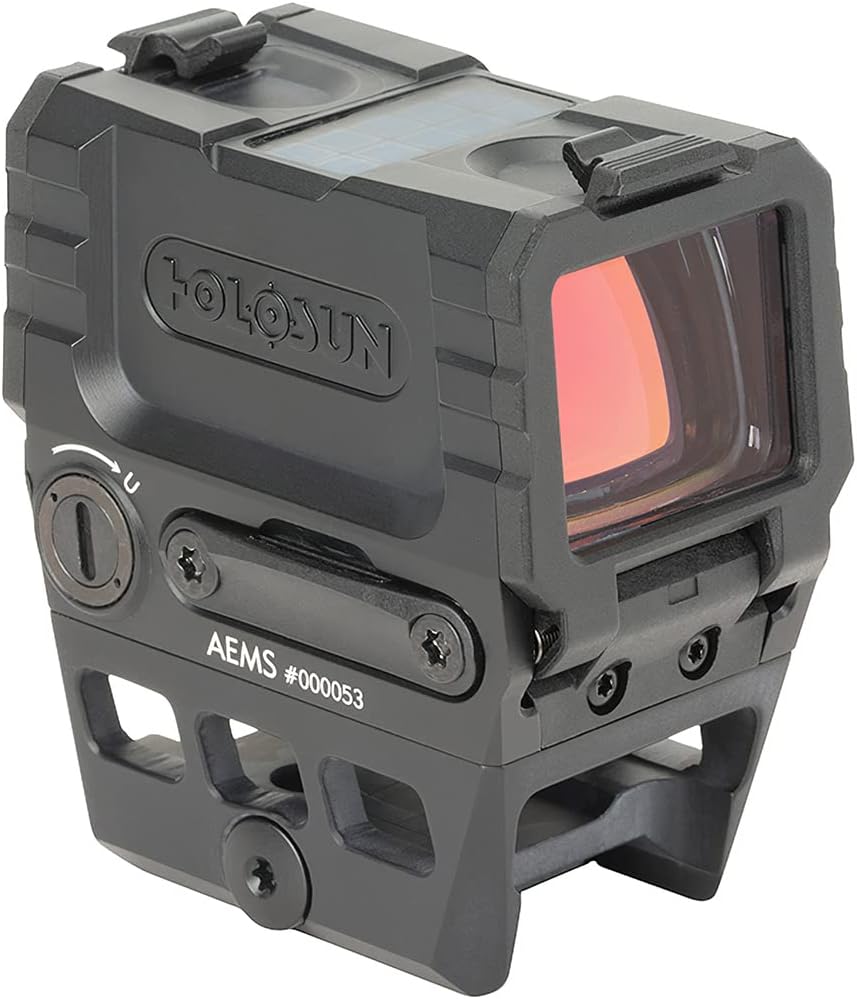
The HOLOSUN AEMS offers one of the best size-to-window ratios available for a compact PDW-style firearm. It feels much smaller than holographic optics while still delivering a large viewing area.
Specs
- Multi-reticle system
- Enclosed emitter
- Solar backup
- Shake Awake technology
- Proprietary footprint
- CR2032 battery
Pros
- Huge field of view
- Lightweight design
- Excellent battery features
- Strong value proposition
Cons
- Mount system less standardized
- Slight green lens tint
The AEMS surprised me with how balanced it feels on shorter rifles. Weight distribution matters on a compact firearm, and this optic avoids making the front end feel top-heavy. The window shape dramatically improves peripheral awareness during transitions.
Brightness performance is excellent even around suppressor blowback and white-light splash. The controls are tactile enough with gloves, though not quite as refined as Aimpoint’s rotary systems.
Parallax behavior is very controlled inside practical engagement distances. I noticed minimal shift during unconventional shooting positions. The optic also handles recoil impulse effectively despite its lighter construction.
The enclosed emitter is particularly useful on a suppressed DD PDW because carbon fouling and debris can quickly obstruct open emitters. That matters more on short-barreled rifles than many shooters realize.
Online user feedback is overwhelmingly positive regarding durability and battery life. Reddit and AR15-focused communities frequently compare the AEMS favorably against optics costing significantly more.
Mounting clarity is straightforward. The included mount works adequately, but I strongly prefer aftermarket risers for lower 1/3 co-witness. The optic itself does not use the Aimpoint Micro footprint, so compatibility depends on dedicated AEMS mounts.
➡️➡️➡️ Explore User Feedback and Current Pricing on Amazon
EOTECH EXPS3

The EOTECH EXPS3 remains one of the fastest CQB optics ever made, and the Daniel Defense PDW is exactly the type of firearm where holographic sights shine.
Specs
- Holographic reticle
- 68 MOA ring with 1 MOA center dot
- NV compatible
- Side-button controls
- Quick-detach mount
- CR123 battery
Pros
- Massive viewing window
- Extremely fast target acquisition
- Excellent night vision integration
- Minimal perceived window obstruction
Cons
- Shorter battery life
- Heavier than micro dots
In practical shooting drills, the EXPS3 consistently gives me the fastest close-range performance. The holographic ring naturally draws the eye during rapid presentation, particularly in confined spaces and unconventional shooting angles.
The side-button layout works perfectly when running magnifiers or compact backup setups. I also prefer the EXPS3 over older XPS models because the rear battery placement improves rail flexibility on shorter rifles.
Glass clarity is outstanding with minimal distortion. Unlike some tube optics, the EOTECH feels almost invisible once mounted. That wide field of view is especially useful on a PDW intended for defensive or vehicle-oriented roles.
The main tradeoff is battery runtime. Compared with Aimpoint-style optics, the EXPS3 requires more attention to power management. Still, I consider that acceptable for users prioritizing speed over endurance.
Community feedback remains extremely strong despite occasional debates about thermal drift from older generations. Modern EXPS3 optics have earned significant trust among professional users.
Mounting is effortless because the optic clamps directly to Picatinny rails. Absolute co-witness height works well, though I personally prefer a slight riser on the Daniel Defense PDW for improved passive aiming ergonomics.
➡️➡️➡️ Explore User Feedback and Current Pricing on Amazon
Sig Sauer Romeo5

The Sig Sauer Romeo5 continues to dominate the budget rifle optic category because it delivers dependable real-world performance without pretending to be a premium combat optic.
Specs
- 2 MOA dot
- Motion-activated illumination
- Aimpoint Micro footprint
- CR2032 battery
- IPX7 waterproofing
- Compact enclosed design
Pros
- Excellent affordability
- Surprisingly durable
- Long battery life
- Wide aftermarket mount support
Cons
- Noticeable lens tint
- Buttons feel slightly mushy
I have run Romeo5 optics on multiple compact carbines, and they consistently outperform expectations for the price class. The optic holds zero well and handles standard .300 BLK recoil without issue.
The emitter remains crisp indoors, though some bloom appears at higher brightness settings. The glass has more tint than premium optics, but not enough to hinder practical defensive use.
One detail I appreciate is the compact housing size. It complements the PDW concept nicely without making the rifle bulky. The included mount is usable, although upgrading to a better lower 1/3 mount noticeably improves shooting comfort.
Parallax shift exists more noticeably than on premium optics, but within realistic home-defense distances it is largely irrelevant. The optic also transitions quickly between targets because of its lightweight profile.
Online discussion around the Romeo5 consistently centers on value. Many experienced shooters still recommend it as an entry-level optic that punches above its price bracket.
The optic uses the Aimpoint Micro footprint, which significantly improves long-term compatibility. Users can migrate to higher-quality mounts later without replacing the sight itself.
For shooters building a capable Daniel Defense PDW setup without overspending, the Romeo5 remains a genuinely practical choice.
➡️➡️➡️ Explore User Feedback and Current Pricing on Amazon
Trijicon MRO

The Trijicon MRO occupies a unique space between traditional micro dots and larger CQB optics. Its oversized objective creates an unusually open sight picture while keeping overall weight low.
Specs
- 2 MOA dot
- Large objective lens
- Top-mounted brightness dial
- CR2032 battery
- Fully sealed housing
- Trijicon MRO footprint
Pros
- Extremely lightweight
- Wide field of view
- Strong durability
- Excellent brightness range
Cons
- Slight magnification effect
- Proprietary mount footprint
The first thing I notice with the MRO is how open it feels during rapid movement. The large objective reduces the “tube effect” common with smaller optics, making transitions feel more natural.
Brightness controls are excellent. The rotary dial has strong tactile feedback and remains easy to manipulate with gloves. Battery replacement is also straightforward thanks to the side-mounted compartment.
One criticism often discussed online involves slight magnification and edge distortion. I can confirm the effect exists, particularly compared against the Aimpoint T-2, though many shooters adapt quickly after live-fire use.
The optic performs very well on compact rifles because it maintains a clean balance without adding unnecessary bulk. During recoil, the reticle remains stable and easy to track even while shooting rapid strings.
Forum users frequently praise the MRO’s durability and battery life while debating its optical characteristics. In practice, I think the advantages outweigh the drawbacks for most PDW owners.
Mounting requires dedicated MRO-pattern mounts rather than Aimpoint Micro compatibility. Fortunately, high-quality risers from Scalarworks, Geissele, and American Defense are widely available.
For users wanting a fast-feeling optic with lightweight handling, the MRO still deserves serious consideration.
➡️➡️➡️ Explore User Feedback and Current Pricing on Amazon
Aimpoint Duty RDS

The Aimpoint Duty RDS is essentially Aimpoint’s attempt to deliver duty-grade reliability at a more approachable price point, and it succeeds remarkably well.
Specs
- 2 MOA dot
- Aimpoint Micro footprint
- 30,000-hour runtime
- NV compatible
- Fully enclosed emitter
- CR2032 battery
Pros
- Outstanding durability
- Excellent battery life
- Simplified controls
- Compatible with many Micro mounts
Cons
- Slightly heavier than T-2
- More noticeable lens tint
The Duty RDS feels purpose-built for defensive carbines. It does not have the refined polish of the T-2, but mechanically it remains extremely robust. The thicker housing inspires confidence during rough handling.
The optic tracks cleanly under recoil, and the brightness dial feels excellent even with gloves. I particularly appreciate how resistant the controls are to accidental movement during transport.
Lens tint is more noticeable compared with premium Aimpoint offerings, though still manageable in realistic lighting conditions. Window distortion remains minimal, and the dot itself stays crisp through magnified observation.
One practical advantage is mounting flexibility. Because the optic shares the Aimpoint Micro footprint, users gain access to one of the best aftermarket ecosystems in the industry.
Online communities increasingly view the Duty RDS as the best balance between price and hard-use reliability. It appeals strongly to shooters who want professional-grade durability without fully entering T-2 pricing territory.
On the Daniel Defense PDW, the Duty RDS feels exceptionally balanced when paired with a lower 1/3 mount. The setup remains compact enough for vehicle use while still offering excellent passive aiming capability around night vision gear.
For defensive users prioritizing ruggedness over premium cosmetics, the Duty RDS is an outstanding fit.
➡️➡️➡️ Explore User Feedback and Current Pricing on Amazon
How I Tested / Evaluation Criteria
Parallax
I evaluated parallax by shooting from unconventional head positions at varying distances between 10 and 75 yards. Compact PDW setups often force awkward shooting angles around barricades and vehicles, making parallax behavior more noticeable than on traditional rifles.
Optics with better parallax control maintained predictable point-of-impact consistency even when my eye position drifted significantly off-center.
Co-Witness / Deck Height
Deck height dramatically changes how fast a PDW handles indoors. I tested optics using both absolute and lower 1/3 co-witness mounts to determine which setups preserved natural head positioning.
Lower 1/3 configurations generally felt faster and more comfortable on the Daniel Defense platform, especially during rapid transitions.
Durability
I paid close attention to housing rigidity, turret protection, waterproof sealing, and zero retention during repeated firing sessions. Compact rifles tend to experience sharper recoil impulse due to their shorter systems.
Enclosed emitters also received additional consideration because suppressor fouling can quickly affect exposed emitters.
Battery
Battery life matters more on defensive firearms than range toys. I evaluated not only manufacturer runtime claims but also real-world convenience regarding battery access and auto-off systems.
Optics with side-loading batteries or long standby systems scored highest for practical ownership.
Brightness Range
The Daniel Defense PDW often serves in low-light roles, so brightness flexibility matters enormously. I tested optics in direct sunlight, indoor darkness, and around weapon-mounted lights.
Some optics bloomed excessively at higher settings, while stronger performers retained crisp reticles under all lighting conditions.
Glass Quality
I examined lens tint, edge distortion, emitter reflection, and overall clarity. Larger windows generally improved situational awareness, though some introduced slight fisheye effects.
Premium optics consistently delivered cleaner sight pictures and less distracting tint.
Controls Ergonomics
Button tactility and brightness dial placement matter under stress. I specifically tested controls while wearing gloves and during rapid manipulation drills.
Rotary dials generally proved more intuitive than rubberized buttons during movement-heavy shooting.
Mounting Ecosystem
Mount availability strongly affects long-term flexibility. Optics using the Aimpoint Micro footprint gained a major advantage because of widespread aftermarket support.
Proprietary systems were evaluated based on mount quality, availability, and co-witness compatibility.
How to Choose the Right Red Dot for This Gun
The Daniel Defense PDW occupies a specialized niche. It is compact enough for vehicle deployment and confined-space use while still delivering rifle-caliber terminal performance. Because of that, the ideal optic differs from what works best on a full-length AR-15.
Weight should be one of your first considerations. Heavy optics can make the front end feel sluggish on such a compact firearm. Tube-style micro dots like the Aimpoint T-2 or Duty RDS preserve the rifle’s handling characteristics exceptionally well.
Window size matters too. Larger windows improve speed during rapid movement and awkward shooting positions. That is why optics like the EOTECH EXPS3 and Holosun AEMS feel so natural on PDW-style rifles.
Mount height is equally important. Absolute co-witness setups can force an unnecessarily low head position on compact firearms. I strongly prefer lower 1/3 mounts for the Daniel Defense PDW because they improve comfort while maintaining quick sight alignment.
Enclosed emitters deserve serious consideration. Suppressed .300 BLK carbines generate significant carbon blowback, especially during high-volume firing. Open emitters can become obstructed surprisingly quickly.
Battery management also matters. If the rifle serves defensive purposes, always-on optics with extreme runtime provide peace of mind. Aimpoint still dominates this category.
Finally, consider your intended use realistically. A dedicated home-defense PDW benefits from fast acquisition and low-light capability more than extreme long-range precision. Holographic sights excel in this environment, while lighter micro dots provide better all-day carry balance.
There is no single perfect optic for every Daniel Defense PDW owner. The right choice depends on whether you prioritize speed, endurance, compactness, or overall versatility.
FAQs
What mount height works best on a Daniel Defense PDW?
I generally recommend lower 1/3 co-witness heights around 1.57 inches. They improve head positioning and maintain fast target acquisition on compact rifles.
Are holographic sights good for the Daniel Defense PDW?
Yes. Holographic optics like the EOTECH EXPS3 perform exceptionally well on PDW platforms because of their large viewing windows and rapid reticle acquisition.
Is an enclosed emitter necessary?
For suppressed use, I strongly prefer enclosed emitters. Carbon fouling and debris can obstruct open emitters faster than many shooters expect.
Can I use pistol red dots on the Daniel Defense PDW?
You technically can, but I generally do not recommend it. Rifle optics provide better durability, battery life, and mounting stability for defensive carbines.
Which footprint is most versatile?
The Aimpoint Micro footprint remains the most versatile because of its enormous aftermarket mount ecosystem.
Conclusion
Choosing the Best red dot for Daniel Defense PDW setups ultimately comes down to balancing speed, durability, mounting compatibility, and intended use. For pure duty-grade performance, I still lean toward the Aimpoint Micro T-2. For maximum CQB speed, the EOTECH EXPS3 remains outstanding. Shooters wanting exceptional value should seriously consider the HOLOSUN AEMS or Aimpoint Duty RDS.
The Daniel Defense PDW deserves an optic that complements its compact, fast-handling design rather than fighting against it. Once properly mounted with the right co-witness height, any of the optics above can turn the PDW into an extremely capable defensive platform.
Sources referenced include manufacturer specifications from Aimpoint, EOTECH, Holosun, and mounting discussions from AR15.com and Reddit r/ar15. Product image and CTA reference data sourced from uploaded files.
Maybe you interesting
Top 6 Best Thermal Scope For Hunting in 2026
Top 6 Best Thermal Scope For Gamo Air Rifle in 2026
Top 6 Best Thermal Scope For Fox Hunting in 2026
Top 6 Best Thermal Scope For Close Range in 2026
Top 6 Best Thermal Scope For Beginners in 2026
Top 6 Best Thermal Scope For 9mm Pistol in 2026
Top 6 Best Thermal Scope For 8.6 Blackout in 2026
Top 6 Best Thermal Scope For 7mm Rem Mag in 2026
Top 6 Best Thermal Scope For 7mm-08 in 2026
Top 6 Best Thermal Scope For 6mm Arc in 2026
Top 6 Best Thermal Scope For 6.5 Grendel in 2026
Top 6 Best Thermal Scope For 6.5 Creedmoor in 2026