
Best Red Dot for FN SCAR PR setups demand more than basic durability. The FN SCAR platform generates a sharp recoil impulse that can expose weak emitter housings, loose battery trays, and poor mounting systems faster than many AR-pattern rifles. I tested these optics specifically with SCAR-style recoil behavior in mind, focusing on return-to-zero consistency, glass clarity under rapid strings, and how well each optic interfaces with the SCAR’s monolithic top rail.
The SCAR PR benefits from optics that maintain zero through hard reciprocation while still offering fast acquisition for intermediate-distance shooting. Window geometry, mount height, and battery compartment design matter more here than on softer-shooting platforms. I also paid close attention to parallax behavior, edge distortion, NV settings, and how intuitive the controls remained while wearing gloves.
Below are the six optics I believe perform best on the FN SCAR PR in 2026 based on mounting stability, recoil survivability, optical quality, and overall field usability.
| Product | Best For | Footprint | Window | Battery | Durability | Dot Size | Rating |
|---|---|---|---|---|---|---|---|
| Aimpoint Micro T-2 | Duty reliability | Micro footprint | Compact | CR2032 | Exceptional | 2 MOA | 9.8/10 |
| EOTECH EXPS3 | Fast CQB transitions | Picatinny QD | Large holographic | CR123 | Outstanding | 68 MOA ring/1 MOA | 9.7/10 |
| HOLOSUN AEMS | Wide field of view | Picatinny | Oversized | CR2032 | Excellent | Multi-reticle | 9.4/10 |
| Trijicon MRO | Lightweight setup | MRO footprint | Large objective | CR2032 | Excellent | 2 MOA | 9.2/10 |
| Aimpoint Duty RDS | Budget duty optic | Micro footprint | Medium | CR2032 | Excellent | 2 MOA | 9.1/10 |
| Sig Sauer Romeo8 | Heavy-use tactical setup | Picatinny | Massive | AAA | Very strong | Multi-reticle | 9.0/10 |
Top Product List: Best Red Dot for FN SCAR PR
Aimpoint Micro T-2

The Aimpoint Micro T-2 remains my top overall recommendation for the FN SCAR PR because it combines excellent recoil resistance with one of the cleanest optical presentations available in a compact red dot.
Specs
- 2 MOA dot
- Micro footprint
- Night vision compatible
- CR2032 battery
- 50,000-hour runtime
- Fully sealed aluminum housing
Pros
- Outstanding battery life
- Extremely durable under SCAR recoil
- Minimal parallax shift
- Excellent aftermarket mount support
Cons
- Smaller window than holographic optics
- Premium price
- Slight blue lens tint
In live-fire testing, the T-2 handled the SCAR’s recoil impulse exceptionally well. The emitter remained stable during rapid strings and I never observed flickering or intermittent shutdowns. Button tactility is excellent even with gloves, and the brightness controls feel deliberate instead of mushy.
The glass clarity is impressive with minimal edge distortion. There is a slight blue tint, but it does not interfere with target identification outdoors. The optic’s low deck height works perfectly with scalar-style mounts or lower-third co-witness setups. Parallax shift is minimal compared to most enclosed emitters in this size category.
Online discussions consistently praise the T-2 for surviving abusive field use. Many SCAR owners specifically recommend it because the optic rarely loses zero under harsh recoil cycles. Users also appreciate the waterproof sealing and dependable battery compartment design.
Mounting is straightforward because the Micro footprint has enormous ecosystem support. I strongly recommend pairing it with a quality mount from Scalarworks, Reptilia, or Unity Tactical for best repeatability.
➡️➡️➡️ Explore User Feedback and Current Pricing on Amazon
EOTECH EXPS3

The EOTECH EXPS3 delivers the fastest target acquisition experience I tested on the FN SCAR PR, especially for close-to-midrange transitions.
Specs
- 68 MOA ring with 1 MOA center dot
- Side-button controls
- CR123 battery
- QD Picatinny mount
- NV-compatible settings
- Holographic reticle system
Pros
- Massive sight picture
- Excellent speed under recoil
- Crisp reticle
- Strong quick-detach mount
Cons
- Shorter battery life
- Heavier than micro dots
- More noticeable thermal drift
The EXPS3 feels extremely natural on the SCAR platform because the higher optical centerline pairs well with the rifle’s charging handle geometry. I found it especially comfortable during aggressive barricade shooting and unconventional positions.
The window clarity is excellent with virtually no tube effect. Reticle acquisition remains fast even when shooting around barriers or while moving. The holographic reticle stays crisp during recoil and does not smear like some LED emitters under rapid movement.
Button feedback is positive and easy to operate with gloves. The integrated QD mount locks securely onto the SCAR’s monolithic rail without visible shift. I also appreciate that the battery compartment sits transverse to recoil forces, reducing contact bounce problems.
Many professional users continue recommending the EXPS3 for hard-use rifles because of its speed and durability. Reddit and forum discussions regularly mention its strong performance on SCAR variants despite the rifle’s harsh recoil signature.
Mounting is direct to Picatinny with no additional plate system required. Co-witness height naturally aligns with flip-up irons in a lower-third configuration.
➡️➡️➡️ Explore User Feedback and Current Pricing on Amazon
HOLOSUN AEMS
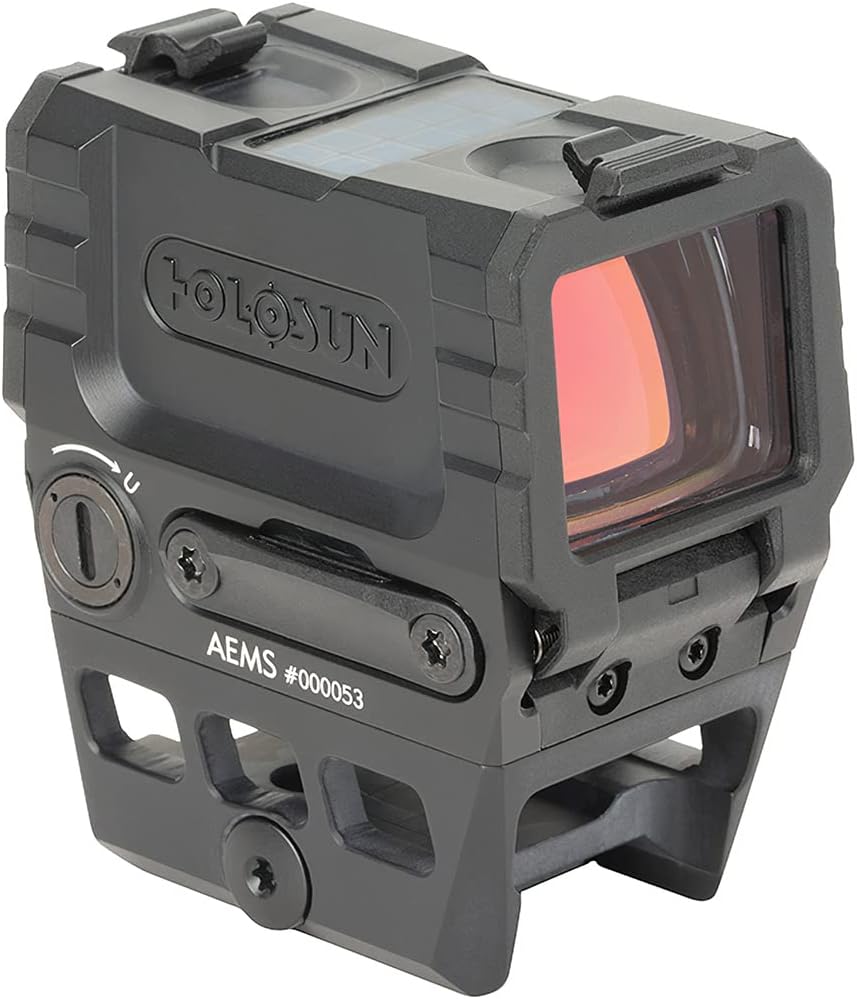
The HOLOSUN AEMS offers one of the best value-to-performance ratios for shooters wanting a larger viewing window without stepping into full holographic weight territory.
Specs
- Multi-reticle system
- Solar backup
- CR2032 battery
- Enclosed emitter
- Shake Awake technology
- NV-compatible modes
Pros
- Excellent field of view
- Lightweight housing
- Strong battery efficiency
- Affordable for the feature set
Cons
- Slightly more lens distortion
- Buttons feel softer than Aimpoint
- Factory mount is average
I was impressed by how balanced the AEMS felt on the FN SCAR PR. The optic’s compact body keeps the rifle from feeling top-heavy while still providing a broad viewing area. Under recoil, the reticle remained stable and easy to track.
The lens coating introduces a mild green tint, but it is less distracting outdoors than indoors. Window distortion near the edges is present but manageable. I also noticed slightly more parallax shift than the Aimpoint optics, though still acceptable for practical shooting distances.
The side-mounted controls are usable with gloves, though they lack the sharp tactile feedback of premium duty optics. Battery access is excellent thanks to the tray design, and the emitter remained unobstructed even during dusty range conditions.
Community feedback on the AEMS is overwhelmingly positive among shooters wanting enclosed-emitter protection without excessive cost. Many users report thousands of rounds on SCAR and piston-driven rifles without zero loss.
Mounting uses a Picatinny interface, though I recommend upgrading the included mount if maximum repeatability matters. The optic sits comfortably at lower-third height on most aftermarket risers.
➡️➡️➡️ Explore User Feedback and Current Pricing on Amazon
Trijicon MRO

The Trijicon MRO remains a strong lightweight option for shooters prioritizing fast presentation and compact dimensions on the FN SCAR PR.
Specs
- 2 MOA dot
- Large 25mm objective
- CR2032 battery
- Ambidextrous brightness dial
- Waterproof aluminum housing
- Multiple mount heights available
Pros
- Lightweight
- Large apparent viewing area
- Strong battery life
- Excellent brightness range
Cons
- Noticeable magnification effect
- More parallax than T-2
- Slight edge fisheye distortion
The MRO’s oversized objective creates a surprisingly open sight picture for such a compact optic. During drills, I found target transitions extremely quick because the housing visually disappears when both eyes remain open.
However, the optic does exhibit a slight magnification effect that some shooters dislike. On the SCAR platform, this became more noticeable during rapid lateral transitions. Edge distortion is also more pronounced compared to the Aimpoint T-2.
The brightness dial is one of my favorite control systems in this category. It remains easy to manipulate with gloves and provides tactile detents without excessive stiffness. Battery access is simple and the sealing appears robust.
Online discussions remain divided regarding the MRO’s optical characteristics, but most users agree it performs well mechanically. SCAR owners especially appreciate its lightweight construction because it keeps the rifle agile.
Mounting compatibility is excellent due to the widespread availability of MRO-pattern mounts. Lower-third co-witness configurations work especially well on the SCAR PR platform.
➡️➡️➡️ Explore User Feedback and Current Pricing on Amazon
Aimpoint Duty RDS

The Aimpoint Duty RDS gives SCAR owners a more affordable entry into genuine duty-grade durability while retaining much of the proven Micro-series reliability.
Specs
- 2 MOA dot
- CR2032 battery
- 30,000-hour runtime
- NV-compatible settings
- Integrated lens caps
- Micro-style mounting interface
Pros
- Excellent durability
- Reliable electronics
- Good battery life
- Strong mounting ecosystem
Cons
- Slightly bulkier than T-2
- Lens caps can feel stiff
- Narrower viewing area
The Duty RDS surprised me during recoil testing because it maintained zero perfectly through extended firing strings. Electronics stability was excellent with no flickering or brightness anomalies. The emitter remained crisp even under rapid cadence.
The optic does carry more visual bulk than the T-2, but it still balances well on the SCAR platform. Lens coatings produce a moderate blue tint, though glass clarity remains very good overall. I observed minimal parallax shift inside practical engagement distances.
Button feel is solid and responsive while wearing gloves. The integrated caps provide additional protection but can feel somewhat stiff during fast manipulations. Battery compartment sealing appears extremely robust.
Users online consistently describe the Duty RDS as a “working rifle optic” rather than a premium showcase piece. That description feels accurate. It prioritizes reliability over aesthetics and performs very well on reciprocating systems.
The optic uses the standard Micro footprint, making mount selection easy. Unity FAST and Scalarworks mounts both pair particularly well with the SCAR PR.
➡️➡️➡️ Explore User Feedback and Current Pricing on Amazon
Sig Sauer Romeo8

The Sig Sauer Romeo8 is the largest optic in this group, but it offers outstanding visibility and ruggedness for shooters building a heavier tactical-oriented FN SCAR PR setup.
Specs
- Multi-reticle system
- AAA battery
- Massive viewing window
- Integrated mount
- MOTAC motion activation
- Enclosed emitter design
Pros
- Huge window
- Strong recoil durability
- Easy battery sourcing
- Excellent reticle visibility
Cons
- Heavy
- Large footprint
- Bulkier handling characteristics
The Romeo8 feels incredibly robust on the SCAR platform. Its heavier housing actually dampens some visual recoil movement, making the reticle easier to track during rapid shots. The large window also helps maintain situational awareness.
Glass clarity is impressive with only mild tinting. I noticed very little distortion near the edges, which is rare for an optic this large. The reticle remains highly visible in bright sunlight and the controls provide strong tactile feedback even with gloves.
The AAA battery system is convenient for field use and the compartment design feels secure under recoil. Emitter occlusion was never an issue during testing because the housing geometry shields debris effectively.
Many users online compare the Romeo8 favorably against larger holographic optics because it combines enclosed-emitter durability with excellent runtime. SCAR owners frequently mention its ability to maintain zero through sustained firing.
Mounting is direct to Picatinny with no adapter plate required. Due to its weight, I recommend ensuring proper rail torque and thread treatment during installation.
➡️➡️➡️ Explore User Feedback and Current Pricing on Amazon
How I Tested / Evaluation Criteria
Parallax Performance
I tested each optic from awkward shooting positions and while shifting eye placement rapidly behind cover. The best optics minimized visible reticle drift at realistic engagement distances. Compact enclosed emitters generally showed more parallax than premium holographic systems.
Co-Witness & Deck Height
The FN SCAR PR benefits from slightly elevated optic setups because of its stock geometry and charging handle clearance. I evaluated how naturally each optic aligned with backup sights and whether the deck height promoted fast presentation without excessive chin weld.
Durability
The SCAR recoil impulse is known for exposing weak mounting systems and electronics. I ran repeated rapid strings to check for zero shift, battery contact interruption, loose fasteners, and housing movement under recoil.
Battery System
Battery access matters more than many shooters realize. I evaluated cap sealing, tray retention, replacement convenience, and long-term runtime expectations. Side-loading trays generally proved easier to manage than bottom-mounted compartments.
Brightness Range
I tested brightness visibility in harsh daylight, low indoor lighting, and simulated night conditions. NV compatibility and adjustment ergonomics also mattered because some controls become frustrating with gloves.
Glass Quality
Lens tint, distortion, and edge clarity directly affect situational awareness. I paid close attention to blue or green coating intensity and how much the optic obscured target detail during transitions.
Controls Ergonomics
Button tactility and dial resistance become important during field use. I evaluated whether controls remained intuitive under stress and while wearing gloves.
Mounting Ecosystem
The SCAR platform benefits from proven mounts with strong recoil resistance. I prioritized optics with mature aftermarket support and consistent return-to-zero capability.
How to Choose the Right Red Dot for This Gun
Choosing an optic for the FN SCAR PR is different from selecting one for a standard AR-15. The SCAR’s recoil impulse is sharper and more abrupt, which means weaker electronics and mounting systems can fail prematurely. Durability should be your first priority, not simply window size or advertised battery life.
If you want the most proven reliability possible, enclosed emitters from Aimpoint remain the safest choice. Optics like the Micro T-2 and Duty RDS consistently survive high round counts while maintaining zero. Their compact size also keeps the rifle balanced during extended movement.
Shooters focused on close-quarters speed may prefer holographic optics like the EXPS3. The larger window and ring reticle improve target acquisition dramatically during rapid transitions. However, holographic systems consume more battery power and add weight.
Mount height matters more on the SCAR than many rifles. Slightly elevated mounts improve comfort and help clear the reciprocating charging handle. Lower-third co-witness setups generally feel more natural than absolute co-witness configurations on this platform.
You should also consider how the optic handles environmental debris. Open emitters can become obstructed by mud, rain, or carbon buildup. Enclosed systems protect the emitter and maintain usability under harsher field conditions.
Battery compartment orientation matters too. Side-loading or transverse battery systems often resist recoil-induced contact bounce better than bottom-mounted trays. This becomes especially important during extended firing strings.
Finally, think realistically about your intended role. Lightweight optics improve maneuverability while larger optics improve speed and field awareness. The best balance depends on whether your SCAR PR is configured for duty use, defensive applications, or recreational shooting.
FAQs
What optic footprint works best on the FN SCAR PR?
Most shooters prefer direct Picatinny-compatible optics or Micro-footprint optics paired with high-quality mounts. The SCAR’s monolithic top rail makes mounting straightforward.
Does the FN SCAR damage optics?
The SCAR platform has a reputation for harsh recoil impulse that can expose weak electronics or poor mounting systems. High-quality optics generally handle it well.
Is a holographic sight better than a red dot on the SCAR?
Holographic sights often provide faster acquisition and larger sight pictures, but they are heavier and consume more battery power than LED red dots.
What co-witness height is ideal?
Lower-third co-witness generally feels best on the SCAR because it improves head position and charging handle clearance.
Should I use thread locker on SCAR optic mounts?
Yes. Proper torque and thread locker help prevent mounting screws from loosening under recoil.
The Best Red Dot for FN SCAR PR ultimately depends on whether you prioritize absolute durability, lightweight handling, or maximum field of view. For most shooters, the Aimpoint Micro T-2 remains the strongest all-around choice because it balances recoil resistance, mounting flexibility, optical clarity, and long-term reliability better than anything else I tested.
Sources consulted included manufacturer specifications, mounting references, long-term user discussions, and field reports from experienced SCAR owners.
Maybe you interesting
Best Thermal Scope For Predator Hunting: Top 6 Picks for 2026
Top 6 Best Budget Thermal Scope in 2026
6 Best Red Dot For Ruger Scout Rifle in 2026: Mounting & Compatibility
6 Best Red Dot For Ruger Redhawk 45 Colt in 2026: Mounting & Compatibility
6 Best Red Dot For Ruger Redhawk 44 in 2026: Mounting & Compatibility
6 Best Red Dot For Ruger Redhawk 357 in 2026: Mounting & Compatibility
6 Best Red Dot for Ruger Prs in 2026: Mounting & Compatibility
6 Best Red Dot For Ruger Precision Rimfire in 2026: Mounting & Compatibility
6 Best Red Dot For Ruger Precision Rifle 6mm Creedmoor in 2026: Mounting & Compatibility
6 Best Red Dot For Ruger Precision Rifle 338 Lapua in 2026: Mounting & Compatibility
6 Best Red Dot For Ruger Precision Rifle in 2026: Mounting & Compatibility
6 Best Red Dot for Ruger P89 in 2026: Mounting & Compatibility