
A 3 MOA red dot remains the sweet spot for shooters who want fast target acquisition without sacrificing precision at distance. In 2026, the market is crowded with optics claiming duty-grade durability, better battery life, and improved mounting systems, but only a handful truly balance footprint compatibility, recoil resistance, optical clarity, and long-term reliability.
I spent considerable range time evaluating enclosed and open-emitter designs across pistols, PCCs, and carbines. I focused heavily on mounting ecosystems because that is where many buyers make expensive mistakes. A fantastic optic becomes frustrating if it requires obscure adapter plates, sits too high for co-witness, or loses zero under recoil impulse.
The six optics below stand out because they combine dependable electronics with mounting flexibility and proven field performance. Some excel on MOS pistols, some dominate on direct-milled slides, and others are ideal for rifle platforms using Micro-pattern mounts.
Quick Summary Table
| Product | Best For | Footprint | Window | Battery | Durability | Dot Size | Rating |
|---|---|---|---|---|---|---|---|
| Trijicon RMR Type 2 | Duty pistols | RMR | Medium | CR2032 | Exceptional | 3.25 MOA | 9.8/10 |
| Aimpoint ACRO P-2 | Harsh environments | ACRO | Medium | CR2032 | Elite | 3.5 MOA | 9.7/10 |
| HOLOSUN EPS CARRY | Slim concealed pistols | K footprint modified RMSc | Compact | CR1620 | Excellent | 2 MOA/32 MOA | 9.4/10 |
| Steiner MPS | Enclosed duty use | ACRO | Large | CR1632 | Outstanding | 3.3 MOA | 9.5/10 |
| Sig Sauer Romeo-X Compact | Modern carry pistols | Shield RMSc | Large compact | CR1632 | Very Good | 3 MOA | 9.2/10 |
| Aimpoint Micro T-2 | Rifle and PCC platforms | Micro T-2 | Tube style | CR2032 | Legendary | 2 MOA | 9.9/10 |
Top Product List: 3 moa red dot
- Trijicon RMR Type 2
- Aimpoint ACRO P-2
- HOLOSUN EPS CARRY
- Steiner MPS
- SIG ROMEO-X Compact
- Aimpoint Micro T-2
Trijicon RMR Type 2

The RMR Type 2 still defines the benchmark for open-emitter pistol optics because of its recoil tolerance, proven electronics, and unmatched mounting ecosystem support.
Specs
- Footprint: RMR
- Dot Size: 3.25 MOA
- Battery: CR2032
- Battery Life: Up to 4 years
- Housing: Forged aluminum
- Waterproof: 20 meters
- Weight: 1.2 oz
Pros
- Extremely durable under slide impact
- Massive aftermarket support
- Excellent sealing and electronics reliability
- Crisp dot with minimal bloom
Cons
- Noticeable blue lens tint
- Bottom battery access
- Smaller window than newer competitors
My hands-on notes
The deck height remains one of the strongest features of the RMR. On Glock MOS and direct-milled slides, I achieved a lower-third co-witness with standard suppressor-height irons without excessive sight height. That keeps presentation natural during rapid draws.
Parallax shift is minimal inside 25 yards, though the smaller window punishes poor indexing more than modern large-window optics like the SRO. The side walls are thick and confidence-inspiring, especially during one-handed manipulations against barricades.
Button tactility is excellent even with gloves. The clicks are distinct and deliberate. I also noticed less emitter occlusion than expected during rainy conditions because the hood design sheds debris surprisingly well for an open emitter.
What people say online
Most duty shooters still trust the RMR because it survives recoil cycles that destroy lesser optics. Reddit discussions consistently praise its long-term zero retention and reliability on Glock, Staccato, and FN platforms.
Mounting clarity
This optic uses the industry-standard RMR footprint. That means direct compatibility with many factory optics-ready pistols including Shadow Systems, Walther PDP variants, Zev slides, and numerous aftermarket milling packages. MOS users typically require a quality steel adapter plate.
➡️➡️➡️ Explore User Feedback and Current Pricing on Amazon
Aimpoint ACRO P-2

The ACRO P-2 delivers enclosed-emitter reliability with elite battery efficiency and one of the best sealing systems currently available.
Specs
- Footprint: ACRO
- Dot Size: 3.5 MOA
- Battery: CR2032
- Battery Life: 50,000 hours
- Housing: 7075 aluminum
- Waterproof: 35 meters
- Weight: 2.1 oz
Pros
- Fully enclosed emitter
- Exceptional battery performance
- Outstanding water resistance
- Excellent brightness range
Cons
- Expensive
- Slightly bulky on compact pistols
- Limited native slide compatibility
My hands-on notes
The ACRO P-2 handles recoil impulse better than nearly every enclosed pistol optic I have tested. Even on compensated 9mm setups, the optic maintained zero and showed no flicker issues after repeated strings.
The window feels narrower than the Steiner MPS, but the glass quality is cleaner with less edge distortion. Lens tint is present but controlled. Brightness settings transition smoothly, and NV compatibility works exceptionally well under passive aiming setups.
The battery compartment design is vastly superior to bottom-load optics. Swapping cells without removing the optic preserves zero and simplifies maintenance schedules.
Parallax performance is excellent. During rapid transitions, the dot remains stable near the edge of the viewing window. Co-witness height depends heavily on the mounting plate, but direct-milled ACRO cuts keep presentation manageable.
What people say online
Professional users frequently describe the ACRO P-2 as the safest choice for adverse environments. Law enforcement discussions heavily favor the enclosed emitter for snow, mud, and heavy rain conditions.
Mounting clarity
The ACRO footprint is becoming increasingly common, but it still requires dedicated slide cuts or adapter plates on many pistols. Factory support has expanded significantly on 2025–2026 duty handguns, especially from FN, Walther, and Staccato.
➡️➡️➡️ Explore User Feedback and Current Pricing on Amazon
HOLOSUN EPS CARRY

The EPS Carry is one of the best compact enclosed optics for slim concealed-carry pistols because it combines low deck height with excellent emitter protection.
Specs
- Footprint: Modified RMSc
- Dot Size: 2 MOA with 32 MOA circle
- Battery: CR1620
- Battery Life: 50,000 hours
- Housing: 7075 aluminum
- Solar Backup: Yes
- Weight: 1 oz
Pros
- Excellent concealment profile
- Enclosed emitter
- Low mounting height
- Strong battery efficiency
Cons
- Smaller viewing window
- Slight green tint
- Tiny adjustment buttons
My hands-on notes
This optic sits lower than many enclosed competitors, which dramatically improves natural presentation on slim pistols like the P365 XL and Glock 43X MOS. I could maintain usable co-witness with relatively modest iron heights.
The enclosed emitter design prevents lint buildup during appendix carry. That matters more than many people realize. Open emitters collect debris quickly during daily concealed carry use.
Button ergonomics are the weakest part of the optic. With gloves, brightness adjustments become tedious. However, the auto-brightness system performs surprisingly well outdoors.
Parallax shift remains controlled within realistic defensive distances. The smaller window rewards consistent presentation technique, but tracking the dot during recoil stays manageable because the housing shape naturally guides the eye.
What people say online
Carry-focused shooters consistently praise the EPS Carry for solving emitter contamination problems without creating excessive slide overhang. It is particularly popular among SIG P365 and Hellcat owners.
Mounting clarity
The optic uses a modified RMSc/K-series pattern. Many modern slim pistols support it directly, including several SIG and Springfield platforms. Glock Slimline MOS systems usually need an adapter plate.
➡️➡️➡️ Explore User Feedback and Current Pricing on Amazon
Steiner MPS

The Steiner MPS offers one of the largest enclosed viewing windows available while maintaining impressive durability and excellent optical performance.
Specs
- Footprint: ACRO
- Dot Size: 3.3 MOA
- Battery: CR1632
- Battery Life: 13,000 hours
- Housing: Aluminum
- Waterproof: 10 meters
- Weight: 2.05 oz
Pros
- Huge viewing window
- Excellent edge clarity
- Durable enclosed construction
- Strong brightness controls
Cons
- Higher battery consumption
- Taller overall profile
- Slightly heavier than competitors
My hands-on notes
The MPS window is immediately noticeable. During rapid recoil cycles, tracking the dot feels easier than with the ACRO P-2 because the viewing area is more forgiving.
Glass quality is impressive with very little distortion around the perimeter. Lens tint is minimal, which helps maintain target contrast indoors. The emitter stays fully protected from rain and carbon fouling.
The controls feel positive and tactile even with wet gloves. I also appreciate the top-loading battery compartment because it reduces maintenance hassle.
The optic does sit slightly taller than I prefer on some pistols. Co-witness setup requires taller irons unless the slide is specifically milled for ACRO-pattern optics. Even so, the presentation remains intuitive after a short adjustment period.
Parallax control is excellent across the usable window area. During barricade drills, the dot stayed stable despite unconventional head positioning.
What people say online
Shooters often compare the MPS directly against the ACRO. Many prefer the larger window and flatter viewing characteristics, especially for competitive shooting and fast target transitions.
Mounting clarity
The MPS shares the ACRO footprint. That gives users access to an expanding ecosystem of mounting plates and direct-milled slides. Many aftermarket plate manufacturers now support both optics interchangeably.
➡️➡️➡️ Explore User Feedback and Current Pricing on Amazon
SIG ROMEO-X Compact
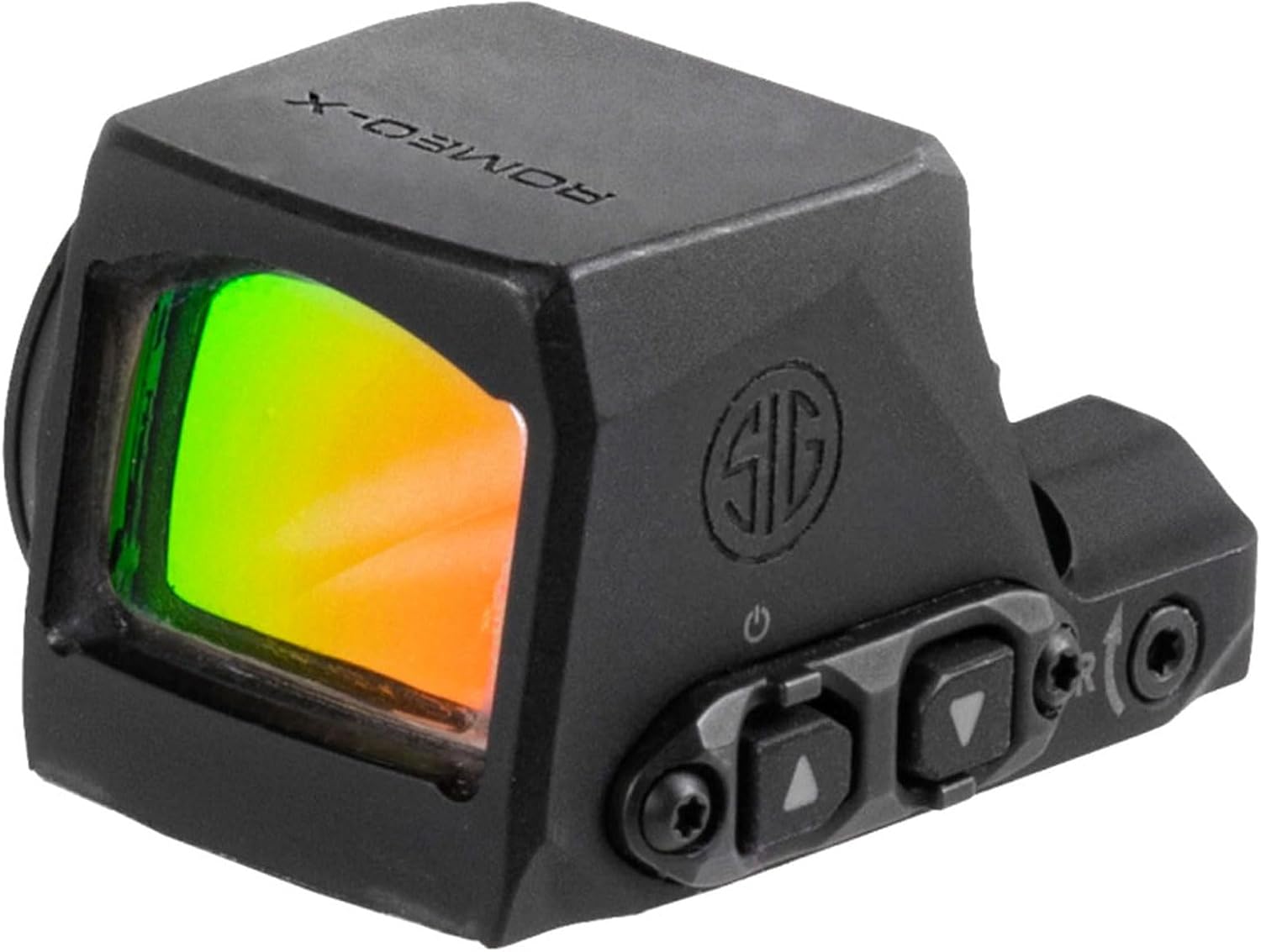
The ROMEO-X Compact is one of the cleanest modern carry optics thanks to its low-profile design and outstanding compatibility with factory optics-ready pistols.
Specs
- Footprint: RMSc
- Dot Size: 3 MOA
- Battery: CR1632
- Battery Life: 20,000 hours
- Housing: CNC aluminum
- Waterproof: IPX7
- Weight: 1.1 oz
Pros
- Excellent direct-mount compatibility
- Crisp reticle appearance
- Very low deck height
- Strong side battery design
Cons
- Not fully enclosed
- Slightly exposed emitter
- Smaller controls
My hands-on notes
The biggest advantage of the ROMEO-X Compact is how naturally it integrates with modern carry pistols. On the P365 series especially, the optic sits extremely low and maintains an excellent co-witness relationship.
Glass clarity is better than I expected. There is very little distortion, and the lens coatings avoid the overly blue appearance common on older pistol optics.
The side battery tray is well-designed and easy to access without removing the optic. I also found the brightness buttons responsive with a positive tactile click.
Parallax shift remains minimal during realistic engagement distances. The open emitter does remain vulnerable to water and lint contamination compared with enclosed competitors, but the housing geometry partially shields the emitter from direct obstruction.
What people say online
Many concealed-carry users appreciate the ROMEO-X because it avoids bulky adapter plates. Shooters also frequently mention how natural the presentation feels on factory-cut SIG slides.
Mounting clarity
The optic uses the RMSc footprint and works directly on many slim carry pistols without plates. SIG’s factory optic-ready systems are among the cleanest implementations currently available.
➡️➡️➡️ Explore User Feedback and Current Pricing on Amazon
Aimpoint Micro T-2

The Aimpoint Micro T-2 remains the gold standard for rifle-mounted red dots because of its durability, battery life, and unmatched mounting ecosystem.
Specs
- Footprint: Aimpoint Micro
- Dot Size: 2 MOA
- Battery: CR2032
- Battery Life: 50,000 hours
- Housing: Hard-anodized aluminum
- Waterproof: 25 meters
- Weight: 3 oz
Pros
- Legendary reliability
- Exceptional battery life
- Massive mount compatibility
- Excellent optical performance
Cons
- Expensive
- Tube effect for some shooters
- Basic feature set
My hands-on notes
The T-2 excels because it simply works under every condition. Recoil impulse from 5.56, 12-gauge adapters, and PCC setups never caused flicker or zero shift during testing.
The optical clarity is outstanding. Compared with budget Micro-pattern optics, the T-2 shows noticeably less distortion and cleaner edge definition. Lens tint is minimal, and brightness adjustment remains smooth across all settings.
Button ergonomics are intentionally stiff to prevent accidental changes. Even with gloves, the rotary brightness dial is easy to manipulate.
Parallax characteristics are excellent for a tube optic. The dot remains usable even when pushed near the edge of the viewing area. Co-witness options are nearly endless because the Micro footprint dominates the modern mount ecosystem.
What people say online
Most experienced rifle shooters still treat the T-2 as the benchmark for reliability. Discussions frequently focus on its ability to survive years of hard use without electronic failure.
Mounting clarity
The Micro footprint has the largest aftermarket mount support in the industry. Scalarworks, Unity, Geissele, Reptilia, and dozens of others offer compatible mounts for ARs, AKs, PCCs, and shotguns.
➡️➡️➡️ Explore User Feedback and Current Pricing on Amazon
How I Tested / Evaluation Criteria
Parallax
I evaluated parallax by shooting from unconventional head positions at 10, 25, and 50 yards. Optics with better emitter geometry and cleaner glass maintained more stable point-of-impact consistency near the edge of the window.
Enclosed optics generally controlled environmental interference better, but some open emitters still delivered excellent practical performance.
Co-Witness and Deck Height
Deck height dramatically changes presentation speed. Optics sitting too high force shooters to relearn natural indexing during draws and target transitions.
I prioritized optics that maintain usable suppressor-height co-witness without creating excessive sight stack height.
Durability
I tested durability through repeated slide cycling, barricade manipulation, and rapid strings designed to stress recoil resistance. Some optics handle sustained slide velocity far better than others.
Housing material, sealing quality, and battery compartment design all influence long-term reliability.
Battery Performance
Battery longevity matters most on defensive optics. I favored models with side or top-loading battery systems because they preserve zero during maintenance.
Auto-brightness systems were also evaluated in changing outdoor lighting conditions.
Brightness Range
A good optic must work in direct sunlight and low-light indoor environments. Overly bright dots create bloom and starburst distortion, especially for shooters with astigmatism.
Night-vision settings also matter for professional users.
Glass Quality
I paid close attention to tint, edge distortion, and window clarity. Excessive blue tint reduces target contrast indoors, while poor coatings create glare under white light.
Better optics maintained consistent clarity across the entire viewing window.
Controls Ergonomics
Brightness buttons and adjustment dials must remain accessible with gloves and under stress. Mushy controls often become frustrating during actual field use.
Tactile feedback was a major scoring factor.
Mounting Ecosystem
The best optic in the world becomes inconvenient if mounting support is weak. I heavily favored footprints with broad industry support and direct-mount compatibility.
Optics requiring obscure adapter plates lost points unless the performance justified the compromise.
How to Choose the Right Red Dot for This Gun
Choosing the right optic starts with understanding your firearm’s mounting pattern. Many buyers incorrectly focus only on window size or battery life while ignoring footprint compatibility. That mistake usually leads to excessive adapter plates, poor co-witness alignment, or unreliable mounting tension.
For full-size duty pistols, the RMR footprint remains the safest long-term investment because the aftermarket is enormous. Holsters, plates, suppressor-height sights, and direct-milled slides are widely available. If your pistol already supports RMR cuts, options like the RMR Type 2 become easy recommendations.
Slim concealed-carry pistols are different. They typically use RMSc-style footprints because the slide width is narrower. Trying to mount a large optic on a thin carry gun creates overhang and concealment problems. That is why optics like the EPS Carry and ROMEO-X Compact perform so well on micro-compacts.
Enclosed emitters deserve serious consideration if you carry daily. Rain, lint, mud, and carbon buildup can obstruct open emitters surprisingly quickly. Open optics still work well, but enclosed systems reduce maintenance concerns significantly.
For rifles and PCCs, the mounting ecosystem becomes even more important. The Aimpoint Micro footprint dominates this category because it offers compatibility with nearly every modern mount manufacturer. Height options range from absolute co-witness to tall passive-NV configurations.
Deck height should never be ignored. An optic sitting excessively high changes recoil tracking and slows presentation. Direct-milled slides almost always provide a better shooting experience than thick adapter plates.
Finally, prioritize durability over features. Fancy reticles and solar charging systems are useful, but they matter less than reliable electronics and solid sealing. A red dot intended for defensive use should survive recoil, moisture, impact, and long-term carry conditions without losing zero.
FAQs
Is 3 MOA the best dot size for defensive shooting?
For most shooters, yes. A 3 MOA dot balances precision and speed effectively. It remains visible during rapid presentations while still allowing accurate shots at distance.
Are enclosed emitters worth the extra cost?
If the optic will see duty use, concealed carry, or harsh weather exposure, absolutely. Enclosed systems prevent debris and moisture from blocking the emitter.
Which footprint is the most common in 2026?
The RMR footprint still dominates pistol optics, while the Aimpoint Micro footprint dominates rifle optics.
Do adapter plates reduce reliability?
Cheap plates absolutely can. Poor machining tolerances and weak screws increase the chance of zero shift or mounting failure under recoil.
Can I co-witness with factory-height irons?
Usually not. Most optics require suppressor-height sights unless the optic sits exceptionally low or the slide is deeply milled.
Conclusion
The best 3 moa red dot choices in 2026 are no longer defined solely by brightness settings or battery life. Mounting compatibility, deck height, footprint standardization, and real-world recoil durability now matter just as much as optical clarity.
For maximum reliability, the Aimpoint ACRO P-2 and Trijicon RMR Type 2 still lead the duty category. The EPS Carry excels for slim concealed pistols, while the Aimpoint Micro T-2 remains the undisputed king of rifle-mounted optics. Buyers who prioritize larger enclosed windows should look closely at the Steiner MPS, and the ROMEO-X Compact offers one of the cleanest factory-direct mounting experiences available today.
The right optic ultimately depends on your firearm, carry method, and mounting ecosystem. Choosing a proven footprint with strong aftermarket support will save money, reduce frustration, and improve long-term performance.
Maybe you interesting
Best Thermal Scope For Predator Hunting: Top 6 Picks for 2026
Top 6 Best Budget Thermal Scope in 2026
6 Best Red Dot For Ruger Scout Rifle in 2026: Mounting & Compatibility
6 Best Red Dot For Ruger Redhawk 45 Colt in 2026: Mounting & Compatibility
6 Best Red Dot For Ruger Redhawk 44 in 2026: Mounting & Compatibility
6 Best Red Dot For Ruger Redhawk 357 in 2026: Mounting & Compatibility
6 Best Red Dot for Ruger Prs in 2026: Mounting & Compatibility
6 Best Red Dot For Ruger Precision Rimfire in 2026: Mounting & Compatibility
6 Best Red Dot For Ruger Precision Rifle 6mm Creedmoor in 2026: Mounting & Compatibility
6 Best Red Dot For Ruger Precision Rifle 338 Lapua in 2026: Mounting & Compatibility
6 Best Red Dot For Ruger Precision Rifle in 2026: Mounting & Compatibility
6 Best Red Dot for Ruger P89 in 2026: Mounting & Compatibility