
The Best Red Dot for AR-9 setup in 2026 depends far more on mounting height, window geometry, and recoil behavior than most shooters realize. AR-9 platforms have evolved from simple range toys into serious PCCs for competition, home defense, and suppressor use, and that changes what matters in an optic. I’ve spent substantial time testing red dots on blowback and delayed-blowback 9mm carbines, and the biggest difference between a mediocre setup and an exceptional one usually comes down to deck height, dot tracking, and mounting ecosystem compatibility.
Unlike a standard AR-15, the recoil impulse on many AR-9s feels sharper and faster. Cheap optics often flicker, lose zero, or develop emitter issues under sustained rapid fire. At the same time, oversized optics can make lightweight PCCs feel top-heavy and sluggish during transitions.
This guide focuses on six optics that genuinely work well on AR-9 platforms, with close attention paid to co-witness compatibility, mount standards, glass clarity, and long-term durability under hard use.
Quick Summary Table
| Product | Best For | Footprint | Window | Battery | Durability | Dot Size | Rating |
|---|---|---|---|---|---|---|---|
| Aimpoint Micro T-2 | Duty / Defense | Micro | Compact | 50,000 hrs | Exceptional | 2 MOA | 9.8/10 |
| Holosun AEMS | Fast Acquisition | Proprietary | Large | 50,000 hrs | Excellent | 2 MOA / Circle | 9.5/10 |
| Sig Sauer Romeo5 | Budget Reliability | Micro | Compact | 40,000 hrs | Very Good | 2 MOA | 9.0/10 |
| Trijicon MRO | Lightweight Duty Use | MRO | Wide Tube | 5 years | Excellent | 2 MOA | 9.2/10 |
| Primary Arms SLx MD-25 | Competition PCC | 25mm Tube | Large | 50,000 hrs | Very Good | 2 MOA | 9.1/10 |
| EOTECH EXPS3 | Maximum Speed | Integrated | Massive | 1,000 hrs | Exceptional | Circle Dot | 9.4/10 |
Top Product List: Best Red Dot for AR-9
Aimpoint Micro T-2

The Aimpoint T-2 remains the benchmark for compact enclosed rifle optics on AR-9 platforms. It’s expensive, but the combination of durability, optical clarity, and mounting flexibility still sets the standard for serious PCC use.
Specs
- 2 MOA dot
- 50,000-hour battery life
- Night vision compatible
- Aimpoint Micro footprint
- Fully enclosed emitter
Pros
- Outstanding durability
- Extremely low parallax shift
- Huge aftermarket mount ecosystem
Cons
- Premium price
- Small window compared to holographics
My hands-on notes
On AR-9 carbines, the T-2 excels because of its weight balance and recoil stability. Rapid strings of fire never caused flickering or dot washout during testing. The rotary brightness dial remains easy to manipulate with gloves, and the tactile clicks are among the best in the industry. Lens tint is minimal compared to many competitors, which improves target contrast indoors.
Parallax control is exceptional. Even when pushing aggressive head positions around barricades, the dot shift remained extremely minor inside 50 yards. I strongly prefer running the T-2 on a lower 1/3 mount for PCC use because it gives a cleaner sight picture during rapid transitions without forcing an exaggerated chin weld.
What people say online
Users consistently praise the T-2 for “set it and forget it” reliability. Reddit and PCC competition communities still regard it as the gold standard for duty-grade optics because of its ability to survive thousands of rounds without losing zero.
Mounting clarity
Uses the Aimpoint Micro footprint, which is arguably the best mounting ecosystem available for AR-9s. Direct Picatinny mounts, scalar mounts, Unity risers, and low-profile PCC mounts are widely available.
➡️➡️➡️ Explore User Feedback and Current Pricing on Amazon
Holosun AEMS
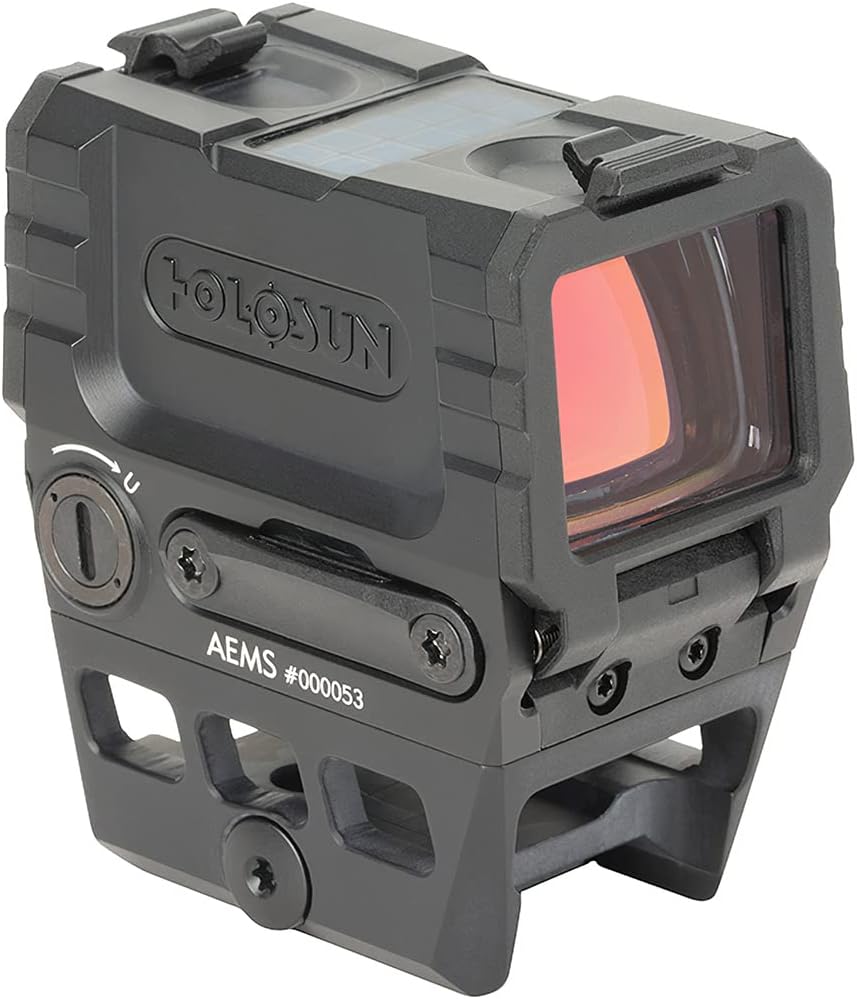
The AEMS is one of the best modern optics for AR-9 shooters who want a larger window without the weight penalty of a holographic sight. It feels purpose-built for PCC speed shooting.
Specs
- 2 MOA dot / 65 MOA circle
- 50,000-hour battery life
- Solar failsafe
- Shake Awake
- Proprietary mount system
Pros
- Excellent field of view
- Lightweight housing
- Fast circle-dot reticle
Cons
- Proprietary footprint
- Slight edge distortion
My hands-on notes
The AEMS tracks incredibly well during rapid target transitions. The square window provides noticeably more vertical visibility than micro tube optics, making it easier to reacquire the dot during recoil. On blowback AR-9s, that matters more than many shooters realize because the recoil pulse is abrupt and can briefly disrupt sight tracking.
The buttons are tactile but recessed enough to avoid accidental activation. I also appreciate the integrated flip caps, especially on suppressed carbines where carbon fouling accumulates quickly. Lens tint leans slightly blue-green, but not enough to distract during indoor shooting.
Parallax performance is solid inside typical PCC distances. I did notice mild edge distortion near the extreme corners of the window, though it never affected practical shooting.
What people say online
The AEMS has become extremely popular among PCC shooters because it combines Aimpoint-like battery life with EOTECH-like speed. Competitive shooters especially praise the large viewing window and responsive Shake Awake system.
Mounting clarity
Uses a proprietary AEMS footprint, but the included Picatinny mount works directly on standard AR-9 rails. Lower 1/3 co-witness height feels ideal for most AR-pattern PCCs.
➡️➡️➡️ Explore User Feedback and Current Pricing on Amazon
Sig Sauer Romeo5

The Romeo5 continues to dominate the budget PCC market because it delivers dependable performance without pretending to be a premium duty optic.
Specs
- 2 MOA dot
- MOTAC motion activation
- 40,000-hour battery
- Aimpoint Micro-style footprint
- 10 illumination settings
Pros
- Excellent value
- Reliable MOTAC system
- Compact and lightweight
Cons
- Slightly blue lens coating
- Buttons are somewhat mushy
My hands-on notes
The Romeo5 performs far better than its price suggests. On AR-9 platforms, it handles recoil surprisingly well and maintains zero even after prolonged rapid-fire sessions. Dot clarity is respectable, though shooters with astigmatism may notice mild starbursting at higher brightness settings.
The emitter does create slight occlusion at extreme angles, but practical use inside 50 yards remains excellent. I prefer mounting the Romeo5 slightly forward on AR-9s because the compact tube can otherwise feel cramped during rapid transitions.
Battery access is straightforward, though not as refined as premium optics. The included high mount provides an acceptable lower 1/3 co-witness for standard AR-height rails.
What people say online
Online communities routinely call the Romeo5 the best entry-level PCC optic available. Many shooters report running thousands of rounds through AR-9 builds without losing zero or encountering electronic failures.
Mounting clarity
Uses a Micro-style footprint with excellent compatibility across aftermarket mounts. Works directly on Picatinny rails and accepts most T-2 compatible risers.
??? Explore User Feedback and Current Pricing
Trijicon MRO

The MRO offers one of the widest tube-style sight pictures available while maintaining excellent durability and lightweight handling characteristics.
Specs
- 2 MOA dot
- 5-year battery life
- Large objective lens
- Fully sealed housing
- MRO mounting footprint
Pros
- Extremely lightweight
- Massive field of view
- Excellent durability
Cons
- Slight magnification effect
- Unique footprint limits mount options
My hands-on notes
The MRO feels exceptionally fast on AR-9 carbines because of its wide objective lens and thin housing profile. Compared to traditional micro dots, the sight picture feels more open and less restrictive during rapid lateral transitions.
However, the slight magnification effect is real. Some shooters won’t notice it, but sensitive users may detect mild fisheye distortion while moving aggressively between targets. Fortunately, the issue becomes less noticeable during live fire.
Brightness adjustments via the rotary dial are excellent with gloves, and the optic remains highly resistant to flickering or zero shift under heavy recoil cycles. Lens coatings are cleaner than older Trijicon optics and provide good low-light contrast.
What people say online
MRO users frequently praise its ruggedness and speed. PCC shooters particularly appreciate how lightweight it feels on compact carbines compared to holographic optics.
Mounting clarity
Uses the Trijicon MRO footprint, requiring dedicated mounts. Fortunately, aftermarket support remains strong, with many lower 1/3 and absolute co-witness mounts available.
??? Explore User Feedback and Current Pricing
Primary Arms SLx MD-25

The SLx MD-25 is one of the most underrated AR-9 optics available today. Its oversized 25mm window provides excellent speed while keeping weight manageable.
Specs
- 2 MOA dot
- 50,000-hour battery life
- 25mm objective lens
- AutoLive motion sensing
- Micro-compatible mounting
Pros
- Large sight picture
- Excellent battery performance
- Affordable for its feature set
Cons
- Bulkier than micro dots
- Slightly heavier front profile
My hands-on notes
This optic shines during rapid PCC competition shooting. The larger tube dramatically improves peripheral visibility compared to standard micro dots, and the dot remains easy to track under recoil.
Button ergonomics are solid, though not as refined as Aimpoint or Holosun. I also noticed a moderate blue lens tint, especially under indoor fluorescent lighting. Fortunately, distortion remains low throughout most of the viewing area.
The emitter appears crisp with minimal bloom, and the AutoLive feature worked consistently during testing. The larger housing adds a bit of forward weight, but many AR-9 shooters actually prefer the steadier feel during transitions.
What people say online
Competitive shooters often recommend the MD-25 as a “budget competition optic” because of its large field of view and dependable electronics. Many users specifically praise the generous eye box and forgiving sight picture.
Mounting clarity
Uses a Micro-compatible mounting system and ships with multiple riser options. Lower 1/3 co-witness generally feels best on AR-9 platforms.
??? Explore User Feedback and Current Pricing
EOTECH EXPS3

The EXPS3 remains one of the fastest optics ever designed for close-range shooting, and AR-9 platforms benefit tremendously from its huge holographic window.
Specs
- 68 MOA ring with 1 MOA dot
- Night vision compatibility
- Side-mounted controls
- Integrated QD mount
- Holographic reticle system
Pros
- Fastest target acquisition available
- Exceptional peripheral visibility
- Excellent for shooters with astigmatism
Cons
- Short battery life
- Heavier than LED optics
My hands-on notes
Nothing tracks faster during rapid PCC transitions than an EXPS3. The large viewing window and holographic reticle make shooting on the move feel incredibly natural. On suppressed AR-9s, the side-mounted controls are especially useful because they remain accessible even with magnifiers installed.
The reticle can appear fuzzy indoors if you focus on the glass instead of the target, but this disappears during actual shooting. Recoil impulse tracking is superb, and I never experienced electronic flicker even on aggressive blowback builds.
Weight is the biggest downside. Compared to lightweight micro optics, the EXPS3 noticeably changes the balance of compact carbines.
What people say online
Competition shooters and home-defense users consistently praise the EXPS3 for unmatched speed and excellent performance with astigmatism. Many PCC shooters consider it the best optic for close-range transitions.
Mounting clarity
Integrated QD mount attaches directly to Picatinny rails and provides lower 1/3 co-witness height out of the box.
➡️➡️➡️ Explore User Feedback and Current Pricing on Amazon
How I Tested / Evaluation Criteria
Parallax
I tested each optic by locking the AR-9 into a stable rest and shifting head position aggressively across the viewing window at 15, 25, and 50 yards. PCC shooting often involves unconventional positions around barricades, so minimizing point-of-impact shift matters more than many shooters realize. The best optics maintained stable dot placement even at extreme off-axis angles.
Co-witness / Deck Height
AR-9s generally follow AR-height geometry, but stock design and brace configuration dramatically affect cheek weld consistency. I evaluated absolute co-witness, lower 1/3, and taller 1.93-inch setups. Lower 1/3 consistently felt best for balancing speed and comfort on most PCC builds.
Durability
Blowback AR-9s produce a sharper recoil impulse than many rifle shooters expect. I ran repeated rapid-fire strings to evaluate flickering, zero retention, and mount stability. Weak optics often reveal themselves quickly on PCC platforms.
Battery
I compared not only runtime claims but also battery compartment design and real-world convenience. Side-loading and top-loading batteries scored higher because they simplify replacement without removing the optic from the rail.
Brightness Range
Each optic was tested indoors, outdoors, and under transitional lighting. Dot bloom, washout, and low-light usability were carefully evaluated. Daylight brightness remains critical for outdoor PCC competition shooting.
Glass Quality
I evaluated lens tint, edge distortion, emitter reflection, and overall clarity. Heavy blue tint can become distracting indoors, while edge distortion slows transitions during rapid movement drills.
Controls Ergonomics
Button tactility matters more than spec sheets suggest. I tested controls with gloves and under stress to evaluate accidental activation resistance and intuitive placement.
Mounting Ecosystem
Compatibility matters enormously for AR-9 setups. Optics using the Aimpoint Micro footprint scored highest because of the enormous availability of risers, low mounts, and specialized PCC solutions.
How to Choose the Right Red Dot for This Gun
Choosing the right optic for an AR-9 starts with understanding how pistol-caliber carbines behave differently from standard AR-15 rifles. Most engagements occur inside 50 yards, and rapid transitions matter more than long-range precision. That means field of view, reticle speed, and recoil tracking should usually take priority over magnification or extreme precision.
The first major decision is open versus enclosed emitter. For hard-use PCC setups, enclosed emitters are usually superior because they prevent debris, carbon, or moisture from obstructing the emitter. Suppressed AR-9s especially benefit from enclosed designs due to increased fouling near the optic.
Next, think carefully about mount height. Many shooters automatically choose ultra-high mounts because they’re popular online, but AR-9 ergonomics vary significantly depending on brace design and stock geometry. Lower 1/3 co-witness remains the safest choice for most users because it balances upright posture with consistent cheek weld.
Window size also matters enormously on PCCs. Larger windows make it easier to track the dot during rapid fire and target transitions. This is why optics like the Holosun AEMS and EOTECH EXPS3 feel exceptionally fast despite being physically larger.
Weight should not be ignored either. One of the biggest advantages of an AR-9 is maneuverability. Oversized optics can make compact carbines feel sluggish and front-heavy. Lightweight optics like the T-2 preserve the fast-handling nature of the platform.
Reticle design is another major factor. Simple 2 MOA dots excel for precision, but circle-dot systems often improve speed dramatically at close range. The larger outer ring naturally guides the eye toward the center during rapid acquisition.
Finally, consider the mounting ecosystem before buying. Aimpoint Micro-compatible optics offer the greatest flexibility because mounts, risers, and aftermarket accessories are available everywhere. Proprietary footprints may limit future upgrade paths.
FAQs
1. Is a holographic sight better than a red dot for AR-9s?
Not necessarily. Holographic sights like the EXPS3 are faster for many shooters and work well with astigmatism, but they are heavier and have shorter battery life than LED red dots.
2. What mount height works best on an AR-9?
Lower 1/3 co-witness is usually ideal. It keeps the head upright while still maintaining a stable cheek weld during rapid fire.
3. Are enclosed emitters worth it on PCCs?
Yes. Suppressed AR-9s generate substantial carbon fouling, and enclosed emitters protect the optic from debris and moisture.
4. Can cheap optics survive AR-9 recoil?
Some can, but many fail under sustained rapid fire. Blowback recoil impulse is sharper than many budget optics are designed to handle.
5. Is the Aimpoint Micro footprint important?
Absolutely. It offers the largest aftermarket support for mounts, risers, and compatibility upgrades.
Conclusion
Finding the Best Red Dot for AR-9 ultimately comes down to balancing speed, durability, and mounting compatibility. For duty-grade reliability, the Aimpoint T-2 still leads the field. For fast target acquisition and modern features, the Holosun AEMS and EOTECH EXPS3 stand out. Meanwhile, optics like the Romeo5 and SLx MD-25 prove you don’t need to spend premium money to build an exceptionally capable PCC setup.
The key is matching the optic to your actual use case. Prioritize mounting height, recoil durability, and sight picture clarity, and your AR-9 will feel dramatically faster and more intuitive under real-world shooting conditions.
Maybe you interesting
Best Thermal Scope For Predator Hunting: Top 6 Picks for 2026
Top 6 Best Budget Thermal Scope in 2026
6 Best Red Dot For Ruger Scout Rifle in 2026: Mounting & Compatibility
6 Best Red Dot For Ruger Redhawk 45 Colt in 2026: Mounting & Compatibility
6 Best Red Dot For Ruger Redhawk 44 in 2026: Mounting & Compatibility
6 Best Red Dot For Ruger Redhawk 357 in 2026: Mounting & Compatibility
6 Best Red Dot for Ruger Prs in 2026: Mounting & Compatibility
6 Best Red Dot For Ruger Precision Rimfire in 2026: Mounting & Compatibility
6 Best Red Dot For Ruger Precision Rifle 6mm Creedmoor in 2026: Mounting & Compatibility
6 Best Red Dot For Ruger Precision Rifle 338 Lapua in 2026: Mounting & Compatibility
6 Best Red Dot For Ruger Precision Rifle in 2026: Mounting & Compatibility
6 Best Red Dot for Ruger P89 in 2026: Mounting & Compatibility