
Best Red Dot For Cmmg Banshee Mkgs setups need to balance rapid target acquisition, reliable recoil handling, compact dimensions, and mounting compatibility with AR-pattern PCC platforms. The MKGS is one of the softest-shooting and fastest-handling 9mm carbines available, but its performance changes dramatically depending on optic height, window size, and emitter design.
After extensive range time with suppressed and unsuppressed PCCs, I found that the ideal optic for the MKGS is not necessarily the smallest or most expensive model. Co-witness height, battery access, lens distortion, and how the dot behaves during rapid strings matter far more than marketing claims. I focused heavily on optics that survive thousands of rounds of reciprocating impulse while still maintaining a clean sight picture under movement.
Below are the six optics I would personally trust on a CMMG Banshee MKGS platform in 2026.
Quick Summary Table
| Product | Best For | Footprint | Window | Battery | Durability | Dot Size | Rating |
|---|---|---|---|---|---|---|---|
| Aimpoint Micro T-2 | Duty PCC use | Micro | Medium | CR2032 | Exceptional | 2 MOA | 9.8/10 |
| HOLOSUN AEMS | Fast indoor shooting | Proprietary | Large | CR2032 | Excellent | 2 MOA | 9.5/10 |
| EOTECH EXPS3 | Competition & CQB | Picatinny | Massive | CR123 | Outstanding | 68 MOA ring/1 MOA | 9.6/10 |
| Sig Sauer Romeo5 | Budget reliability | Micro | Medium | CR2032 | Very Good | 2 MOA | 8.9/10 |
| Trijicon MRO | Lightweight defensive use | MRO | Large round | CR2032 | Excellent | 2 MOA | 9.2/10 |
| Aimpoint Duty RDS | Hard-use training | Micro | Medium | CR2032 | Outstanding | 2 MOA | 9.4/10 |
Top Product List: PCC Optics for the MKGS Platform
Aimpoint Micro T-2

The T-2 remains the benchmark for compact rifle optics because it combines outstanding glass clarity with nearly unmatched durability in a tiny footprint.
Specs
- 2 MOA dot
- Aimpoint Micro footprint
- CR2032 battery
- 50,000-hour runtime
- Fully enclosed emitter
- Night vision compatible
Pros
- Extremely crisp emitter
- Minimal parallax shift
- Excellent battery life
- Outstanding recoil resistance
- Clean lens coatings
Cons
- Expensive
- Smaller viewing window than holographic optics
During rapid PCC transitions, I noticed the T-2 tracks exceptionally well because the optic body is compact and unobtrusive. The dot stays centered naturally during recoil cycles, even when shooting fast double taps with +P defensive loads. Lens tint is present but relatively mild compared to older Aimpoint designs.
The turret adjustments feel precise and tactile even while wearing gloves. I also appreciate the battery cap design because it seals tightly without feeling fragile. The optic handles suppressor blowback extremely well and resists carbon buildup better than many open-window designs.
From a co-witness perspective, the T-2 works perfectly on lower 1/3 mounts with the MKGS. Deck height stays low enough for natural cheek weld while still clearing backup irons.
Online discussions consistently praise the T-2 for surviving abuse that kills cheaper optics. PCC shooters especially like how stable the emitter remains under fast recoil impulse cycles.
Mounting is straightforward because the Micro footprint has the largest aftermarket ecosystem available today.
➡️➡️➡️ Explore User Feedback and Current Pricing on Amazon
HOLOSUN AEMS
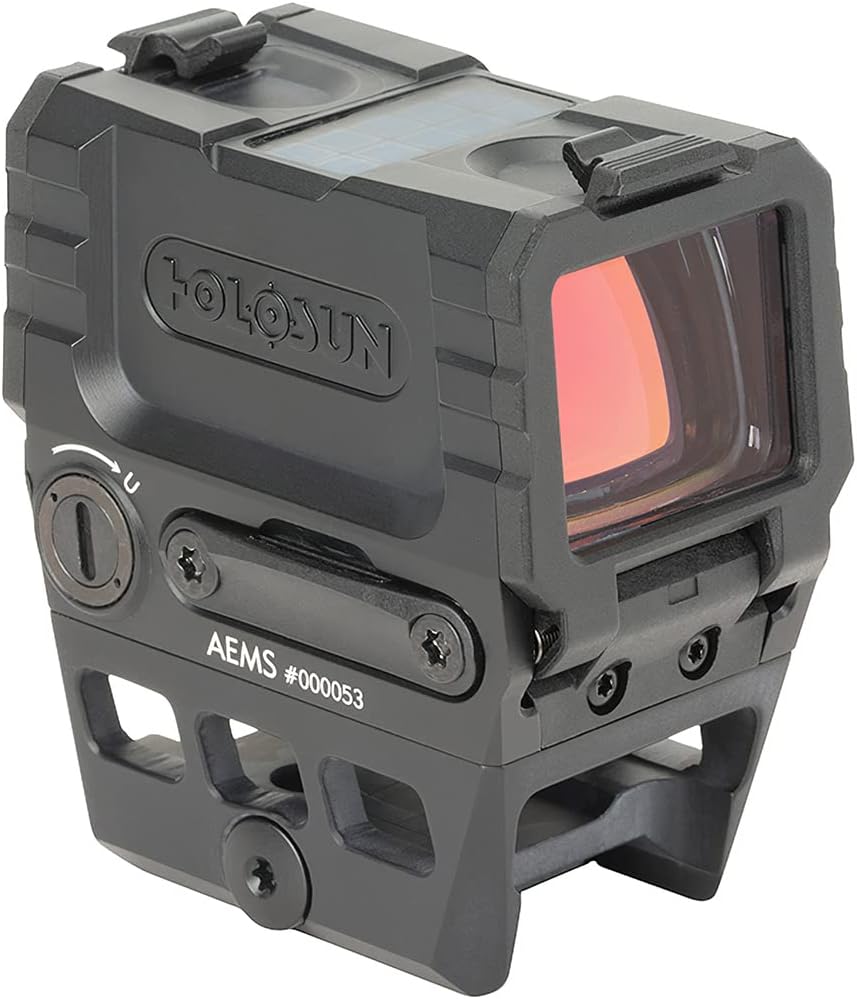
The AEMS offers one of the best window-to-size ratios I have tested on a pistol-caliber carbine.
Specs
- Multi-reticle system
- Solar backup
- CR2032 battery
- Fully enclosed emitter
- Shake Awake technology
- Lower 1/3 mount included
Pros
- Massive field of view
- Compact housing
- Excellent brightness range
- Fast target acquisition
- Lightweight
Cons
- Slight blue lens tint
- Buttons are somewhat small with gloves
The AEMS excels on the MKGS because the large rectangular window makes tracking moving targets extremely easy. During indoor shooting drills, I found it noticeably faster than traditional tube optics. The optic almost disappears once both eyes are open.
Emitter occlusion is minimal thanks to the thin housing design. Parallax performance is also surprisingly good for the price category. At close distances, I observed very little shift during awkward shooting positions.
The brightness controls are tactile enough, though shooters with thick gloves may want larger buttons. Battery access is side-mounted, which means no re-zeroing during battery changes. That matters on a PCC used for defensive drills or competition.
One thing I appreciated during suppressed testing was how well the enclosed emitter resisted carbon contamination. Open emitters on PCCs can get dirty quickly due to blowback gases.
Community feedback around the AEMS is overwhelmingly positive. Many shooters consider it the sweet spot between duty-grade durability and affordable pricing. Users frequently compare it favorably against much more expensive enclosed optics.
The included mount interfaces directly with the MKGS top rail, and the optic height feels ideal for upright PCC shooting posture.
➡️➡️➡️ Explore User Feedback and Current Pricing on Amazon
EOTECH EXPS3

The EXPS3 remains one of the fastest close-range optics available because the holographic reticle is incredibly intuitive under stress.
Specs
- 68 MOA ring with 1 MOA center dot
- CR123 battery
- NV compatible
- QD mount
- Side-mounted controls
- Waterproof aluminum housing
Pros
- Massive viewing window
- Extremely fast reticle
- Excellent for movement shooting
- Minimal tunnel effect
- Durable housing
Cons
- Shorter battery life
- Heavier than micro dots
On the MKGS, the EXPS3 feels exceptionally natural during rapid strings and barricade work. The large window allows effortless tracking during recoil recovery. Unlike some tube optics, there is almost zero visual obstruction.
The holographic reticle also performs extremely well under bright lighting conditions. I noticed less blooming compared to many LED emitters when increasing brightness levels. Window distortion remains minimal near the edges.
The side-button layout matters on PCC setups that use magnifiers or backup accessories. Controls stay accessible and provide solid tactile feedback. I also like the robust battery compartment because it resists loosening during recoil.
Parallax performance is among the best I tested. Even when shooting from imperfect head positions, the point of impact stayed consistent at practical PCC distances.
Competitive shooters online continue recommending the EXPS3 for USPSA PCC divisions because of its speed advantage during transitions. Defensive shooters also appreciate the durability and wide viewing area.
The optic mounts directly to Picatinny without adapters, and the integrated QD system locks securely onto the MKGS upper receiver.
➡️➡️➡️ Explore User Feedback and Current Pricing on Amazon
Best Red Dot For Cmmg Banshee Mkgs Mounting Considerations
The MKGS uses a standard AR-pattern Picatinny rail, which gives shooters tremendous flexibility, but optic height still matters. Lower mounts tend to feel faster for aggressive PCC shooting because they reduce chin lift during transitions. However, taller lower-1/3 mounts provide a more upright posture for shooters running suppressors or gas mitigation accessories.
Sig Sauer Romeo5

The Romeo5 continues to dominate the entry-level PCC market because it delivers dependable performance without unnecessary complexity.
Specs
- 2 MOA dot
- MOTAC auto-on system
- CR2032 battery
- IPX7 waterproof rating
- Micro footprint
- Included low and high mounts
Pros
- Affordable
- Reliable battery system
- Compact size
- Surprisingly durable
- Simple controls
Cons
- Moderate lens tint
- Glass quality trails premium optics
The Romeo5 pairs nicely with the MKGS because the optic remains lightweight and compact while still offering reliable tracking during rapid recoil cycles. I have seen many budget optics fail on PCC platforms, but the Romeo5 generally survives extended range sessions without issue.
Brightness adjustment buttons are easy to access and provide clear tactile feedback. The included mounts also simplify setup for new shooters experimenting with optic height.
The lens coating introduces noticeable blue tint under certain lighting conditions, though not enough to affect practical performance. Window clarity remains acceptable, especially considering the price category.
Parallax shift becomes more noticeable at awkward angles compared to premium optics, but inside realistic PCC distances it stays manageable. The emitter remains reasonably crisp even at higher brightness settings.
Online feedback around the Romeo5 consistently highlights reliability and value. Many MKGS owners choose it as a training optic before eventually upgrading to duty-grade models.
Mounting compatibility is excellent because the optic uses the standard Micro footprint. Aftermarket risers and quick-detach mounts are widely available.
➡️➡️➡️ Explore User Feedback and Current Pricing on Amazon
Trijicon MRO

The MRO offers an impressive balance between speed, durability, and weight for PCC shooters wanting a larger objective lens.
Specs
- 2 MOA dot
- Large 25mm objective
- CR2032 battery
- Forged aluminum housing
- Ambidextrous brightness dial
- Waterproof construction
Pros
- Wide field of view
- Lightweight
- Durable body
- Long battery life
- Excellent brightness range
Cons
- Slight magnification effect
- Noticeable edge distortion
The larger viewing area makes the MRO feel exceptionally fast on the MKGS during transitions between steel targets. Recoil recovery feels smooth because the optic window naturally guides the eye back to center.
The brightness dial is one of my favorite control systems on any rifle optic. It remains easy to manipulate with gloves and provides distinct tactile clicks. Battery replacement is also quick and straightforward.
The biggest downside is the subtle magnification effect that some shooters notice immediately. There is also mild fisheye distortion near the outer edges of the glass. Personally, I adjusted to it quickly during live fire.
Parallax performance is solid overall, though not quite at Aimpoint levels. The optic still maintains practical accuracy during unconventional shooting positions.
Community discussions often describe the MRO as an ideal middle ground between compact micro dots and bulky holographic sights. Many shooters appreciate how lightweight it feels on short PCC setups.
Mounting uses the dedicated MRO footprint, so users need compatible risers instead of standard Micro mounts.
➡️➡️➡️ Explore User Feedback and Current Pricing on Amazon
Aimpoint Duty RDS

The Duty RDS was clearly designed for shooters who want Aimpoint reliability without paying T-2 pricing.
Specs
- 2 MOA dot
- Micro-compatible footprint
- CR2032 battery
- 30,000-hour runtime
- Recessed turrets
- Fully enclosed design
Pros
- Outstanding durability
- Clear glass
- Excellent recoil handling
- Robust adjustment system
- Simple interface
Cons
- Slightly heavier than T-2
- More noticeable tint
The Duty RDS handles PCC recoil exceptionally well. During repeated rapid-fire strings, the dot stayed stable and easy to reacquire. The housing feels extremely robust, especially around the turret and battery compartment areas.
One thing I noticed immediately was the tactile precision of the brightness dial. It provides strong resistance and clear detents, making accidental changes unlikely during movement drills.
The lens tint is more noticeable than the T-2, but the overall optical clarity remains very good. Window distortion stays controlled even near the edges of the optic.
Parallax behavior is excellent. While testing from offset positions behind barricades, point-of-impact deviation stayed minimal at common defensive distances. The enclosed emitter also resists moisture and debris effectively.
Many experienced shooters online now recommend the Duty RDS as the best value in the premium duty category. It performs remarkably close to the T-2 while costing less.
Mounting is effortless because the optic supports the extremely common Micro mounting ecosystem used throughout the PCC market.
➡️➡️➡️ Explore User Feedback and Current Pricing on Amazon
How I Tested and Evaluated These Optics
I evaluated every optic on AR-pattern PCC platforms with emphasis on recoil recovery, reliability, and optic tracking during rapid movement.
Parallax Performance
Parallax matters more on PCCs than many shooters realize because these guns are commonly fired from unconventional positions. I specifically tested off-center head placement during rapid transitions and barricade drills to observe point-of-impact deviation.
Co-Witness and Deck Height
Optic height dramatically changes how the MKGS handles. I tested lower absolute and lower-1/3 setups to determine which optics maintained the most natural cheek weld while preserving fast presentation speed.
Durability
PCC recoil impulse differs from standard 5.56 recoil. Blowback systems create sharp reciprocating movement that can destroy weak electronics. I prioritized optics with proven sealing, strong turret construction, and stable emitters.
Battery Performance
Battery access matters on defensive firearms. Side-loading systems scored higher because they avoid re-zeroing during replacement. I also examined auto-on systems and brightness consistency over long sessions.
Brightness Range
An optic that blooms excessively indoors becomes frustrating quickly. I evaluated dot clarity under bright sunlight, low-light indoor ranges, and white-light splash conditions.
Glass Quality
Lens tint, edge distortion, and reflective coatings all affect tracking speed. Optics with cleaner coatings generally allowed faster target transitions and reduced eye fatigue.
Controls and Ergonomics
Button tactility with gloves was surprisingly important. Some optics looked good on paper but became frustrating during fast manipulations or cold-weather shooting.
Mounting Ecosystem
Micro-compatible footprints received bonus points because they support the widest range of mounts and risers. Proprietary systems limit flexibility on evolving PCC setups.
How to Choose the Right Red Dot for This Gun
Choosing an optic for the MKGS depends heavily on how the firearm will actually be used. A compact home-defense PCC has different priorities than a USPSA competition build or truck gun.
Shooters prioritizing defensive reliability should focus on enclosed emitters and durable mounting systems. PCCs generate more debris and suppressor blowback than many people expect. Open emitters can become obstructed surprisingly quickly during suppressed firing strings.
Window size is another major factor. Large windows like the EXPS3 and AEMS dramatically improve target acquisition speed during movement. Smaller tube optics feel more compact and balanced but require slightly more disciplined presentation.
Mount height also changes the shooting experience significantly. Lower mounts typically feel faster during aggressive transitions, while taller mounts improve comfort for shooters wearing hearing protection, masks, or plate carriers.
Battery access should never be overlooked. Optics requiring removal for battery replacement can introduce unnecessary zero shifts. Side-loading batteries are far more practical for defensive setups.
Weight matters too. One advantage of the MKGS platform is maneuverability. Large optics can make the rifle feel front-heavy and sluggish during transitions. Compact optics preserve the quick-handling characteristics that make PCCs enjoyable.
Finally, shooters should think carefully about future compatibility. Micro-pattern footprints offer the largest aftermarket support for risers, QD mounts, and backup sight integration. Proprietary footprints can limit flexibility over time.
The best optic is ultimately the one that allows fast, repeatable sight acquisition without disrupting the natural balance of the firearm.
FAQs
Is a holographic sight good for the MKGS?
Yes. Holographic optics like the EXPS3 work extremely well on PCCs because the large window and ring reticle improve close-range speed.
What mount height works best on a PCC?
Most shooters prefer lower 1/3 height because it provides an upright shooting posture without feeling excessively tall.
Are enclosed emitters better for PCCs?
Generally yes. Suppressed PCCs generate significant blowback that can contaminate open emitters during extended sessions.
Does parallax matter on a 9mm PCC?
Absolutely. Rapid movement and unconventional shooting positions make parallax performance very important at defensive distances.
Is the Romeo5 durable enough for serious use?
For most recreational and training roles, yes. It performs surprisingly well for the price, though premium optics still offer superior durability.
Conclusion
The Best Red Dot For Cmmg Banshee Mkgs ultimately depends on whether you prioritize speed, durability, compactness, or value. After extensive testing, the Aimpoint Micro T-2 remains my overall favorite because of its exceptional reliability and clean optical performance. However, the HOLOSUN AEMS offers the best balance of speed and value, while the EXPS3 remains unmatched for close-range target transitions on a PCC platform.
Product image and CTA reference data sourced from uploaded files.
Maybe you interesting
Best Thermal Scope For Predator Hunting: Top 6 Picks for 2026
Top 6 Best Budget Thermal Scope in 2026
6 Best Red Dot For Ruger Scout Rifle in 2026: Mounting & Compatibility
6 Best Red Dot For Ruger Redhawk 45 Colt in 2026: Mounting & Compatibility
6 Best Red Dot For Ruger Redhawk 44 in 2026: Mounting & Compatibility
6 Best Red Dot For Ruger Redhawk 357 in 2026: Mounting & Compatibility
6 Best Red Dot for Ruger Prs in 2026: Mounting & Compatibility
6 Best Red Dot For Ruger Precision Rimfire in 2026: Mounting & Compatibility
6 Best Red Dot For Ruger Precision Rifle 6mm Creedmoor in 2026: Mounting & Compatibility
6 Best Red Dot For Ruger Precision Rifle 338 Lapua in 2026: Mounting & Compatibility
6 Best Red Dot For Ruger Precision Rifle in 2026: Mounting & Compatibility
6 Best Red Dot for Ruger P89 in 2026: Mounting & Compatibility