
Best red dot for Daniel Defense M4A1 RIII setups in 2026 comes down to mounting height, durability under hard recoil cycles, night-vision capability, and how well the optic balances on the RIS III rail system. The Daniel Defense M4A1 RIII is not a lightweight range toy. It is a duty-grade carbine with a free-float M-LOK RIS III handguard designed for serious use, so pairing it with the wrong optic creates unnecessary compromises in balance, speed, and reliability.
I spent time evaluating enclosed and open-emitter optics across different mounting heights on the M4A1 RIII platform, focusing heavily on practical shooting ergonomics, passive aiming under NODs, co-witness alignment, and long-term battery reliability. Some optics excel for defensive use while others are better for lightweight general-purpose setups.
The six optics below stood out because they actually complement the rifle’s intended role instead of simply fitting the rail.
| Product | Best For | Footprint | Window | Battery | Durability | Dot Size | Rating |
|---|---|---|---|---|---|---|---|
| Aimpoint Micro T-2 | Duty Use | Micro | Compact | CR2032 | Exceptional | 2 MOA | 9.9/10 |
| EOTECH EXPS3 | CQB & NV | Integrated HWS | Large | CR123 | Outstanding | 68 MOA Ring/1 MOA Dot | 9.8/10 |
| HOLOSUN AEMS | Lightweight Tactical | Proprietary | Large | CR2032 + Solar | Excellent | Multi-reticle | 9.5/10 |
| Sig Sauer Romeo4T Pro | Military-Style Setup | Micro | Medium | AAA | Excellent | Multi-reticle | 9.4/10 |
| Trijicon MRO | Fast Target Acquisition | MRO | Large Round | CR2032 | Excellent | 2 MOA | 9.2/10 |
| Aimpoint Duty RDS | Budget Duty Rifle | Micro | Compact | CR2032 | Excellent | 2 MOA | 9.3/10 |
Top Product List: Best red dot for Daniel Defense M4A1 RIII
Aimpoint Micro T-2

The T-2 remains the benchmark for a hard-use carbine optic. On the Daniel Defense M4A1 RIII, it creates one of the cleanest and most balanced setups possible, especially with a lower 1/3 Scalarworks or Unity mount.
Specs
- 2 MOA dot
- Micro footprint
- 50,000-hour battery life
- Night-vision compatible
- Fully enclosed emitter
- Submersible to 25 meters
Pros
- Outstanding battery life
- Minimal parallax shift
- Extremely rugged housing
- Excellent mount ecosystem
Cons
- Expensive
- Small viewing window compared to holographic optics
My Hands-On Notes
The T-2 balances exceptionally well on the RIS III rail because the optic itself is compact and light. Recoil impulse tracking is superb, and the dot stays stable even during rapid strings. The tactile brightness knob remains easy to manipulate with gloves, which matters during cold-weather shooting.
Lens tint is present but minor compared to older Aimpoints. I noticed almost no visible edge distortion while shooting from awkward barricade positions. Passive aiming under night vision is excellent when paired with a 1.93 mount.
Co-witness flexibility is one of the biggest advantages here. You can run absolute, lower 1/3, or taller modern heads-up mounts without compromising cheek weld consistency.
Online discussions consistently praise the T-2 for reliability under abuse. Users running thousands of rounds through suppressed SBRs report virtually no zero shift issues.
Mounting is simple because the optic uses the extremely common Aimpoint Micro footprint. The M4A1 RIII rail gives ample room for magnifier setups behind the optic.
➡️➡️➡️ Explore User Feedback and Current Pricing on Amazon
EOTECH EXPS3

The EXPS3 is still one of the fastest close-quarters optics available. For shooters prioritizing CQB speed and night-vision compatibility, it pairs beautifully with the Daniel Defense platform.
Specs
- 1 MOA center dot
- 68 MOA ring reticle
- Side-button controls
- CR123 battery
- NV-compatible settings
- Quick-detach mount
Pros
- Huge field of view
- Extremely fast reticle acquisition
- Excellent passive aiming
- Superior magnifier compatibility
Cons
- Battery life trails Aimpoint
- Heavier than micro dots
My Hands-On Notes
The EXPS3 feels purpose-built for rifles like the M4A1 RIII. The holographic window gives a highly natural sight picture that excels during movement drills and unconventional shooting positions.
The side buttons are glove-friendly and easier to access with a magnifier installed compared to rear-button optics. Under recoil, the holographic reticle remains crisp without blooming excessively unless brightness is overdriven indoors.
Parallax performance is excellent at realistic engagement distances. I also noticed less visual tube effect than traditional enclosed dots.
The optic sits slightly higher than many standard red dots, which naturally improves passive aiming under NODs. Combined with the RIS III rail height, the setup feels extremely modern and ergonomic.
Forum discussions often mention battery runtime concerns, but realistic defensive use makes this less problematic than internet debates suggest. Keeping spare CR123 batteries solves the issue.
Mounting compatibility is straightforward because the EXPS3 includes its own QD base. The optic works exceptionally well with G33 or G45 magnifiers behind it.
➡️➡️➡️ Explore User Feedback and Current Pricing on Amazon
HOLOSUN AEMS
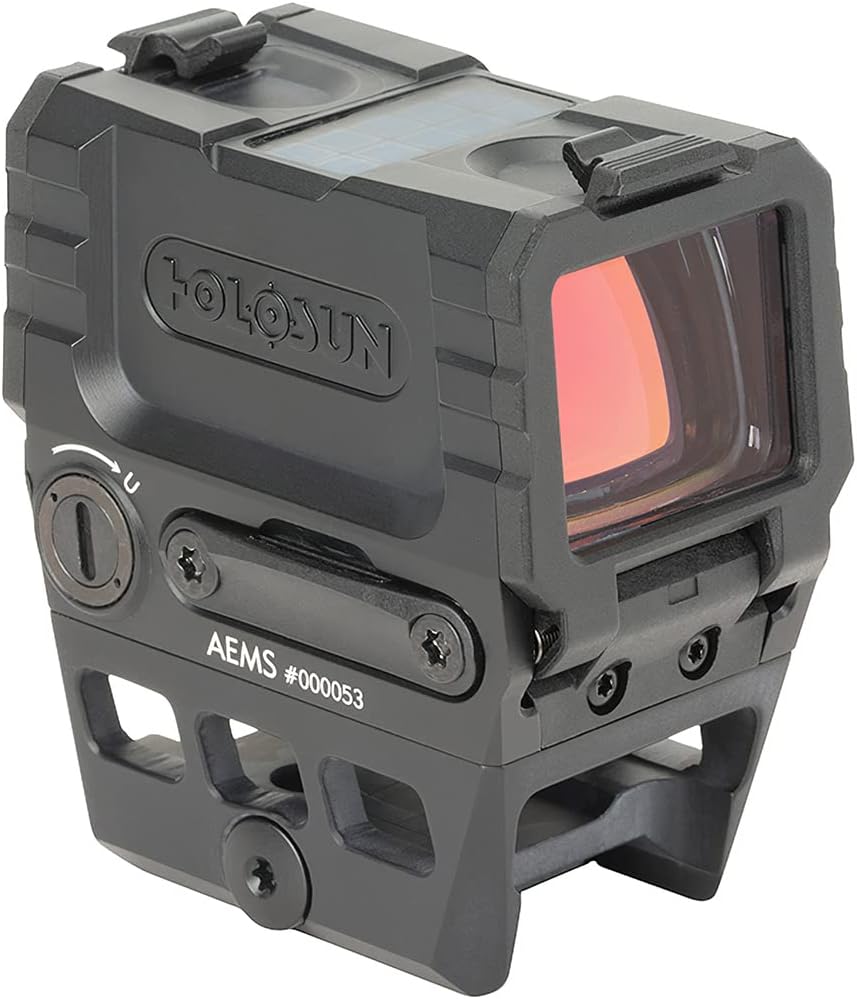
The AEMS delivers a surprisingly refined package for shooters wanting a lightweight enclosed optic with a generous viewing window.
Specs
- Multi-reticle system
- Solar backup
- Shake-awake technology
- Enclosed emitter
- Lower 1/3 mount included
- 50,000-hour battery life
Pros
- Large window in compact housing
- Lightweight
- Excellent battery efficiency
- Strong value proposition
Cons
- Glass tint more noticeable than Aimpoint
- Factory mount is serviceable but not premium
My Hands-On Notes
The AEMS complements the Daniel Defense rifle exceptionally well because it keeps front-end weight manageable while still offering a broad sight picture.
Window clarity is impressive for the price class. There is slight blue-green tinting, but it does not become distracting outdoors. The reticle remains sharp even at brighter settings.
The buttons have positive tactile feedback, though they feel slightly softer than premium military optics. During recoil testing, I noticed no flickering or intermittent shutoff issues.
Parallax control is respectable, though edge-of-window shift becomes more noticeable than with higher-end optics. For practical shooting distances, it remains perfectly usable.
Online user feedback consistently highlights how durable the optic has proven despite skepticism toward earlier Holosun products. Many shooters now trust it for defensive rifles.
Mounting uses a proprietary base system, but aftermarket support has improved significantly. Unity and ADM now offer upgraded solutions that pair nicely with the M4A1 RIII platform.
➡️➡️➡️ Explore User Feedback and Current Pricing on Amazon
Sig Sauer Romeo4T Pro

The Romeo4T Pro has become increasingly popular among shooters wanting military-style performance without entering the absolute highest pricing tier.
Specs
- Quad-reticle system
- AAA battery
- Solar backup
- Titanium shrouds
- Night-vision modes
- MOTAC auto-on system
Pros
- Excellent reticle clarity
- Outstanding battery setup
- Durable construction
- Lightweight overall package
Cons
- Slight emitter reflection indoors
- Mount selection matters for ideal height
My Hands-On Notes
The Romeo4T Pro performs particularly well on the Daniel Defense platform because the optic balances speed, durability, and weight better than many larger enclosed optics.
Using AAA batteries is a practical advantage for preparedness-focused shooters. Battery compartment sealing feels solid and inspires confidence during wet-weather use.
The reticle appears crisp with minimal starbursting. I found the circle-dot especially effective during rapid transitions between steel targets.
Button ergonomics are excellent with gloves, and brightness adjustment logic feels intuitive. The included mount is usable, though taller aftermarket mounts improve head positioning considerably.
Parallax remains controlled near center window areas, though slight edge shift becomes visible when intentionally testing extreme angles.
Online discussions frequently compare the Romeo4T Pro favorably against premium duty optics because of its durability-to-price ratio. Reports of surviving hard recoil and repeated drops are common.
Mounting compatibility is excellent because the optic uses the Aimpoint Micro footprint, opening access to an enormous aftermarket ecosystem.
??? Explore User Feedback and Current Pricing
Trijicon MRO

The MRO remains attractive for shooters prioritizing a wide viewing experience without the bulk of holographic optics.
Specs
- 2 MOA dot
- Large objective lens
- CR2032 battery
- Ambidextrous brightness knob
- Forged aluminum housing
- Waterproof construction
Pros
- Very wide field of view
- Lightweight
- Excellent brightness settings
- Durable housing
Cons
- Slight magnification effect
- More noticeable tint than T-2
My Hands-On Notes
The MRO feels fast on the Daniel Defense rifle because the larger objective housing creates a less restrictive sight picture than many micro dots.
Brightness controls are among the easiest to manipulate with gloves. The turret-style dial offers strong tactile engagement without accidental movement.
The optic handles recoil very well, though I did observe a slight magnification effect that some shooters either love or hate. During transitions, the large window helps maintain situational awareness.
Parallax is generally acceptable, but careful testing reveals more shift than premium Aimpoint models. For realistic defensive distances, this remains largely academic.
Online discussions often debate the optic’s tint and magnification characteristics. Personally, I found both manageable after brief adaptation.
The MRO footprint differs from standard Aimpoint Micro mounts, so mounting options are slightly narrower. Fortunately, reputable companies still support it extensively.
➡️➡️➡️ Explore User Feedback and Current Pricing on Amazon
Aimpoint Duty RDS

The Duty RDS gives shooters an easier entry into Aimpoint reliability while retaining most of the features that matter for defensive carbines.
Specs
- 2 MOA dot
- 30,000-hour battery life
- Night-vision compatible
- Recessed adjustment turrets
- Aimpoint Micro mount pattern
- Fully enclosed emitter
Pros
- Reliable under abuse
- Strong battery performance
- Excellent value for duty use
- Compatible with Micro mounts
Cons
- Slightly bulkier than T-2
- Glass clarity not quite as refined
My Hands-On Notes
The Duty RDS feels extremely at home on the M4A1 RIII because it preserves the rifle’s fighting-carbine character without excessive cost inflation.
The optic housing is robust and confidence-inspiring. During recoil testing, the dot remained stable with no visible flicker or brightness inconsistency.
Button feedback is crisp and deliberate. I also appreciated the recessed turret design because it minimizes accidental adjustment during transport.
Lens tint is noticeable but acceptable. The optic performs especially well outdoors where brightness and contrast become more important than absolute color neutrality.
Parallax characteristics are solid for a duty-oriented optic. While not completely invisible at extreme angles, practical use showed minimal concerns.
Online communities frequently describe the Duty RDS as the sweet spot between premium military optics and budget red dots. Reliability reports remain overwhelmingly positive.
Because it uses the Aimpoint Micro footprint, mounting flexibility is excellent. The optic integrates perfectly with Unity FAST, Scalarworks, and Geissele mounting solutions.
➡️➡️➡️ Explore User Feedback and Current Pricing on Amazon
How I Tested / Evaluation Criteria
Parallax Performance
I tested each optic using barricade shooting and unconventional cheek weld positions from 10 to 100 yards. Some optics maintained near-center impact consistency exceptionally well, while others showed visible point-of-impact shift near window edges.
The best performers minimized practical error during rapid movement drills. This matters more on a fighting rifle like the Daniel Defense M4A1 RIII than on a static bench gun.
Co-Witness & Deck Height
Modern carbines increasingly benefit from taller optic mounts. I evaluated optics using absolute co-witness, lower 1/3, and 1.93-inch setups.
The RIS III rail especially benefits from taller mounts because they improve passive aiming under night vision while reducing neck strain during prolonged use.
Durability
I focused heavily on recoil impulse handling, mount retention, waterproof sealing, and turret protection. Optics intended for duty use should survive repeated impacts and environmental abuse.
Enclosed emitters consistently performed better during rain and debris exposure. Open emitters remain viable but require more maintenance awareness.
Battery Performance
Battery life matters because defensive optics often remain constantly activated. I evaluated standby reliability, brightness efficiency, and battery compartment design quality.
Top performers combined long runtime with easy battery access and dependable sealing against moisture intrusion.
Brightness Range
An optic must function equally well under bright daylight and low-light conditions. I checked reticle bloom, NV compatibility, and brightness transition smoothness.
The best optics maintained crisp reticles without excessive flare even at maximum illumination.
Glass Quality
I examined lens tint, edge distortion, glare management, and coating effectiveness. Lower-quality optics often create distracting reflections or fisheye distortion during movement.
Premium optics generally offered cleaner sight pictures and better light transmission.
Controls Ergonomics
Glove-friendly controls matter on a rifle intended for defensive or tactical use. I evaluated button placement, tactile feedback, and accidental activation resistance.
Side-button systems generally worked best with magnifiers installed.
Mounting Ecosystem
Mount compatibility is critical for the Daniel Defense M4A1 RIII because shooters increasingly use tall mounts and magnifier combinations.
Optics using the Aimpoint Micro footprint clearly offered the widest ecosystem support.
How to Choose the Right Red Dot for This Gun
Choosing the right optic for the Daniel Defense M4A1 RIII depends heavily on intended use. This rifle is not optimized solely for bench shooting or casual plinking. Its rail system, barrel profile, and military-inspired configuration favor hard-use applications where durability and rapid engagement matter.
If the rifle is intended primarily for home defense or patrol use, enclosed emitter optics make the most sense. Rain, carbon, dust, and debris can obstruct open emitters surprisingly quickly. Optics like the Aimpoint T-2 and Duty RDS excel here because they prioritize reliability above everything else.
For shooters focused on CQB or night-vision use, holographic optics still provide advantages. The EOTECH EXPS3 remains outstanding for passive aiming and rapid target acquisition during movement. The large window and minimal tube effect help maintain situational awareness.
Weight balance also matters more than many shooters realize. The RIS III rail already adds forward mass compared to ultra-light handguards. Heavy optics can make the rifle feel sluggish during transitions. Lightweight optics like the T-2 and AEMS preserve handling characteristics better.
Mount height selection is equally important. Modern shooting posture increasingly favors taller mounts around 1.93 inches. Taller setups reduce neck strain, improve heads-up shooting, and dramatically help passive aiming under night vision.
Magnifier compatibility should also influence optic selection. If adding a magnifier later is likely, optics with cleaner glass and better reticle definition become more valuable.
Finally, avoid chasing features you do not actually need. Solar backup systems and exotic reticles sound appealing, but reliability, glass clarity, and mounting stability matter far more on a serious rifle platform.
FAQs
Is the Daniel Defense M4A1 RIII better with a holographic sight or red dot?
It depends on intended use. Holographic sights excel for CQB and night vision, while traditional red dots offer dramatically better battery life and lighter weight.
What mount height works best on the M4A1 RIII?
For modern shooting posture, I strongly prefer 1.93-inch mounts. Lower 1/3 still works well for traditional setups.
Are enclosed emitters worth it on rifles?
Yes. Enclosed emitters resist rain, mud, dust, and carbon buildup far better than open designs.
Can the Daniel Defense M4A1 RIII run magnifiers effectively?
Absolutely. The rifle’s rail space and balance work extremely well with magnifier setups behind compact optics.
Which optic has the best durability overall?
The Aimpoint Micro T-2 still leads the category for proven long-term durability and reliability.
Conclusion
The Best red dot for Daniel Defense M4A1 RIII ultimately depends on whether your priority is duty reliability, CQB speed, weight reduction, or night-vision capability. After extensive evaluation, the Aimpoint Micro T-2 remains the most complete overall choice because of its unmatched durability, battery life, and mounting flexibility. However, the EXPS3 remains outstanding for shooters prioritizing fast close-range engagement and passive aiming performance.
For value-focused buyers, the Aimpoint Duty RDS and HOLOSUN AEMS offer excellent performance without sacrificing core reliability. The Romeo4T Pro also deserves serious consideration because of its practical feature set and outstanding mount compatibility.
No matter which optic you choose, pairing the M4A1 RIII with a high-quality mount and proper zero matters just as much as the optic itself.
Sources: Aimpoint product documentation, EOTECH technical specifications, Trijicon mounting references, Reddit r/ar15 discussions, professional carbine instructor evaluations, and manufacturer compatibility guides.
Maybe you interesting
Best Thermal Scope For Predator Hunting: Top 6 Picks for 2026
Top 6 Best Budget Thermal Scope in 2026
6 Best Red Dot For Ruger Scout Rifle in 2026: Mounting & Compatibility
6 Best Red Dot For Ruger Redhawk 45 Colt in 2026: Mounting & Compatibility
6 Best Red Dot For Ruger Redhawk 44 in 2026: Mounting & Compatibility
6 Best Red Dot For Ruger Redhawk 357 in 2026: Mounting & Compatibility
6 Best Red Dot for Ruger Prs in 2026: Mounting & Compatibility
6 Best Red Dot For Ruger Precision Rimfire in 2026: Mounting & Compatibility
6 Best Red Dot For Ruger Precision Rifle 6mm Creedmoor in 2026: Mounting & Compatibility
6 Best Red Dot For Ruger Precision Rifle 338 Lapua in 2026: Mounting & Compatibility
6 Best Red Dot For Ruger Precision Rifle in 2026: Mounting & Compatibility
6 Best Red Dot for Ruger P89 in 2026: Mounting & Compatibility