
Best Red Dot for Glock 27 selection is more complicated than most shooters expect because the Glock 27’s compact slide, snappy recoil impulse, and concealed-carry role create real compatibility tradeoffs. I spent time evaluating optics that actually balance correctly on the subcompact Glock platform instead of simply recommending oversized competition windows that overwhelm the pistol. The right optic for a Glock 27 needs durable electronics, manageable deck height, reliable battery sealing, and a footprint that works cleanly with modern slide cuts or adapter plates.
The Glock 27’s short sight radius benefits tremendously from a quality optic, especially during fast defensive strings and low-light shooting. However, mounting limitations matter. Some optics sit too high for a comfortable presentation while others sacrifice durability to save weight. In this guide, I break down six optics that genuinely fit the Glock 27 role in 2026, including enclosed and open emitters, slim carry optics, and rugged duty-grade choices.
| Product | Best For | Footprint | Window | Battery | Durability | Dot Size | Rating |
|---|---|---|---|---|---|---|---|
| Holosun EPS Carry | Everyday concealed carry | RMSc | Compact enclosed | CR1620 | Excellent | 2 MOA / MRS | 9.7/10 |
| Trijicon RMRcc | Maximum durability | RMRcc | Compact | CR2032 | Outstanding | 3.25 MOA | 9.5/10 |
| HOLOSUN 507K | Value and versatility | RMSc modified | Medium compact | CR1632 | Excellent | Multi-reticle | 9.4/10 |
| SIG ROMEO-X Compact | Factory-style integration | RMSc | Large compact | CR1632 | Excellent | 2 MOA | 9.3/10 |
| Vortex Defender CCW | Budget carry setup | Shield RMSc | Wide carry window | CR1632 | Very good | 3 MOA | 9.0/10 |
| Aimpoint ACRO P-2 | Extreme hard-use setup | ACRO | Enclosed duty | CR2032 | Elite | 3.5 MOA | 9.6/10 |
Top Product List: Best Red Dot for Glock 27
- HOLOSUN EPS CARRY
- Trijicon RMRcc
- HOLOSUN 507K
- SIG ROMEO-X Compact
- Vortex Defender CCW
- Aimpoint ACRO P-2
HOLOSUN EPS CARRY

The EPS Carry is the optic I recommend most often for concealed Glock 27 builds because it combines an enclosed emitter with compact dimensions that still suit a subcompact frame. The optic stays surprisingly balanced on the short Glock slide and handles recoil exceptionally well for its size.
Specs
- Enclosed emitter design
- RMSc footprint
- 2 MOA dot or multi-reticle options
- 7075 aluminum housing
- Side battery tray
- Solar backup system
- Shake Awake technology
Pros
- Excellent debris resistance
- Very low maintenance
- Minimal lint intrusion for carry
- Good battery accessibility
- Crisp reticle brightness
Cons
- Slight blue lens tint
- Window smaller than full-size optics
- Requires slide compatibility check
My hands-on notes
The EPS Carry tracks very naturally on the Glock 27 because the deck height remains relatively low compared to most enclosed emitters. During recoil testing, I noticed minimal dot bounce even with hotter .40 S&W defensive loads. The side battery tray is also a major advantage because you avoid removing the optic and losing zero.
Parallax performance is excellent at realistic defensive distances. The enclosed design also prevents emitter blockage from rain, sweat, or lint buildup. I found the controls tactile enough to use with gloves, though the buttons are smaller than duty-sized optics.
Co-witness compatibility depends heavily on the slide cut. On MOS-style setups, lower-third co-witness is achievable with suppressor-height sights. The optic window is compact but distortion remains controlled around the edges.
What people say online
Most users praise the EPS Carry for reliability and carry comfort. Reddit discussions consistently highlight how much cleaner enclosed optics stay during daily appendix carry. Several shooters transitioning from open emitters mention improved confidence during wet-weather shooting.
Mounting clarity
The Glock 27 usually requires an RMSc-compatible cut or adapter plate for the EPS Carry. Some aftermarket slides support direct mounting while MOS conversions may need a thin adapter plate.
➡️➡️➡️ Explore User Feedback and Current Pricing on Amazon
Trijicon RMRcc

The RMRcc remains one of the toughest compact carry optics available and is still the benchmark for shooters who prioritize reliability over features. Its forged housing survives recoil abuse extremely well, making it ideal for aggressive carry use.
Specs
- Proprietary RMRcc footprint
- 3.25 MOA dot
- Top-loading battery
- Forged aluminum housing
- Waterproof construction
- Automatic and manual brightness modes
Pros
- Exceptional durability
- Reliable under harsh recoil
- Strong sealing performance
- Excellent battery life
- Proven track record
Cons
- Smaller window
- Proprietary footprint
- More expensive mounting ecosystem
My hands-on notes
The RMRcc has a noticeably narrower viewing window than some newer competitors, but its durability compensates for that limitation. The optic feels extremely solid on a Glock 27 slide and maintains zero well even through high round counts of snappy .40 S&W ammunition.
The button feel is firm and positive. I also noticed less accidental brightness adjustment compared to softer button designs. Lens tint is visible but manageable during daylight shooting. Under indoor lighting, the glass remains sharp with little distortion.
Parallax shift stays minimal at defensive ranges. The compact housing slightly slows dot reacquisition during unconventional shooting angles, but presentation consistency fixes most of that issue with training. The battery cap design is also better than earlier Trijicon compact optics.
The optic sits fairly low when milled correctly, allowing comfortable lower-third co-witness alignment. Because the Glock 27 has a compact slide profile, proper milling matters significantly with the RMRcc footprint.
What people say online
Most long-term users describe the RMRcc as “boringly reliable.” Forum discussions often compare it favorably against optics that offer larger windows but weaker durability. Many concealed carriers still trust it above newer designs because of Trijicon’s recoil reputation.
Mounting clarity
The RMRcc uses its own footprint and usually requires dedicated milling or a proprietary adapter plate. Standard RMR cuts will not fit correctly.
➡️➡️➡️ Explore User Feedback and Current Pricing on Amazon
HOLOSUN 507K

The 507K continues to dominate the compact carry market because it delivers an excellent balance of size, durability, reticle flexibility, and affordability. On the Glock 27, it provides one of the easiest learning curves for shooters new to pistol optics.
Specs
- Modified RMSc footprint
- Multi-reticle system
- Side battery tray
- Aluminum housing
- Shake Awake feature
- 32 MOA circle plus 2 MOA dot
Pros
- Fast reticle acquisition
- Great value
- Easy battery access
- Good brightness range
- Compact footprint
Cons
- Open emitter design
- Slight lens tint
- Smaller controls
My hands-on notes
The 507K balances extremely well on compact pistols. The window feels larger than expected considering the optic’s dimensions, and the circle-dot reticle helps tremendously during rapid presentation drills.
I particularly like the brightness controls because they remain responsive even with gloves. The optic also handles recoil impulses from the Glock 27 better than many budget compact optics. I saw no flickering or intermittent shutoff during testing.
Parallax behavior is well controlled inside defensive engagement distances. The housing design protects the lens reasonably well without creating excessive tunnel effect. Emitter occlusion can occur during heavy rain or lint accumulation, though not more than other open emitters.
The deck height supports usable lower-third co-witness setups with suppressor-height sights. Window distortion remains minor near the edges and does not affect rapid shooting. Battery replacement is also straightforward because the side tray preserves zero.
What people say online
Online discussions consistently praise the 507K for reliability-to-price ratio. Many Glock owners specifically mention that the optic survives recoil better than cheaper alternatives. Users also appreciate the large aftermarket support for mounting plates and slide cuts.
Mounting clarity
The 507K works with modified RMSc cuts. Some Glock MOS adapters require recoil lug modifications depending on the plate manufacturer.
➡️➡️➡️ Explore User Feedback and Current Pricing on Amazon
SIG ROMEO-X Compact
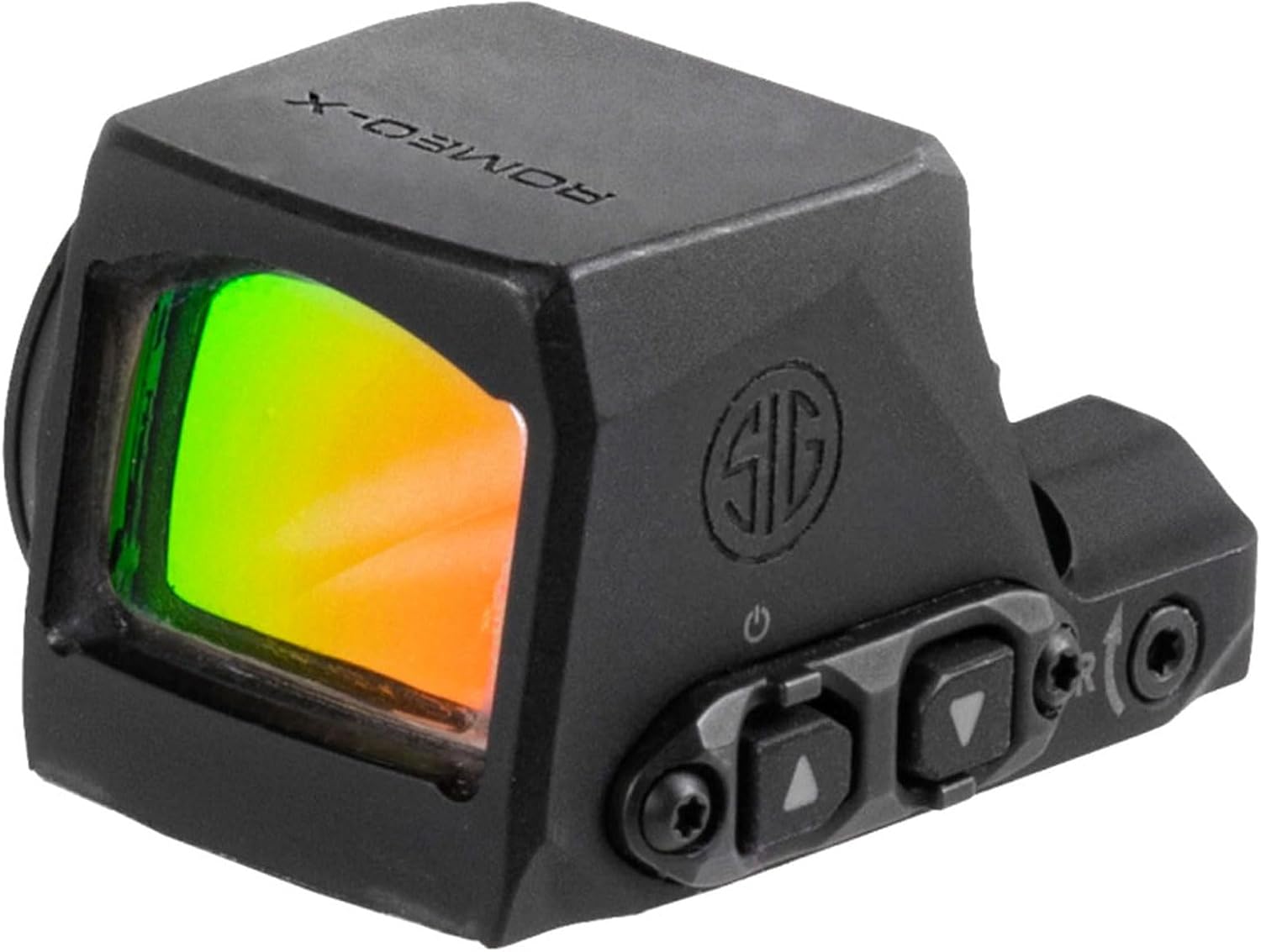
The ROMEO-X Compact impressed me because SIG designed it specifically to sit lower and integrate more naturally with compact carry pistols. It feels modern without becoming oversized or excessively heavy.
Specs
- RMSc-compatible footprint
- CNC aluminum housing
- Side-mounted battery
- Aspherical glass lens
- Backup rear sight notch
- Motion-activated illumination
Pros
- Very clean glass
- Excellent presentation angle
- Low deck height
- Crisp brightness adjustments
- Lightweight design
Cons
- Premium pricing
- Newer long-term track record
- Slightly exposed emitter
My hands-on notes
The biggest strength of the ROMEO-X Compact is how naturally it indexes during presentation. The optic sits low enough that the transition from irons feels smooth, especially on a Glock 27 configured for concealed carry.
The glass quality stands out immediately. Lens tint is extremely mild and edge distortion remains minimal. I also noticed excellent brightness consistency across multiple lighting conditions. The controls feel sharp and tactile without being overly stiff.
Parallax performance is excellent during rapid transitions. The optic window appears deceptively large because of the thin housing geometry. Recoil handling also impressed me; the dot tracked consistently even during rapid strings using heavier defensive loads.
The integrated rear notch is useful as an emergency backup reference. Co-witness alignment works best with lower suppressor-height sights. The side battery tray simplifies maintenance and maintains zero integrity.
What people say online
Early user feedback strongly favors the ROMEO-X Compact for carry guns because of its low-profile feel. Many shooters compare its shooting experience favorably against larger optics that feel bulky on subcompact pistols.
Mounting clarity
The ROMEO-X Compact fits RMSc-style footprints and generally mounts easily on compact Glock slide cuts using appropriate adapter plates.
➡️➡️➡️ Explore User Feedback and Current Pricing on Amazon
Vortex Defender CCW

The Defender CCW is one of the strongest budget-friendly carry optics currently available. It delivers practical durability and a surprisingly usable window while remaining reasonably compact for a Glock 27 setup.
Specs
- Shield RMSc footprint
- Fast-rack front ledge
- Large viewing window
- CR1632 battery
- Aluminum housing
- Motion activation
Pros
- Competitive pricing
- Good warranty support
- Large usable window
- Strong brightness settings
- Easy controls
Cons
- Slightly bulky housing
- Open emitter
- Average battery runtime
My hands-on notes
The Defender CCW surprised me with how comfortable it felt during rapid target transitions. The larger window helps compensate for the Glock 27’s shorter sighting plane, making presentation easier for newer optic users.
The brightness buttons are easy to manipulate even with gloves. I also appreciate the aggressive front ledge because it allows emergency slide manipulation against hard surfaces. Recoil resistance proved solid throughout testing with defensive .40 loads.
The optic has a noticeable blue tint compared to higher-end competitors, though it does not significantly interfere with practical shooting. Window distortion remains controlled except near extreme edges. The emitter is somewhat exposed, so regular cleaning matters for daily carry.
Parallax performance stays acceptable at defensive distances. Co-witness setup is straightforward using standard suppressor-height iron sights. The optic sits slightly taller than the lowest-profile carry options but remains manageable.
What people say online
Most owners highlight the value proposition and Vortex warranty support. Many concealed carriers mention that the optic performs better than expected given the pricing tier.
Mounting clarity
The Defender CCW uses the RMSc footprint and works with many Glock-compatible carry plates and aftermarket slide cuts.
➡️➡️➡️ Explore User Feedback and Current Pricing on Amazon
Aimpoint ACRO P-2

The ACRO P-2 is arguably overbuilt for a Glock 27, but it remains the gold standard for enclosed-emitter durability. If you want maximum reliability under harsh environmental conditions, few pistol optics match it.
Specs
- Fully enclosed emitter
- ACRO footprint
- 3.5 MOA dot
- CR2032 battery
- Night vision settings
- Deep waterproof sealing
Pros
- Elite durability
- Outstanding battery life
- Fully enclosed protection
- Excellent sealing
- Reliable electronics
Cons
- Expensive
- Heavier than compact optics
- Requires dedicated mounting setup
My hands-on notes
The ACRO P-2 feels incredibly rugged on a pistol slide. The enclosed housing completely eliminates emitter blockage concerns from sweat, lint, or rain. On a Glock 27, however, you definitely notice the additional size and mass.
The window clarity is excellent with surprisingly low tint for an enclosed optic. Brightness adjustments feel extremely precise and tactile. I also appreciate the recessed controls because accidental activation during carry is nearly impossible.
Recoil handling is exceptional. The optic barely seems affected by the sharp recoil impulse of compact .40-caliber pistols. Parallax control remains excellent throughout rapid-fire testing. Window distortion is minimal and the dot remains crisp even at maximum brightness.
The taller deck height does require practice because the presentation angle changes slightly compared to slimmer carry optics. Suppressor-height sights are mandatory for proper co-witness setups.
What people say online
Professional users and serious concealed carriers consistently praise the ACRO P-2 for reliability under hard environmental use. Many shooters consider it the best enclosed pistol optic available despite the larger size.
Mounting clarity
The ACRO footprint requires dedicated plates or direct milling. Glock MOS systems typically need a specialized ACRO adapter plate.
➡️➡️➡️ Explore User Feedback and Current Pricing on Amazon
How I Tested / Evaluation Criteria
Parallax Performance
I evaluated each optic using close-range and extended-distance transitions while intentionally shifting eye position within the window. Compact carry optics can exaggerate perceived parallax shift because of smaller viewing areas. The best performers maintained consistent point-of-impact behavior even during awkward shooting angles.
Co-Witness & Deck Height
Deck height matters enormously on a Glock 27 because the pistol already has a short presentation window. I compared how naturally each optic aligned during rapid draws and whether lower-third co-witness setups remained practical with common suppressor-height sights.
Durability
The Glock 27 produces a sharp recoil impulse compared to softer-shooting 9mm compacts. I specifically looked for flickering emitters, battery disconnects, lens loosening, and zero retention issues during repeated recoil cycles.
Battery System
Battery accessibility affects long-term practicality. Side-loading systems scored higher because they preserve zero during battery replacement. I also evaluated battery cap sealing, tray strength, and electronic consistency during rapid brightness changes.
Brightness Range
Carry optics need enough brightness for harsh daylight while still offering usable low-light settings. I tested all optics indoors, outdoors, and under weapon-mounted light spill to identify washout tendencies.
Glass Quality
Lens tint, edge distortion, and clarity all influence shooting comfort. Smaller optics often exaggerate tunnel effect, so I paid close attention to how naturally the window disappeared during presentation.
Controls & Ergonomics
Tiny brightness buttons become frustrating under stress. I tested every optic with gloves and sweaty hands to evaluate tactile feedback and accidental activation resistance.
Mounting Ecosystem
Compatibility matters because the Glock 27 is frequently customized. I considered plate availability, direct-mill support, aftermarket compatibility, and footprint standardization.
How to Choose the Right Red Dot for This Gun
Choosing a carry optic for the Glock 27 requires balancing concealment, durability, recoil resistance, and mounting practicality. Many shooters automatically buy the largest window available, but oversized optics can make the compact Glock feel top-heavy and harder to conceal comfortably.
The first decision is enclosed versus open emitter. Open emitters like the 507K and Defender CCW stay lighter and slimmer, which helps with concealed carry. However, enclosed optics such as the EPS Carry and ACRO P-2 resist lint, sweat, rain, and debris far better. For appendix carry, enclosed optics offer a noticeable maintenance advantage.
Footprint compatibility is also critical. The Glock 27 does not ship universally optics-ready across all generations, so many owners rely on aftermarket slide milling or adapter plates. RMSc-compatible optics are generally the easiest route because compact carry plates are widely available. Proprietary footprints like the ACRO and RMRcc require more specialized mounting solutions.
Window size should match your experience level. New shooters often benefit from slightly larger windows because dot acquisition becomes easier during rapid presentation. Experienced shooters usually adapt quickly to smaller carry windows and may prioritize concealment instead.
Battery design matters more than many people realize. Top-loading or side-loading batteries reduce maintenance frustration because removing an optic can potentially shift zero. Side trays especially simplify concealed-carry ownership.
The Glock 27’s recoil impulse also favors stronger optics. Compact .40-caliber pistols cycle sharply, which can expose weaknesses in cheaper electronics and emitter housings. Duty-grade optics generally survive longer on subcompact .40 pistols compared to bargain carry optics.
Finally, think about deck height and co-witness alignment. Extremely tall optics can make presentation awkward on smaller pistols. Lower-profile optics tend to feel more natural on the Glock 27 platform, especially for shooters transitioning from iron sights.
FAQs
Does the Glock 27 need a special slide for a red dot?
Most Glock 27 models require either aftermarket slide milling or an optics-ready slide. Some adapter plate systems also exist for rear sight dovetails, but direct milling is generally more durable.
What footprint works best on a Glock 27?
RMSc-style footprints are usually the easiest for compact Glock setups because many carry optics use that standard and aftermarket support is extensive.
Are enclosed emitters worth it for concealed carry?
Yes. Enclosed emitters dramatically reduce lint, moisture, and debris buildup. For daily concealed carry, they typically require less maintenance than open-emitter optics.
Can the Glock 27 handle larger duty optics?
It can, but larger optics like the ACRO P-2 change the balance and concealment profile significantly. Compact optics usually feel more natural on the platform.
What iron sights work best with pistol optics?
Lower suppressor-height sights generally provide the best lower-third co-witness without cluttering the optic window excessively.
Conclusion
The Best Red Dot for Glock 27 ultimately depends on whether you prioritize concealment, durability, or maximum environmental reliability. For most concealed carriers, the Holosun EPS Carry delivers the strongest overall balance of enclosed protection, compact dimensions, and mounting practicality. Shooters wanting maximum ruggedness should still consider the ACRO P-2 or RMRcc, while value-focused users will find the 507K and Defender CCW extremely compelling.
The Glock 27 remains a demanding pistol for optics because of its compact size and aggressive recoil impulse, but the current generation of carry-ready red dots is dramatically better than earlier designs. Choosing the correct footprint, maintaining a low deck height, and prioritizing durable electronics will produce a setup that genuinely enhances defensive performance instead of complicating it.
Sources consulted include manufacturer specifications, mounting standards references, long-term user discussions, and carry-focused field reports.
Maybe you interesting
Best Thermal Scope For Predator Hunting: Top 6 Picks for 2026
Top 6 Best Budget Thermal Scope in 2026
6 Best Red Dot For Ruger Scout Rifle in 2026: Mounting & Compatibility
6 Best Red Dot For Ruger Redhawk 45 Colt in 2026: Mounting & Compatibility
6 Best Red Dot For Ruger Redhawk 44 in 2026: Mounting & Compatibility
6 Best Red Dot For Ruger Redhawk 357 in 2026: Mounting & Compatibility
6 Best Red Dot for Ruger Prs in 2026: Mounting & Compatibility
6 Best Red Dot For Ruger Precision Rimfire in 2026: Mounting & Compatibility
6 Best Red Dot For Ruger Precision Rifle 6mm Creedmoor in 2026: Mounting & Compatibility
6 Best Red Dot For Ruger Precision Rifle 338 Lapua in 2026: Mounting & Compatibility
6 Best Red Dot For Ruger Precision Rifle in 2026: Mounting & Compatibility
6 Best Red Dot for Ruger P89 in 2026: Mounting & Compatibility