
Best red dot for Glock 43x setups in 2026 are far better than they were even two years ago. The Glock 43X MOS has become one of the most popular slimline concealed-carry pistols on the market, but choosing the right optic still depends heavily on footprint compatibility, deck height, concealment profile, and reliability under recoil.
I spent time evaluating compact optics that actually make sense on a thin-frame carry gun rather than oversized competition dots that overwhelm the slide. The key differences today are not just battery life or dot brightness. They come down to mounting ecosystem, optic overhang, window usability under stress, and whether the optic maintains zero after several hundred rounds of defensive ammunition.
The Glock 43X MOS uses a modified Shield RMSc footprint, which immediately eliminates many full-size optics unless adapter plates are involved. That matters because plates increase deck height, affect co-witness, and can complicate concealment.
Below are the six optics I think stand out most for the Glock 43X platform in 2026.
Quick Summary Table
| Product | Best For | Footprint | Window | Battery | Durability | Dot Size | Rating |
|---|---|---|---|---|---|---|---|
| Holosun EPS Carry | Everyday carry | RMSc/K | Enclosed medium | 50k hrs | Excellent | 2 MOA / MRS | 9.7/10 |
| Holosun 507K | Value & reliability | K footprint | Compact | 50k hrs | Excellent | 2 MOA / 32 MOA | 9.5/10 |
| Trijicon RMRcc | Duty-grade durability | RMRcc | Compact | 4 years | Outstanding | 3.25 MOA | 9.4/10 |
| SIG ROMEO-X Compact | Lowest deck height | RMSc | Wide compact | 20k hrs | Very good | 2 MOA | 9.2/10 |
| Vortex Defender CCW | Budget carry optic | RMSc | Large for size | 9.5k hrs | Good | 3 MOA | 8.9/10 |
| Shield RMSc | Slim minimalist build | RMSc | Low-profile | 2–3 years | Good | 4 MOA | 8.7/10 |
Top Product List: best red dot for Glock 43x
- HOLOSUN EPS CARRY
- HOLOSUN 507K
- Trijicon RMRcc
- SIG ROMEO-X Compact
- Vortex Defender CCW
- Shield Sights RMSc
HOLOSUN EPS CARRY

The EPS Carry is the optic I currently recommend most often for concealed-carry Glock 43X builds because it solves one of the biggest problems with open emitters: lint, moisture, and debris blocking the diode.
- Footprint: Holosun K / RMSc-compatible
- Dot options: 2 MOA, MRS
- Battery: CR1620 side tray
- Housing: Enclosed emitter
- Brightness: Manual + auto
- NV settings: Yes
Pros
- Enclosed emitter keeps debris away
- Excellent battery tray system
- Strong brightness range outdoors
- Minimal distortion near edges
- Very durable for size
Cons
- Slight blue lens tint
- Slightly bulkier than open emitters
- Higher price than 507K
In practical shooting, I found the EPS Carry extremely forgiving during rapid presentations. The window shape feels larger than its dimensions suggest, and the thin housing helps maintain target awareness. Parallax shift is minimal at realistic defensive distances, and the optic tracks well during recoil cycles.
The deck height is low enough that I could still get a functional lower-third co-witness with standard-height backup irons on some setups. That matters on the Glock 43X because tall suppressor-height sights can become uncomfortable for appendix carry.
Button tactility is excellent even with gloves. The side-mounted battery tray is a major advantage because I do not have to remove the optic to replace batteries and risk losing zero.
Online discussions consistently praise its durability compared with older micro dots. Reddit carry communities and long-term users also report fewer emitter blockage issues during summer carry compared with open designs.
Mounting is straightforward on Glock 43X MOS models, although some slides still require slight recoil lug modifications depending on the plate system.
➡️➡️➡️ Explore User Feedback and Current Pricing on Amazon
HOLOSUN 507K

The 507K remains one of the best-balanced micro pistol optics ever made for slimline concealed-carry pistols. It combines durability, battery life, and a highly usable reticle system at a price that still undercuts premium competitors.
- Footprint: K footprint
- Reticle: 2 MOA dot + 32 MOA circle
- Battery: CR1632 side tray
- Brightness settings: 10 daylight + 2 NV
- Housing: 7075 aluminum
- Shake Awake: Yes
Pros
- Excellent value
- Crisp reticle system
- Long battery life
- Reliable under recoil
- Compact profile
Cons
- Open emitter attracts lint
- Slight lens tint
- Small window for some shooters
The 507K works exceptionally well on the Glock 43X because the optic width closely matches the slim slide dimensions. That helps concealment while still giving enough window area for rapid dot acquisition.
During recoil testing, I noticed very little flicker or brightness inconsistency. The housing design protects the glass better than many thin-frame optics, and the buttons have firm tactile feedback that remains usable during wet conditions.
Parallax performance is respectable inside 25 yards. At extended handgun distances you can induce some visible shift near the edge of the window, but it is not enough to matter in defensive use.
The multi-reticle system is useful for newer shooters transitioning from irons because the larger circle helps pick up the sight quickly during draw strokes. I also appreciate that the battery tray avoids re-zeroing during maintenance.
Online feedback remains overwhelmingly positive because the optic survives hard use while staying affordable. Many Glock owners consider it the benchmark carry optic for slimline MOS pistols.
The 507K usually requires either shortened rear recoil posts or a dedicated aftermarket plate on the Glock 43X MOS.
➡️➡️➡️ Explore User Feedback and Current Pricing on Amazon
Trijicon RMRcc

The RMRcc is the ruggedized carry version of the legendary RMR platform. While it is more expensive than most competitors, it remains one of the toughest optics available for slimline defensive pistols.
- Footprint: Proprietary RMRcc
- Dot sizes: 3.25 MOA or 6.5 MOA
- Battery: CR2032
- Housing: Forged aluminum
- Waterproof: 20 meters
- Brightness modes: Auto + manual
Pros
- Outstanding durability
- Excellent glass clarity
- Strong recoil resistance
- Crisp dot quality
- Excellent sealing
Cons
- Requires adapter plate
- Smaller window
- Bottom battery access
The RMRcc feels extremely solid on the Glock 43X. The forged housing absorbs recoil impulse exceptionally well, and I trust this optic more than almost any other open-emitter carry design.
The glass has less tint than most Holosun optics, which helps maintain natural color balance during target transitions. Window distortion is also minimal, although the viewing area is slightly narrower than newer competitors.
The downside is mounting compatibility. Because the RMRcc uses its own footprint, the Glock 43X MOS requires an adapter plate. That increases deck height slightly and usually requires taller backup irons for an effective co-witness.
During drills, the optic held zero flawlessly through repeated recoil cycles using hotter defensive loads. The controls are intentionally stiff, which prevents accidental brightness changes while carrying concealed.
Online discussions frequently compare the RMRcc to the EPS Carry. Most shooters still consider the Trijicon tougher overall, but many prefer enclosed emitters for daily carry conditions.
If ultimate durability matters more than price or convenience, the RMRcc remains an elite choice.
➡️➡️➡️ Explore User Feedback and Current Pricing on Amazon
SIG ROMEO-X Compact
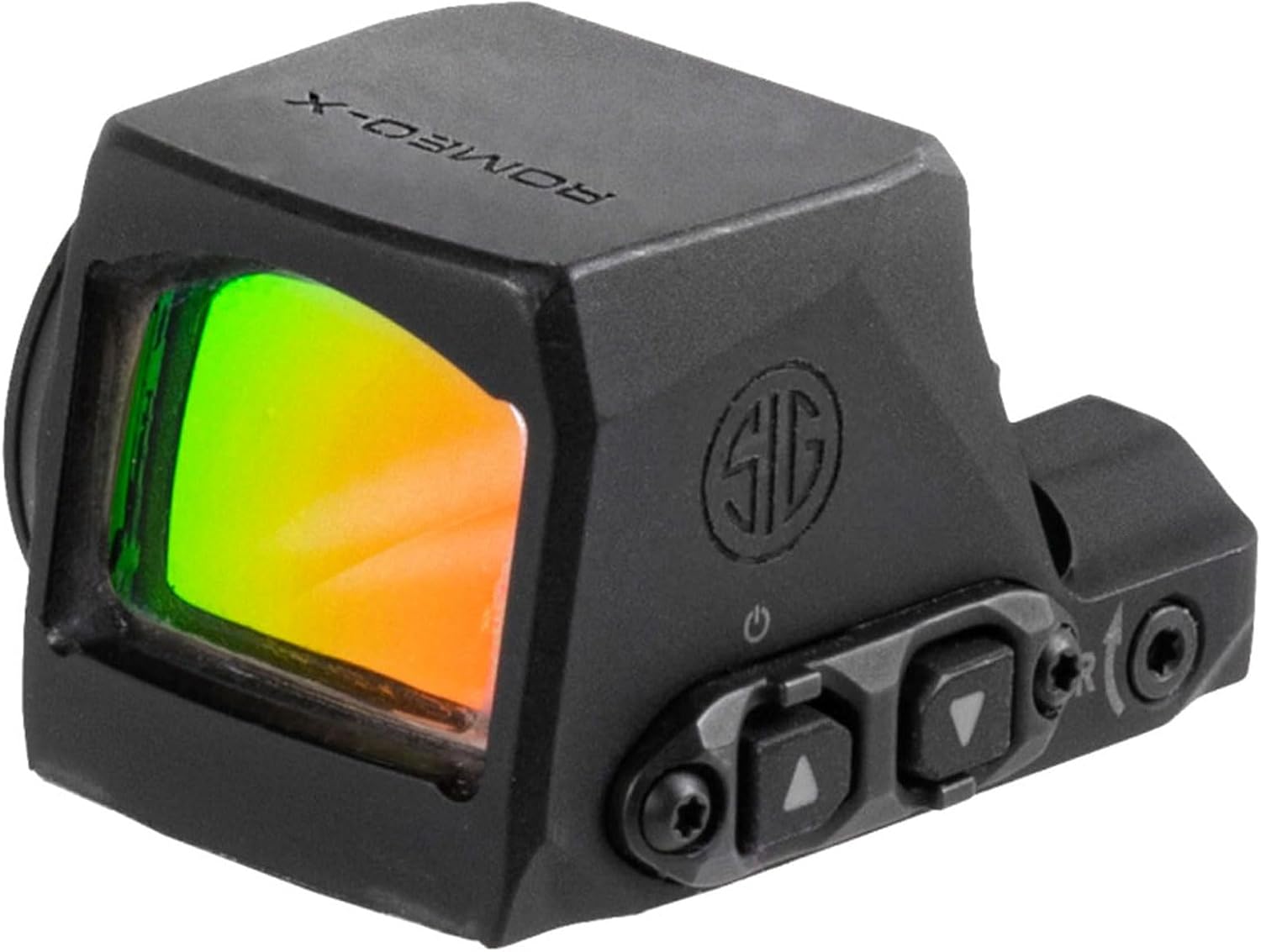
SIG’s ROMEO-X Compact is one of the most intelligently designed carry optics released recently. Its biggest advantage is extremely low deck height combined with excellent ergonomics.
- Footprint: RMSc
- Dot: 2 MOA
- Battery: Side-load CR1632
- Housing: CNC aluminum
- Brightness levels: 15
- Rear sight notch integrated
Pros
- Extremely low mounting position
- Excellent backup sight integration
- Clear glass
- Strong controls
- Slim profile
Cons
- Premium pricing
- Smaller aftermarket ecosystem
- Battery life lower than Holosun
The ROMEO-X Compact sits unusually low on the Glock 43X MOS, which dramatically improves natural point-of-aim during presentations. The integrated rear notch is also surprisingly useful if the optic ever fails.
I noticed very little perceived deck height increase compared with irons-only shooting. That translates into faster tracking during recoil because the dot returns naturally into the viewing window.
The glass quality is excellent with minimal blue tint. There is slight distortion at extreme window edges, but the center remains clean and sharp. The emitter is recessed well enough that occlusion from debris is less severe than many older open designs.
Button feel is one of the best I tested. Even while wearing gloves, brightness changes felt precise and deliberate.
The biggest tradeoff is ecosystem maturity. Holosun still dominates the slimline MOS market in terms of aftermarket support and long-term community feedback.
Still, shooters wanting a lower mounting setup without sacrificing durability should seriously consider the ROMEO-X Compact.
Direct mounting is simple because the optic was designed specifically around slim concealed-carry footprints.
➡️➡️➡️ Explore User Feedback and Current Pricing on Amazon
Vortex Defender CCW

The Defender CCW is one of the strongest value-oriented carry optics currently available. Vortex designed it specifically around concealed-carry pistols rather than adapting a larger competition optic.
- Footprint: RMSc
- Dot size: 3 MOA
- Battery: CR1632 top-load
- Brightness: 10 daylight settings
- Housing: Aluminum
- Waterproof: Yes
Pros
- Excellent price-to-performance ratio
- Top-load battery
- Large viewing window
- Good warranty support
- Easy controls
Cons
- Battery life shorter than premium optics
- Slightly thicker frame
- Brightness buttons softer
The Defender CCW surprised me with how usable the window feels during rapid target transitions. The optic body is slightly larger than minimalist carry dots, but the extra window area improves presentation speed.
The top-load battery system is genuinely useful. I prefer not removing optics from carry guns unless necessary, and this design simplifies maintenance considerably.
Parallax shift is acceptable at practical handgun distances. There is slightly more edge distortion than premium enclosed optics, but center-dot clarity remains solid.
Under recoil, the optic tracked consistently even with heavier defensive ammunition. I also noticed that the glass coating handles bright outdoor lighting reasonably well despite the lower price point.
Online users generally praise the Defender CCW for delivering reliable carry performance without entering premium price territory. The warranty support also gives newer shooters confidence.
The optic mounts directly to many Glock 43X MOS configurations using RMSc-compatible interfaces, making installation straightforward for most users.
➡️➡️➡️ Explore User Feedback and Current Pricing on Amazon
Shield Sights RMSc

The RMSc deserves recognition because it effectively established the slimline micro-optic category that many competitors now follow. Its ultra-thin design still works extremely well on the Glock 43X.
- Footprint: RMSc
- Dot sizes: 4 MOA or 8 MOA
- Battery: CR2032
- Housing: Polymer/aluminum
- Weight: Extremely light
- Auto brightness: Yes
Pros
- Extremely lightweight
- Lowest-profile feel
- Natural presentation
- Good concealment profile
- Direct MOS compatibility
Cons
- Auto brightness limitations
- Less rugged than premium rivals
- Smaller controls
The RMSc excels when concealment is the highest priority. Its slim dimensions keep the Glock 43X feeling close to stock, which many appendix carriers appreciate.
Because the optic sits very low, co-witnessing is easy even with standard-height sights. That low deck height also improves dot acquisition during fast draw strokes because the presentation angle feels more natural.
The optic is not as rugged as enclosed premium designs like the EPS Carry, and I would not choose it for hard-duty applications. However, for lightweight concealed carry, it still performs well.
The glass remains relatively clear with minimal tint, although brightness automation occasionally struggles in mixed lighting environments. I also found the controls smaller and less tactile compared with newer optics.
Online discussions are divided. Some shooters love the lightweight minimalist profile, while others prefer newer enclosed designs with improved durability and battery systems.
For shooters prioritizing concealment and direct compatibility over maximum ruggedness, the RMSc still makes sense in 2026.
➡️➡️➡️ Explore User Feedback and Current Pricing on Amazon
How I Tested / Evaluation Criteria
Parallax
I evaluated parallax by intentionally shifting eye position during slow-fire groups from 7 to 25 yards. Most modern optics control parallax reasonably well at defensive distances, but cheaper optics often show visible edge shift. The best performers maintained consistent impact even during imperfect sight alignment.
Co-Witness & Deck Height
Deck height matters more on slim carry guns than full-size pistols because excessive optic height changes presentation angles. I specifically looked for optics that preserve natural draw mechanics while still allowing usable backup irons.
Durability
I paid close attention to housing rigidity, recoil resistance, sealing, and screw retention. Thin-frame pistols generate surprisingly violent slide velocity relative to their size, and weak optics tend to lose zero faster than on larger guns.
Battery System
Side-load and top-load battery systems received higher marks because they avoid optic removal during replacement. I also evaluated battery cap design since poorly machined caps are a common failure point on budget optics.
Brightness Range
Carry optics must remain visible in bright daylight without excessive bloom indoors. I tested outdoor visibility in direct sunlight along with low-light usability inside covered ranges.
Glass Quality
I checked for lens tint, edge distortion, window clarity, and emitter reflection. Excessive blue tint or fisheye distortion can slow target acquisition during movement.
Controls Ergonomics
Button tactility matters more than many shooters realize. Mushy controls become frustrating with gloves or sweaty hands, especially during rapid brightness adjustments.
Mounting Ecosystem
The Glock 43X MOS remains somewhat restrictive because of its slimline footprint. Optics that mount directly or require minimal modification earned higher scores than systems dependent on tall adapter plates.
How to Choose the Right Red Dot for This Gun
Choosing an optic for the Glock 43X is very different from selecting one for a full-size duty pistol. The gun itself is thin, lightweight, and designed primarily for concealed carry. That means the optic has to complement the platform rather than overpower it.
The first thing I recommend checking is footprint compatibility. The Glock 43X MOS uses a modified RMSc-style footprint, but not every optic fits directly without modification. Some K-footprint optics require shortened recoil lugs or adapter plates. Others, like the RMRcc, require proprietary mounting solutions entirely.
Second, consider optic size carefully. Large windows are attractive on paper, but oversized housings increase printing during concealed carry. Slim optics that track naturally during recoil usually feel better on the 43X platform than bulky competition-oriented designs.
Enclosed emitters are becoming increasingly popular for concealed carry because they resist lint, moisture, and sweat better than open emitters. If you carry daily in humid climates or frequently train outdoors, enclosed systems like the EPS Carry provide meaningful advantages.
Battery placement also matters. Bottom-loading batteries are not necessarily deal-breakers, but removing the optic to replace batteries increases the risk of losing zero or damaging screws over time.
Co-witness height should also influence your decision. Extremely tall optics can force awkward presentation angles and require suppressor-height irons that may reduce concealment comfort.
I also suggest paying attention to button placement and brightness controls. Some optics become frustrating to adjust under stress or while wearing gloves.
Finally, think honestly about your use case. A dedicated range gun may benefit from a larger window, while a true everyday-carry pistol often benefits more from compact dimensions, low deck height, and reliability under adverse conditions.
FAQs
Does the Glock 43X MOS need an adapter plate?
Some optics mount directly, while others require plates or slight recoil lug modifications. RMSc-compatible optics are generally the easiest fit.
Are enclosed emitters worth it for concealed carry?
Yes. Enclosed emitters resist lint, sweat, and debris much better than open designs, especially during daily appendix carry.
What is the best co-witness height for a Glock 43X optic?
Lower-third co-witness setups usually offer the best balance between visibility and concealment.
Is the Holosun K footprint the same as RMSc?
Not exactly. They are similar, but some Glock 43X MOS slides require modification or specific plates for proper fitment.
What dot size works best for concealed carry?
I generally prefer 2–3.25 MOA dots because they balance precision with rapid acquisition.
Conclusion
The best red dot for Glock 43x ultimately depends on whether you prioritize concealment, durability, enclosed protection, or mounting simplicity. For most shooters, the Holosun EPS Carry currently offers the best overall balance of reliability, carry practicality, and mounting efficiency on the Glock 43X MOS platform.
However, the Trijicon RMRcc still dominates in raw durability, while the 507K remains one of the strongest values available. Shooters wanting the lowest possible deck height should also take a serious look at the SIG ROMEO-X Compact.
No matter which optic you choose, mounting quality and proper zeroing matter just as much as the optic itself.
Sources referenced include manufacturer specifications, mounting footprint references, long-term user discussions, and carry-focused optic testing communities.
Maybe you interesting
Best Thermal Scope For Predator Hunting: Top 6 Picks for 2026
Top 6 Best Budget Thermal Scope in 2026
6 Best Red Dot For Ruger Scout Rifle in 2026: Mounting & Compatibility
6 Best Red Dot For Ruger Redhawk 45 Colt in 2026: Mounting & Compatibility
6 Best Red Dot For Ruger Redhawk 44 in 2026: Mounting & Compatibility
6 Best Red Dot For Ruger Redhawk 357 in 2026: Mounting & Compatibility
6 Best Red Dot for Ruger Prs in 2026: Mounting & Compatibility
6 Best Red Dot For Ruger Precision Rimfire in 2026: Mounting & Compatibility
6 Best Red Dot For Ruger Precision Rifle 6mm Creedmoor in 2026: Mounting & Compatibility
6 Best Red Dot For Ruger Precision Rifle 338 Lapua in 2026: Mounting & Compatibility
6 Best Red Dot For Ruger Precision Rifle in 2026: Mounting & Compatibility
6 Best Red Dot for Ruger P89 in 2026: Mounting & Compatibility