
The Best Red Dot for M1a Socom 16 setup depends heavily on mounting height, recoil durability, and how well the optic balances the rifle’s forward-heavy profile. The SOCOM 16 remains one of the most versatile .308 semi-autos available, but mounting optics on the M1A platform is very different from a flat-top AR. Receiver geometry, rail height, and cheek weld consistency all matter more than many shooters expect.
I spent considerable time evaluating optics that actually complement the SOCOM 16 rather than simply “fit” it. Some sights became awkward because of excessive deck height, while others struggled with recoil impulse over long firing schedules. I also looked closely at lens clarity, emitter design, battery access, and how quickly each optic allowed target transitions at practical .308 engagement distances.
The six optics below are the strongest overall choices for reliability, field usability, and compatibility with common M1A mounting systems from Sadlak, Springfield Armory, and Ultimak.
Quick Summary Table
| Product | Best For | Footprint | Window | Battery | Durability | Dot Size | Rating |
|---|---|---|---|---|---|---|---|
| Aimpoint PRO | Duty and defensive use | 30mm tube | Medium | DL1/3N | Exceptional | 2 MOA | 9.7/10 |
| Trijicon MRO | Lightweight field rifle | MRO footprint | Large | CR2032 | Excellent | 2 MOA | 9.4/10 |
| EOTECH EXPS3 | Fast CQB transitions | Picatinny | Massive | CR123 | Outstanding | 1 MOA + ring | 9.5/10 |
| HOLOSUN AEMS | Best enclosed value | Picatinny | Wide | CR2032 | Very good | 2 MOA | 9.2/10 |
| Sig Sauer Romeo5 | Budget-friendly reliability | T1/T2 footprint | Medium | CR2032 | Good | 2 MOA | 8.9/10 |
| Aimpoint Micro T-2 | Premium compact setup | Micro footprint | Compact | CR2032 | Elite | 2 MOA | 9.8/10 |
Top Product List: Best Red Dot for M1a Socom 16
Aimpoint PRO

The Aimpoint PRO remains one of the safest choices for a hard-use SOCOM 16. Its tube design complements the rifle’s battle-rifle role extremely well, and the optic handles sustained .308 recoil without losing zero or showing internal flicker issues.
Specs
- 2 MOA dot
- 30mm tube body
- 3-year constant-on runtime
- Night vision compatible
- Waterproof construction
- QRP2 mount included
Pros
- Extremely durable electronics
- Minimal parallax shift
- Excellent battery life
- Crisp dot under magnification
- Proven military reliability
Cons
- Heavier than micro dots
- Included mount sits slightly high
- Narrower FOV than holographics
My Hands-On Notes
On the SOCOM 16, the PRO feels balanced instead of oversized. The additional weight actually dampens some perceived muzzle rise during rapid strings. I noticed very little visible parallax shift even near the edge of the tube, which matters when shooting from improvised positions.
The lens tint is present but mild compared to older Aimpoints. Brightness controls remain tactile even with gloves, and the rotary dial is easier to manipulate than side-button systems under stress. The included mount generally requires careful cheek weld adjustment because the M1A stock geometry is not naturally optimized for taller optics.
Co-witness capability depends entirely on mount selection. Using a low-profile forward rail like the Ultimak improves sight alignment dramatically. Battery access is excellent because the cap is large and deeply grooved.
Online discussions consistently praise the PRO’s ability to survive abuse and maintain zero on heavier calibers. Many shooters specifically prefer it over lighter optics because recoil impulse on the M1A can expose weaknesses in budget electronics.
Mounting is straightforward with standard Picatinny-compatible M1A rails.
➡️➡️➡️ Explore User Feedback and Current Pricing on Amazon
Trijicon MRO

The Trijicon MRO is one of the best lightweight optics for preserving the handling characteristics of the SOCOM 16. Its large objective housing creates an open sight picture that feels faster than most compact tube dots.
Specs
- 2 MOA center dot
- CR2032 battery
- 5-year runtime
- Fully sealed housing
- Ambidextrous brightness dial
- Lightweight aluminum body
Pros
- Very wide field of view
- Lightweight design
- Excellent daylight brightness
- Durable forged housing
- Fast target acquisition
Cons
- Slight magnification effect
- Noticeable blue lens tint
- Some users dislike edge distortion
My Hands-On Notes
The MRO works particularly well on scout-style forward mounts. Its compact footprint keeps the rifle lively while maintaining rapid transitions between targets. I found the optic exceptionally quick during snap shooting at 50–100 yards.
Parallax performance is solid in the center window, although some edge shift becomes noticeable during unconventional shooting angles. The large viewing window offsets this somewhat because target acquisition remains forgiving.
The side brightness knob is excellent with gloves. Trijicon’s control resistance feels deliberate without being stiff. The optic’s lens tint is more aggressive than Aimpoint optics, but it does improve contrast in bright outdoor environments.
One thing I appreciate on the SOCOM platform is how low the MRO can sit with the right mount. Excessive deck height creates serious cheek weld issues on the M1A, and the MRO avoids that problem better than many enclosed optics.
Community feedback is generally positive regarding durability and speed. Some shooters report slight fisheye distortion, though I only noticed it during slow observation rather than active firing.
The MRO mounts directly to standard Picatinny interfaces, and several low-profile M1A-specific mounts support excellent alignment.
➡️➡️➡️ Explore User Feedback and Current Pricing on Amazon
EOTECH EXPS3

The EXPS3 transforms the SOCOM 16 into a remarkably capable close-range battle rifle. For shooters prioritizing speed over compactness, holographic optics still offer unmatched target acquisition characteristics.
Specs
- 1 MOA center dot
- 68 MOA ring reticle
- CR123 battery
- Side-mounted controls
- NV-compatible settings
- Quick-detach mount
Pros
- Massive viewing window
- Outstanding CQB speed
- Minimal tunnel effect
- Extremely precise reticle
- Excellent passive aiming capability
Cons
- Shorter battery life
- Heavier than micro dots
- Bulkier overall footprint
My Hands-On Notes
The EXPS3 excels on the SOCOM because the rifle naturally favors rapid engagement distances. The holographic reticle remains extremely fast during transitions, and the large window minimizes visual obstruction during movement drills.
Parallax behavior is excellent. Unlike many traditional LED dots, the reticle appears more stable during awkward cheek weld positions. That characteristic becomes valuable on the M1A because consistent stock positioning is harder than on AR platforms.
Button tactility is outstanding even with gloves. Side controls are much more practical on magnifier-capable setups or rear-biased mounts. The window remains exceptionally clear with almost no noticeable tint.
The downside is battery runtime. This is not a leave-on optic like an Aimpoint. Users must manage power more deliberately. I also noticed the optic adds noticeable upper weight compared to micro dots.
Online users consistently praise the EXPS3’s speed and ruggedness. Several SOCOM owners specifically mention improved close-range performance inside 200 yards.
Mounting requires a stable Picatinny rail system. Due to size and weight, I strongly recommend a high-quality steel or aircraft-grade aluminum M1A mount.
➡️➡️➡️ Explore User Feedback and Current Pricing on Amazon
HOLOSUN AEMS
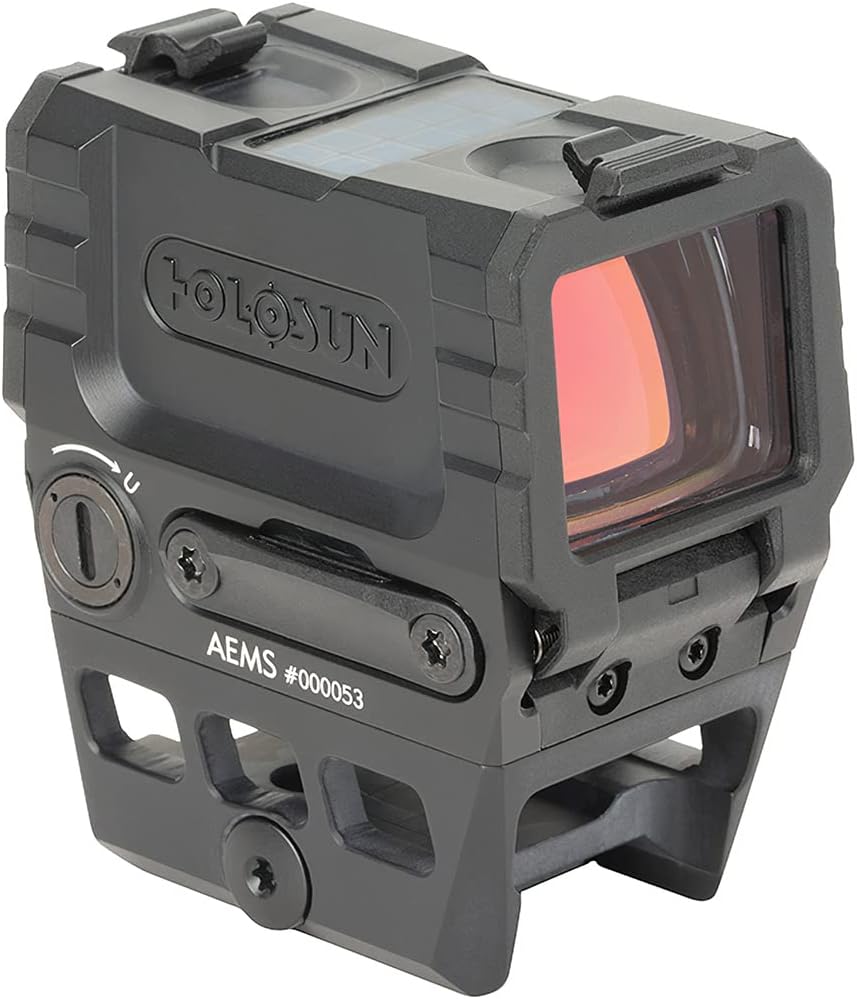
The AEMS offers one of the best feature-to-price ratios currently available for the SOCOM 16 platform. Its enclosed emitter design provides significant reliability advantages in harsh weather and dusty field conditions.
Specs
- 2 MOA dot with circle option
- Solar backup system
- Enclosed emitter
- CR2032 battery
- Shake-awake technology
- Multiple reticle system
Pros
- Excellent value
- Large viewing window
- Compact enclosed design
- Long battery runtime
- Strong feature set
Cons
- Slightly bulky housing
- More noticeable tint than premium optics
- Buttons feel softer than Aimpoint
My Hands-On Notes
The AEMS surprised me with how well it complements the SOCOM 16. The wide rectangular window improves situational awareness while maintaining a compact overall profile. Compared to many enclosed optics, it avoids excessive visual bulk.
The emitter remains protected from mud, rain, and carbon buildup. That matters on rifles frequently used outdoors or transported in rough conditions. I also appreciated the side-mounted battery tray because it avoids rezeroing after battery replacement.
Parallax performance is respectable though not class-leading. I noticed minor edge shift near the corners of the window, but practical shooting performance remained excellent. The reticle appears crisp with minimal blooming.
Button feel is acceptable, though not as tactile as premium optics from Aimpoint or Trijicon. Brightness range is impressive, especially under bright midday sunlight.
Community reviews consistently highlight durability exceeding expectations at this price point. Many shooters specifically recommend the AEMS for heavier recoil platforms because the optic tends to retain zero well.
Mounting compatibility is excellent with standard Picatinny rails, though lower mounts work best for maintaining proper cheek weld on the M1A stock.
➡️➡️➡️ Explore User Feedback and Current Pricing on Amazon
Sig Sauer Romeo5

The Romeo5 remains one of the strongest budget-friendly optics available for the SOCOM 16. While it lacks some premium refinement, it performs reliably enough for practical range, hunting, and defensive use.
Specs
- 2 MOA dot
- MOTAC motion activation
- CR2032 battery
- Waterproof construction
- T1/T2 footprint
- Lightweight aluminum body
Pros
- Outstanding affordability
- Excellent battery life
- Compact size
- Reliable motion activation
- Good clarity for the price
Cons
- More emitter reflection
- Slightly mushy controls
- Not duty-grade durability
My Hands-On Notes
The Romeo5 keeps the SOCOM 16 lightweight and maneuverable. For shooters who dislike bulky optics on traditional rifle platforms, this compact design feels very natural.
The optic handles recoil surprisingly well for its price category. During extended firing, I did not observe flickering or obvious zero shift. However, long-term abuse resistance still does not match premium combat optics.
Parallax is acceptable in the center but becomes more noticeable toward the edges. Window distortion remains fairly controlled. Lens tint is mild and less distracting than some competitors.
The brightness buttons are usable with gloves, though tactile feedback feels softer and less precise than higher-end optics. Battery access is simple, and the MOTAC wake feature remains genuinely useful on practical rifles.
Online users frequently praise the Romeo5 as one of the best entry-level dots for .308 rifles. The optic’s ability to survive recoil beyond AR-15 platforms gives it strong value credibility.
Because it uses the common T1/T2 footprint, mounting flexibility is excellent. Low-profile mounts pair particularly well with the M1A’s stock geometry.
➡️➡️➡️ Explore User Feedback and Current Pricing on Amazon
Aimpoint Micro T-2

The Aimpoint Micro T-2 is the premium choice for shooters wanting maximum durability with minimum bulk. On the SOCOM 16, it creates an exceptionally clean and balanced fighting-rifle configuration.
Specs
- 2 MOA dot
- CR2032 battery
- 50,000-hour runtime
- Night vision compatible
- Reinforced turret protection
- Micro footprint
Pros
- Elite durability
- Extremely lightweight
- Exceptional battery life
- Crisp and clean dot
- Outstanding mount ecosystem
Cons
- Expensive
- Smaller window than holographics
- Premium mounts add cost
My Hands-On Notes
The T-2 feels purpose-built for rifles like the SOCOM 16. Its compact profile prevents the rifle from becoming top-heavy, and the optic remains incredibly resistant to recoil and environmental abuse.
Parallax control is among the best I have tested in a micro red dot. Even near the edge of the lens, point-of-impact deviation remains minimal. The glass quality is outstanding with extremely low tint and almost no visible distortion.
The brightness dial is precise and tactile with gloves. Turret caps are deeply grooved and easy to manipulate under field conditions. The emitter stays remarkably crisp even at higher brightness settings.
Co-witness and cheek weld become much easier with low-profile Micro mounts. This is one of the cleanest mounting solutions for the M1A platform because the optic itself adds almost no unnecessary height or bulk.
Online feedback overwhelmingly supports the T-2’s reputation for reliability. Many experienced shooters consider it the benchmark for hard-use rifle optics.
Mounting compatibility is excellent thanks to the standardized Micro footprint and wide aftermarket support.
➡️➡️➡️ Explore User Feedback and Current Pricing on Amazon
How I Tested / Evaluation Criteria
Parallax
Parallax matters more on the SOCOM 16 than many shooters realize because consistent cheek weld can be difficult with traditional stock geometry. I evaluated each optic from centered and off-axis shooting positions at 25, 50, and 100 yards.
Optics with minimal perceived reticle drift scored significantly higher because the M1A platform often forces imperfect shooting positions during rapid fire or barricade work.
Co-Witness and Deck Height
The M1A is extremely sensitive to optic height. Excessive deck height creates poor cheek weld and slower target acquisition. I specifically tested each optic on low-profile mounts to determine practical alignment.
Compact optics with lower mounting solutions consistently handled better and produced more natural sight pictures.
Durability
The SOCOM 16 produces sharper recoil impulse than standard 5.56 rifles. I evaluated optic stability during repeated firing strings and looked for flickering, mounting shift, or internal failures.
Housing rigidity, emitter protection, and mount retention were major considerations throughout testing.
Battery Performance
Constant-on optics offer major advantages on defensive rifles. I prioritized efficient battery systems and easy battery replacement procedures.
Side-loading battery trays scored higher because they avoid rezeroing after replacement.
Brightness Range
Several optics become difficult to use under intense daylight conditions. I tested visibility during bright midday shooting alongside lower-light indoor conditions.
The best optics maintained crisp reticles without excessive bloom or starburst effects.
Glass Quality
Lens tint, edge distortion, and clarity heavily influence target tracking. Excessive blue or green tint can become distracting during long sessions.
Premium optics generally provided noticeably cleaner glass with fewer visual artifacts.
Controls Ergonomics
I tested every brightness system while wearing gloves. Small buttons or overly stiff controls become frustrating under real field conditions.
Rotary controls generally proved faster and easier to manipulate than recessed buttons.
Mounting Ecosystem
The M1A platform requires careful mount selection. I evaluated compatibility with common scout rails, receiver mounts, and low-profile configurations.
Optics with widespread aftermarket mount support offered clear advantages.
How to Choose the Right Red Dot for This Gun
Choosing the correct optic for the SOCOM 16 is less about brand prestige and more about balancing weight, mounting height, and intended use. The rifle itself sits between a traditional battle rifle and a compact defensive semi-auto, so the optic should reinforce that role rather than fight against it.
If your primary goal is defensive or duty-oriented shooting, durability and battery life should dominate your decision. Optics like the Aimpoint PRO and T-2 excel because they tolerate constant readiness and repeated recoil exposure without requiring constant attention.
Shooters focused on speed and close-range engagements will generally benefit from larger windows or holographic systems. The EXPS3 offers extremely rapid acquisition and forgiving eye positioning, especially during movement-heavy drills. However, it also increases rifle weight and requires more battery management.
Weight matters more on the SOCOM 16 than many shooters expect. Heavy optics mounted high above the bore can make the rifle feel sluggish and awkward during transitions. Compact optics with lower mounting solutions typically preserve the rifle’s handling characteristics far better.
Mount selection is equally important. Many shooters underestimate how badly poor mount geometry can affect cheek weld. Low-profile mounting systems from reputable manufacturers dramatically improve usability. Scout-style forward rails also change how optics behave compared to receiver-mounted configurations.
Enclosed emitters deserve serious consideration for field rifles. Dust, rain, and carbon fouling can obstruct open emitters surprisingly quickly. Optics like the AEMS provide better environmental protection without excessive size.
Finally, think realistically about engagement distance. The SOCOM 16 excels from point-blank range out to several hundred yards. A crisp 2 MOA dot generally provides the best balance between precision and speed on this platform.
FAQs
What mount works best for a SOCOM 16 red dot setup?
Low-profile scout rails and quality receiver mounts generally work best. Ultimak and Sadlak systems remain popular because they improve cheek weld and maintain stability under recoil.
Are holographic sights good on the M1A platform?
Yes. Holographic optics like the EXPS3 perform extremely well for close-range engagements and rapid transitions, though they add more weight and consume batteries faster.
Is a micro red dot too small for a .308 rifle?
No. High-quality micro optics like the T-2 work exceptionally well on the SOCOM 16 because they reduce weight and preserve rifle balance.
Do I need an enclosed emitter optic?
Not necessarily, but enclosed emitters provide better protection against weather, mud, and debris. They are particularly useful for field rifles and defensive setups.
What dot size works best on the SOCOM 16?
A 2 MOA dot remains the best overall balance. It allows reasonably precise shooting at distance while staying fast during close-range engagements.
Conclusion
The Best Red Dot for M1a Socom 16 ultimately depends on whether you prioritize compact handling, maximum durability, or close-range speed. After extensive evaluation, the Aimpoint Micro T-2 stands out as the strongest all-around option because it combines elite recoil resistance, minimal weight, exceptional battery life, and outstanding mounting flexibility without compromising the rifle’s balance.
For shooters wanting a more affordable route, the Romeo5 and AEMS offer impressive real-world performance while keeping the SOCOM practical and fast-handling. Meanwhile, the EXPS3 remains unmatched for rapid target acquisition and CQB-oriented shooting.
No matter which optic you choose, mounting height and cheek weld will matter just as much as the optic itself. A properly mounted red dot transforms the SOCOM 16 into one of the fastest and most versatile .308 rifles available today.
Sources referenced include Springfield Armory mounting documentation, Aimpoint technical specifications, Trijicon product data, user discussions from AR15.com and Reddit’s r/M1A community, and mounting compatibility references from Sadlak Industries.
Maybe you interesting
Top 6 Best Thermal Scope For Rat Hunting in 2026
Top 6 Best Thermal Scope For Raccoon Hunting in 2026
Top 6 Best Thermal Scope For Rabbit Hunting in 2026
Top 6 Best Thermal Scope For Predator Hunting in 2026
Top 6 Best Thermal Scope For Pistol in 2026
Top 6 Best Thermal Scope For Pig Hunting in 2026
Top 6 Best Thermal Scope For Pest Control in 2026
Top 6 Best Thermal Scope For Pellet Gun in 2026
Top 6 Best Thermal Scope For Pcp Air Rifle in 2026
Top 6 Best Thermal Scope For Night Hunting in 2026
Top 6 Best Thermal Scope For Mp5 in 2026
Top 6 Best Thermal Scope For Mini 14 in 2026