
The Best Red Dot for Sig Mpx K setup is not just about picking the optic with the clearest glass or longest battery life. The MPX K is a compact, fast-handling PCC with very little recoil impulse, a low rail height, and enough accuracy to stretch a 9mm cartridge farther than most shooters expect. That changes what matters in a red dot. Window size, mount height, emitter protection, and footprint compatibility all affect how natural the gun feels during rapid strings or awkward transitions around barricades.
I spent time evaluating optics that actually complement the MPX K’s balance rather than overwhelm it. Some optics excel at maintaining a low cheek weld. Others provide superior field of view for CQB work. A few are nearly indestructible but slightly compromise peripheral visibility. The following six optics stand out because they match the MPX K’s strengths while avoiding the common mistakes that make compact PCCs feel clumsy or top-heavy.
Quick Summary Table
| Product | Best For | Footprint | Window | Battery | Durability | Dot Size | Rating |
|---|---|---|---|---|---|---|---|
| Aimpoint Micro T-2 | Duty / Professional Use | Micro | Medium | 50,000 hrs | Exceptional | 2 MOA | 9.8/10 |
| Holosun AEMS | Wide FOV & Fast Shooting | AEMS | Large | 50,000 hrs | Excellent | 2 MOA Circle Dot | 9.6/10 |
| Sig Sauer Romeo4T-Pro | Multi-Reticle Versatility | Micro | Medium | 100,000 hrs | Excellent | 2 MOA / Circle | 9.5/10 |
| Trijicon MRO HD | Lightweight Speed | MRO | Large | 2.5 years | Very Good | 2 MOA / Circle | 9.3/10 |
| Aimpoint ACRO P-2 | Enclosed Duty Optic | Acro | Compact | 50,000 hrs | Outstanding | 3.5 MOA | 9.4/10 |
| EOTECH EXPS3 | CQB & Astigmatism | Integrated QD | Massive | 1,000 hrs | Excellent | 68 MOA Ring / 1 MOA Dot | 9.2/10 |
Top Product List: Best Red Dot for Sig Mpx K
Aimpoint Micro T-2

The Aimpoint Micro T-2 remains the benchmark for compact PCC optics because it balances durability, optical clarity, and mounting flexibility better than almost anything else on the market. On the MPX K, it feels proportionally correct instead of oversized.
Specs:
- 2 MOA dot
- 50,000-hour battery life
- Night vision compatible
- Aimpoint Micro footprint
- Weight: 3 oz
Pros:
- Outstanding battery longevity
- Minimal parallax shift
- Excellent mount ecosystem
- Extremely rugged housing
Cons:
- Expensive
- Smaller window than modern enclosed optics
My hands-on notes:
The T-2 sits perfectly on the MPX K when paired with a low Scalarworks or Unity mount. I noticed virtually no perceptible parallax inside 50 yards, even during unconventional shoulder transitions. The glass has only a faint tint compared to many competing Micro-style optics, and there is almost no edge distortion.
Button tactility is excellent even while wearing gloves. The brightness dial offers enough resistance to avoid accidental movement but remains easy to manipulate under stress. Recoil handling is effectively irrelevant because the optic shrugs off the MPX’s soft impulse with ease.
The tube-style design slightly narrows peripheral visibility compared to an AEMS or EXPS3, but it also keeps the optic lightweight and balanced. Co-witness options are excellent because the Micro footprint has enormous aftermarket support.
What people say online:
Professional users consistently describe the T-2 as “bombproof.” Reddit and Sniper’s Hide discussions frequently mention that it simply works for years without requiring attention. Many MPX owners specifically prefer it because the compact tube does not disrupt the gun’s handling characteristics.
Mounting clarity:
Uses the standard Aimpoint Micro footprint. The MPX K’s full Picatinny top rail makes mounting extremely easy with countless riser options.
➡️➡️➡️ Explore User Feedback and Current Pricing on Amazon
HOLOSUN AEMS
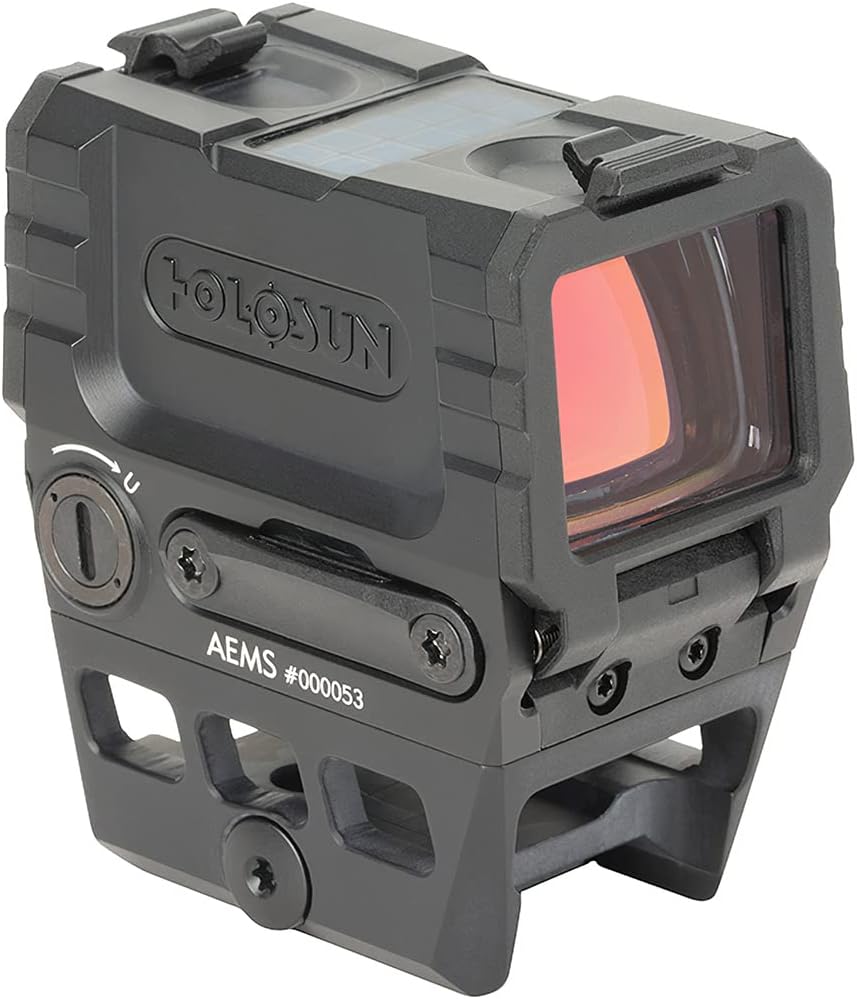
The AEMS delivers one of the best field-of-view experiences available for a compact PCC. It combines enclosed-emitter reliability with a window size that feels much larger than its footprint suggests.
Specs:
- 2 MOA dot with 65 MOA circle
- 50,000-hour battery life
- Solar backup
- Shake Awake technology
- Weight: 3.9 oz
Pros:
- Huge viewing window
- Excellent value
- Multiple reticle system
- Compact enclosed design
Cons:
- Slight fisheye effect at edges
- Lens tint more noticeable than Aimpoint
My hands-on notes:
On the MPX K, the AEMS feels extremely fast. The wide window makes target transitions effortless during close-range drills. The 65 MOA ring works exceptionally well on PCCs because it naturally centers your eye during aggressive movement.
The emitter remains fully protected from rain or debris, which matters more on a defensive PCC than many people realize. The side battery tray is also a major advantage because you can swap batteries without removing the optic or disturbing zero.
I noticed mild edge distortion at the extreme outer corners of the lens, but it never became distracting during live fire. The controls are glove-friendly and easy to locate by feel. Brightness adjustment responsiveness is excellent, and the optic reaches daylight-bright settings quickly.
The AEMS sits slightly higher than some traditional Micros, so lower mounts usually provide the best cheek weld on the MPX K platform.
What people say online:
Most PCC shooters praise the AEMS for offering an EOTECH-like viewing experience in a much smaller package. Online discussions frequently compare it favorably against more expensive enclosed emitters due to its balance of size, weight, and speed.
Mounting clarity:
Uses Holosun’s proprietary AEMS mount system but includes a Picatinny mount. Aftermarket low-profile mounts are widely available.
➡️➡️➡️ Explore User Feedback and Current Pricing on Amazon
Sig Sauer Romeo4T-Pro

The Romeo4T-Pro is one of the most versatile optics available for the MPX K because it combines military-grade durability with flexible reticle options and exceptional battery life.
Specs:
- 2 MOA dot / Circle Dot
- 100,000-hour battery life
- Solar-assisted illumination
- MOTAC activation
- Micro footprint
Pros:
- Outstanding battery performance
- Extremely clear glass
- Multiple reticle choices
- Durable 7075 housing
Cons:
- Slightly heavier than T-2
- Reticle can feel cluttered for precision work
My hands-on notes:
The Romeo4T-Pro pairs naturally with the MPX K because it preserves the gun’s compact handling while offering more reticle flexibility than most Micro optics. I particularly liked the circle-dot configuration during movement drills because it accelerated target acquisition without overwhelming the sight picture.
Lens clarity is surprisingly good. The tint is lighter than most Holosun optics, and there is very little visible distortion near the edges. The emitter remains crisp even at maximum brightness settings.
The brightness buttons provide a pronounced tactile click, which is important during low-light adjustments with gloves. I also appreciate the battery compartment design because it seals tightly without feeling fragile.
Parallax performance is extremely good inside realistic PCC distances. The optic also tracks cleanly during recoil impulse, making follow-up shots very fast.
What people say online:
The Romeo4T series has developed a strong reputation among professional users and PCC shooters because it blends Aimpoint-level durability with modern reticle flexibility. Many owners specifically highlight the glass quality and MOTAC responsiveness.
Mounting clarity:
Uses the Aimpoint Micro footprint, giving you access to nearly every major MPX-compatible mount on the market.
➡️➡️➡️ Explore User Feedback and Current Pricing on Amazon
Trijicon MRO HD

The MRO HD remains a favorite for shooters who want a larger viewing area without stepping into full holographic sight territory.
Specs:
- 2 MOA dot / Circle reticle
- 2.5-year battery life
- Top-mounted controls
- MRO footprint
- Weight: 4.1 oz
Pros:
- Large field of view
- Lightweight design
- Excellent durability
- Ambidextrous brightness dial
Cons:
- Slight magnification effect
- Blue tint more noticeable than competitors
My hands-on notes:
The MRO feels extremely natural on the MPX K because the larger objective lens reduces the “tube effect” common with Micro optics. During rapid strings, the dot remains easy to track even when shooting from awkward positions.
The top-mounted brightness dial is one of my favorite control systems because it remains accessible from either side of the gun. The tactile stops between brightness settings also make quick adjustments intuitive under pressure.
The lens does show a mild blue tint and slight magnification effect. Sensitive shooters will notice it immediately. However, within realistic PCC distances, it does not meaningfully affect performance.
The MRO’s lightweight construction helps preserve the MPX K’s excellent balance. It also maintains a lower overall profile than many enclosed optics.
What people say online:
Shooters consistently praise the MRO’s field of view and speed. Debate usually centers around the mild magnification effect, but most PCC users agree it becomes irrelevant during practical shooting distances.
Mounting clarity:
Requires an MRO-specific mount. Low mounts generally provide the best cheek weld on the MPX K.
➡️➡️➡️ Explore User Feedback and Current Pricing on Amazon
Aimpoint ACRO P-2

The ACRO P-2 is arguably the toughest enclosed-emitter optic currently available. For shooters prioritizing reliability above all else, it is difficult to beat.
Specs:
- 3.5 MOA dot
- 50,000-hour battery life
- Fully enclosed emitter
- Acro footprint
- Weight: 2.1 oz
Pros:
- Nearly indestructible
- Fully sealed optical channel
- Excellent button feel
- Minimal parallax shift
Cons:
- Smaller window
- Requires dedicated mount system
My hands-on notes:
The ACRO P-2 feels incredibly solid on the MPX K. The housing design protects the emitter from mud, water, and carbon fouling, making it ideal for hard-use defensive setups.
The smaller window does require slightly more discipline during presentation compared to an AEMS or EXPS3. However, once acquired, the dot tracks exceptionally cleanly during recoil transitions.
Button tactility is outstanding. Even with gloves, the controls produce a very distinct click. The lens tint is minimal, and distortion is almost nonexistent. I also noticed extremely consistent brightness performance across the adjustment range.
Deck height is higher than traditional open emitters, so achieving a comfortable co-witness may require careful mount selection.
What people say online:
The ACRO P-2 is widely praised for its ruggedness and reliability. Most shooters accept the smaller window as a fair trade-off for enclosed durability.
Mounting clarity:
Uses the Acro footprint. Requires an Acro-compatible Picatinny mount or riser.
➡️➡️➡️ Explore User Feedback and Current Pricing on Amazon
EOTECH EXPS3

The EXPS3 remains the king of fast CQB optics. While larger than the other options here, it offers unmatched target acquisition speed and outstanding compatibility for shooters with astigmatism.
Specs:
- 68 MOA ring with 1 MOA center dot
- Holographic reticle
- Integrated QD mount
- NV compatible
- Weight: 11.2 oz
Pros:
- Massive viewing window
- Excellent for astigmatism
- Fastest close-range acquisition
- Side buttons work well with magnifiers
Cons:
- Short battery life
- Heavier and bulkier
My hands-on notes:
The EXPS3 transforms the MPX K into an exceptionally fast close-range gun. The holographic reticle is incredibly intuitive during movement drills and transitions between multiple targets.
Unlike many LED optics, the reticle remains crisp for shooters with astigmatism. The side-mounted controls are also a huge advantage because they stay accessible even with magnifiers installed.
The optic is undeniably larger than Micro-style alternatives, and you feel the added weight on a compact PCC. However, the oversized window nearly eliminates any sensation of tunneling.
There is no noticeable emitter occlusion because of the holographic design, and the glass remains surprisingly clear despite the layered construction.
What people say online:
Many PCC enthusiasts still consider the EXPS3 the fastest optic available for sub-gun style shooting. Critics mainly point to battery life and bulk, but users who prioritize speed usually accept those compromises immediately.
Mounting clarity:
Integrated QD riser attaches directly to the MPX K Picatinny rail and provides a natural lower 1/3 co-witness height.
➡️➡️➡️ Explore User Feedback and Current Pricing on Amazon
How I Tested / Evaluation Criteria
Parallax
PCCs like the MPX K are often shot from unconventional positions, so parallax consistency matters more than many shooters assume. I evaluated each optic by firing from offset cheek welds and awkward barricade positions between 10 and 75 yards.
The Aimpoint optics consistently demonstrated the least apparent shift. Larger-window optics like the AEMS and EXPS3 felt more forgiving during rapid transitions, even if measurable parallax technically existed.
Co-Witness & Deck Height
The MPX K has a naturally comfortable rail height, but optics with excessive deck height can ruin the cheek weld. I specifically evaluated how naturally each optic aligned with both standard and lower-1/3 setups.
Micro-footprint optics generally provided the best balance. Taller enclosed systems sometimes required careful mount selection to avoid an awkward chin weld.
Durability
Although the MPX K has soft recoil, PCC optics still experience repetitive bolt impulse and vibration. I paid close attention to housing rigidity, lens protection, and mounting stability.
The ACRO P-2 and T-2 stood out immediately for overall confidence. Both feel overbuilt in the best possible way.
Battery Performance
Battery life matters more on a defensive PCC than on a casual range gun. I heavily favored optics capable of remaining continuously powered for years at a time.
The Romeo4T-Pro delivered exceptional endurance thanks to its MOTAC and solar-assisted design. The EXPS3 lagged behind due to holographic power requirements.
Brightness Range
I tested every optic in direct sunlight and low-light indoor environments. Good optics should provide daylight brightness without excessive bloom while still offering usable NV settings.
The AEMS and Romeo4T-Pro handled brightness transitions particularly well.
Glass Quality
I examined lens tint, edge distortion, emitter reflection, and image clarity. Slight tint is common, but excessive blue coloration or fisheye distortion becomes distracting during longer sessions.
Aimpoint still leads in glass neutrality, while Holosun’s optics continue improving significantly year over year.
Controls & Ergonomics
Controls matter when manipulating the gun under stress. I specifically evaluated button tactility with gloves, brightness adjustment speed, and battery access.
The Romeo4T-Pro and ACRO P-2 offered the best tactile feedback overall.
Mounting Ecosystem
A good optic becomes frustrating if mounting options are limited. The MPX K benefits enormously from the massive aftermarket surrounding the Aimpoint Micro footprint.
Acro and proprietary footprints are workable but less flexible overall.
How to Choose the Right Red Dot for This Gun
Choosing the right optic for the MPX K depends entirely on how you actually use the platform. Many shooters automatically install oversized optics because PCCs “look tactical” with large windows, but balance and handling matter far more than appearance.
If you prioritize compactness and reliability, Micro-footprint optics remain the safest choice. The T-2 and Romeo4T-Pro preserve the MPX K’s lightweight handling while still offering outstanding durability and battery life. They also give you the broadest mount compatibility.
For dedicated CQB or competition shooting, larger-window optics become extremely appealing. The AEMS and EXPS3 dramatically speed up target transitions because they reduce visual obstruction around the reticle. The tradeoff is increased size and slightly more top-end weight.
Enclosed emitters deserve serious consideration for defensive use. Open emitters can become obstructed by rain, lint, mud, or carbon buildup. While many shooters dismiss that concern, enclosed systems like the ACRO P-2 or AEMS provide meaningful advantages if the gun may actually see hard environmental exposure.
Mount height is equally important. Excessively tall mounts can make the MPX K feel awkward and disconnected. I generally prefer low or lower-1/3 setups because they maintain a natural cheek weld while still allowing fast presentation.
Reticle choice also matters more on PCCs than rifles. Circle-dot reticles excel on the MPX K because they naturally guide the eye during fast movement. Traditional 2 MOA dots remain superior for precision work at distance.
Finally, think carefully about intended distance. The MPX K is capable of accurate hits past 100 yards, but it still thrives in the 10–50 yard envelope. Optics optimized for speed usually make more sense than ultra-precision setups.
FAQs
1. What mount height works best on the MPX K?
Lower 1/3 co-witness usually feels best on the MPX K. Absolute co-witness can work, but slightly elevated mounts generally improve head positioning during rapid shooting.
2. Are enclosed emitters worth it on a PCC?
Yes. Enclosed emitters prevent rain, debris, and lint from blocking the LED. For defensive or duty use, they provide meaningful reliability advantages.
3. Is the MPX K hard on optics?
Not particularly. The recoil impulse is soft, but the reciprocating bolt still creates vibration over time. Quality optics hold up easily.
4. Are holographic sights better than red dots for PCCs?
Not necessarily. Holographic optics offer excellent speed and astigmatism compatibility, but they are heavier and consume more battery power.
5. Can I use pistol red dots on the MPX K?
Absolutely. Many shooters run ACROs, 509Ts, and other pistol optics successfully. Just ensure you use a solid Picatinny adapter.
Conclusion
The Best Red Dot for Sig Mpx K ultimately depends on whether you prioritize compact handling, maximum durability, or raw speed. For the broadest range of shooters, I still think the Aimpoint Micro T-2 offers the best overall balance of reliability, mounting flexibility, and practical performance. However, the Holosun AEMS and Romeo4T-Pro have closed the gap considerably by offering wider windows and modern reticle systems without dramatically increasing bulk.
The MPX K is one of the smoothest and most enjoyable PCCs available today. Pair it with the right optic, and the platform becomes exceptionally fast, precise, and confidence-inspiring.
Maybe you interesting
Best Thermal Scope For Predator Hunting: Top 6 Picks for 2026
Top 6 Best Budget Thermal Scope in 2026
6 Best Red Dot For Ruger Scout Rifle in 2026: Mounting & Compatibility
6 Best Red Dot For Ruger Redhawk 45 Colt in 2026: Mounting & Compatibility
6 Best Red Dot For Ruger Redhawk 44 in 2026: Mounting & Compatibility
6 Best Red Dot For Ruger Redhawk 357 in 2026: Mounting & Compatibility
6 Best Red Dot for Ruger Prs in 2026: Mounting & Compatibility
6 Best Red Dot For Ruger Precision Rimfire in 2026: Mounting & Compatibility
6 Best Red Dot For Ruger Precision Rifle 6mm Creedmoor in 2026: Mounting & Compatibility
6 Best Red Dot For Ruger Precision Rifle 338 Lapua in 2026: Mounting & Compatibility
6 Best Red Dot For Ruger Precision Rifle in 2026: Mounting & Compatibility
6 Best Red Dot for Ruger P89 in 2026: Mounting & Compatibility