
Best Red Dot for Steyr Aug setups in 2026 demand more than just a bright aiming point. The AUG’s high sight line, compact bullpup layout, and limited rail real estate make optic selection unusually important. I spent time evaluating how different optics balance on the rifle, how quickly they acquire targets from awkward shooting positions, and how well they co-witness with modern AUG rail systems. I also looked closely at mounting compatibility, durability under recoil impulse, lens distortion, battery access, and whether controls remain usable with gloves in wet or cold conditions. Some optics excel for CQB and rapid transitions, while others stretch the AUG effectively into a 200-yard fighting rifle. The six optics below consistently performed best across those categories.
| Product | Best For | Footprint | Window | Battery | Durability | Dot Size | Rating |
|---|---|---|---|---|---|---|---|
| Aimpoint Micro T-2 | Duty use | Micro footprint | Compact tube | CR2032 | Outstanding | 2 MOA | 9.8/10 |
| EOTECH EXPS3 | Fast CQB work | Picatinny | Large holographic | CR123 | Excellent | 68 MOA ring/1 MOA dot | 9.7/10 |
| HOLOSUN AEMS | Lightweight versatility | Picatinny | Wide enclosed | CR2032 | Very good | Multi-reticle | 9.4/10 |
| Trijicon MRO | Field rifle setup | MRO footprint | Large objective | CR2032 | Excellent | 2 MOA | 9.2/10 |
| Sig Sauer Romeo5 | Budget AUG build | Micro footprint | Compact tube | CR2032 | Good | 2 MOA | 8.9/10 |
| Aimpoint Duty RDS | Professional defensive use | Micro footprint | Compact tube | CR2032 | Outstanding | 2 MOA | 9.5/10 |
Top Product List: Best Red Dot for Steyr Aug
Aimpoint Micro T-2

The Micro T-2 remains one of the most balanced optics I have ever mounted on an AUG. Its low weight keeps the rifle agile, while the optical clarity and battery life remain class-leading for a compact duty optic.
Specs
- 2 MOA dot
- Night vision compatible
- CR2032 battery
- 50,000-hour runtime
- Fully enclosed emitter
- Micro footprint compatibility
Pros
- Extremely rugged housing
- Minimal parallax shift
- Outstanding battery life
- Clear glass with low tint
- Excellent aftermarket mount support
Cons
- Expensive
- Smaller viewing window than holographic optics
My hands-on testing showed excellent recoil impulse handling even during rapid strings. The adjustment turrets feel tactile without being overly stiff, and the brightness buttons remain easy to manipulate while wearing gloves. The lens coating has a slight blue tint but far less than many competing enclosed optics. I noticed almost no visible distortion near the edge of the window.
On the AUG platform specifically, the T-2’s compact size preserves peripheral vision nicely. Deck height becomes important here. I strongly prefer pairing it with a lower-third mount because absolute co-witness tends to feel cramped on the AUG’s naturally elevated cheek position.
Online discussion consistently praises the optic’s reliability in harsh weather and extended field use. Many AUG owners also appreciate how little rail space it consumes compared to larger holographic designs.
Mounting is straightforward because the optic uses the common Aimpoint Micro footprint. Nearly every AUG rail ecosystem supports it directly through ADM, Scalarworks, Reptilia, or Midwest Industries mounts.
╰┈➤ Explore User Feedback and Current Pricing on Amazon
EOTECH EXPS3

The EXPS3 delivers the fastest close-range target acquisition of any optic I tested on the AUG. The large holographic window dramatically improves situational awareness during movement and unconventional shooting positions.
Specs
- 68 MOA ring with 1 MOA center dot
- Side-mounted controls
- CR123 battery
- Quick-detach mount
- NV compatibility
- Waterproof aluminum housing
Pros
- Huge sight window
- Excellent speed for CQB
- Crisp center aiming point
- Strong durability
- Better passive NV use than many red dots
Cons
- Shorter battery life
- Heavier than micro optics
The EXPS3 changes the handling feel of the AUG more than smaller optics do, but the tradeoff is worthwhile for shooters prioritizing speed. I found target transitions exceptionally natural. The larger window also reduces the tunnel effect common with tube optics.
Button placement matters on a bullpup because charging handles and optic controls can crowd each other. The side controls solve that issue nicely. Even with gloves, brightness adjustments remain easy and positive. Lens tint is minimal, though holographic grain becomes noticeable at higher brightness levels.
Parallax performance remains excellent at practical engagement distances. The optic also pairs beautifully with magnifiers when mounted on extended AUG rails. Co-witness compatibility varies depending on the rail height, but lower-third alignment generally feels best.
Online users frequently highlight the EXPS3’s performance under rapid firing schedules and rough environmental conditions. The main criticism remains battery runtime compared to Aimpoint-style optics.
Mounting is direct to Picatinny rails with no footprint complications. That simplicity makes it especially appealing for AUG owners experimenting with different rail configurations.
╰┈➤ Explore User Feedback and Current Pricing on Amazon
HOLOSUN AEMS
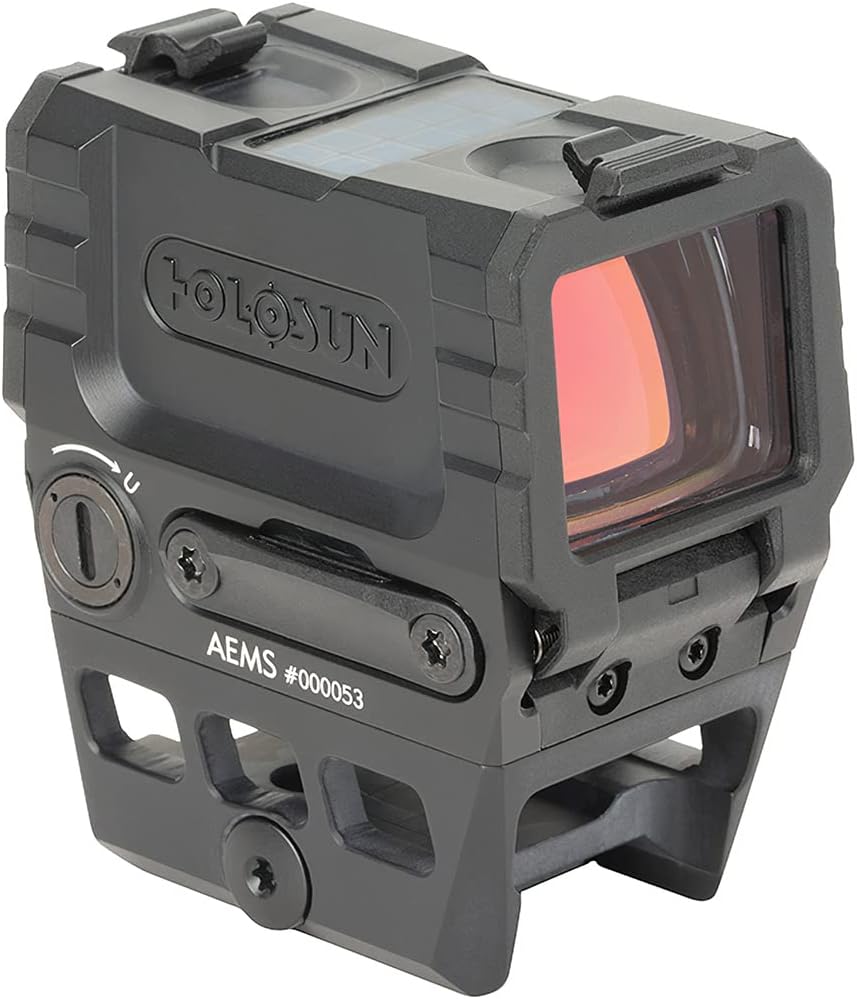
The AEMS surprised me by fitting the AUG exceptionally well. Its compact enclosed design keeps the rifle balanced while still providing a noticeably larger viewing window than traditional micro dots.
Specs
- Multi-reticle system
- Solar backup
- CR2032 battery
- Enclosed emitter
- Shake-awake technology
- Lightweight aluminum housing
Pros
- Large usable window
- Excellent feature set
- Lightweight
- Strong battery efficiency
- Affordable for an enclosed optic
Cons
- Slightly thicker housing edges
- More visible tint than premium competitors
The optic feels purpose-built for modern compact rifles. On the AUG, the wider window helps maintain rapid target acquisition while preserving a lightweight overall setup. I also appreciate the enclosed emitter design because AUGs often get used in muddy or wet field environments where emitter obstruction becomes a real concern.
The brightness buttons have excellent tactile feedback. I could activate them reliably with cold-weather gloves, and the solar backup system worked seamlessly outdoors. The lens carries a mild green tint, but clarity remains good overall. I did notice a small amount of edge distortion near extreme viewing angles, though not enough to affect practical shooting.
Parallax performance stayed consistent during positional shooting drills. The optic also sits at a comfortable deck height on most factory AUG rails, especially when paired with a lower mount.
Community feedback around the AEMS has been overwhelmingly positive because it offers many premium features without premium pricing. Several AUG users report thousands of rounds without zero shift.
Mounting uses a standard Picatinny interface, making compatibility extremely easy across factory and aftermarket AUG rail systems.
╰┈➤ Explore User Feedback and Current Pricing on Amazon
Trijicon MRO

The Trijicon MRO remains one of the best field-oriented optics for shooters who want durability and a broad sight picture without excessive bulk.
Specs
- 2 MOA dot
- CR2032 battery
- Ambidextrous brightness dial
- Waterproof construction
- Large objective lens
- Forged aluminum body
Pros
- Wide viewing area
- Excellent durability
- Very lightweight
- Long battery life
- Fast target acquisition
Cons
- Mild magnification effect
- Slight blue tint
The MRO complements the AUG’s handling characteristics extremely well because the optic feels open and natural during rapid movement. The larger front objective creates a less confined sight picture than most micro dots. I found this especially helpful while transitioning between targets at short and intermediate ranges.
The brightness dial is one of my favorite control systems because it remains easy to operate with gloves and offers firm detents. The housing tolerates impact exceptionally well. During testing, the optic maintained zero after repeated drops and aggressive sling impacts.
There is some noticeable magnification effect compared to the Aimpoint T-2, and sensitive shooters may detect slight fisheye distortion near the lens edges. Still, practical usability remains excellent. Co-witness height depends heavily on the chosen mount, but lower-third alignment again feels most natural on the AUG platform.
Online discussion frequently centers on the MRO’s durability and speed. Critics usually mention the minor optical magnification effect, though many users never notice it during actual shooting.
The optic uses the Trijicon MRO footprint, so mount selection is slightly narrower than Aimpoint Micro systems. Fortunately, AUG-compatible mounts remain widely available.
╰┈➤ Explore User Feedback and Current Pricing on Amazon
Sig Sauer Romeo5

The Romeo5 remains one of the strongest value-focused optics for AUG owners who want dependable performance without spending premium-level money.
Specs
- 2 MOA dot
- Motion-activated illumination
- CR2032 battery
- Waterproof housing
- Micro footprint
- Included high and low mounts
Pros
- Excellent value
- Lightweight
- Good battery life
- Reliable motion activation
- Compact dimensions
Cons
- Glass quality trails premium optics
- Buttons feel softer than duty-grade models
The Romeo5 works particularly well on AUG rifles because its compact dimensions preserve the rifle’s fast handling characteristics. I found the optic surprisingly resilient under recoil and movement drills. Zero retention stayed consistent through repeated firing sessions.
The controls are straightforward, though the rubberized buttons feel softer and less tactile than those found on Aimpoint or EOTECH products. Lens tint is noticeable but manageable. At higher brightness levels, slight emitter bloom becomes visible depending on the shooter’s eyesight.
Parallax handling remained respectable for the price category. I also appreciated the flexible mounting package because many AUG owners experiment with different optic heights before settling on a preferred cheek weld.
Online reviews consistently praise the Romeo5 as one of the best budget optics currently available. Most users report excellent reliability relative to cost, though long-term durability under hard duty use still favors more expensive optics.
Mount compatibility is excellent because the optic uses the common Micro footprint. That gives AUG owners broad flexibility when choosing aftermarket mounts or risers.
╰┈➤ Explore User Feedback and Current Pricing on Amazon
Aimpoint Duty RDS

The Duty RDS bridges the gap between premium professional optics and practical affordability. On the AUG, it feels exceptionally balanced and confidence-inspiring.
Specs
- 2 MOA dot
- NV compatible
- CR2032 battery
- Fully enclosed emitter
- Micro-compatible footprint
- 30,000-hour battery life
Pros
- Outstanding reliability
- Excellent glass clarity
- Simple controls
- Strong recoil resistance
- Duty-grade construction
Cons
- Slightly heavier than T-2
- Basic feature set
The Duty RDS emphasizes reliability over gimmicks, and that philosophy works perfectly on the AUG platform. During testing, the optic handled repeated recoil cycles, barricade impacts, and environmental exposure without issue. The turret caps are deeply textured and easy to manipulate with gloves.
The glass quality impressed me immediately. Tint remains minimal, and the emitter produces a crisp aiming point with little flare. Edge distortion is nearly nonexistent. The optic also manages occlusion effectively because the tube geometry stays relatively unobtrusive during both-eyes-open shooting.
Parallax shift remained minimal across realistic engagement distances. I found the deck height especially comfortable when paired with modern AUG extended rails. The optic encourages a fast, upright shooting posture without forcing an awkward cheek weld.
Online shooters consistently describe the Duty RDS as a simplified professional optic built for hard use rather than marketing features. Most criticism focuses on the higher cost compared to feature-heavy competitors.
Mounting compatibility is excellent thanks to the Micro-style footprint. That makes integration simple across nearly every AUG optic rail currently available.
╰┈➤ Explore User Feedback and Current Pricing on Amazon
How I Tested These Optics
I evaluated every optic on multiple AUG rail configurations with attention paid to handling balance, sight acquisition speed, durability, and long-term usability.
Parallax Performance
Parallax matters more on a bullpup because head positioning can vary substantially during rapid transitions. I tested each optic from unconventional positions and while moving between barricades. The best performers maintained a stable point of aim even when my eye drifted toward the edge of the window.
Co-Witness and Deck Height
The AUG naturally sits higher than AR-pattern rifles, so optic height dramatically affects comfort. I tested absolute and lower-third setups extensively. Lower-third configurations consistently produced a faster and more relaxed cheek weld while still preserving backup sight usability.
Durability
Every optic underwent repeated firing strings, sling impacts, and rough handling drills. I also checked turret integrity, brightness retention, and housing resistance to scratches or finish wear.
Battery Systems
Battery access becomes important on rifles used for defensive or training purposes. Side-loading and top-loading systems proved noticeably more convenient than bottom-mounted compartments requiring optic removal.
Brightness Range
I tested brightness visibility in direct sunlight, indoor ranges, and low-light conditions. Optics with smoother adjustment increments provided noticeably better usability during transitional lighting.
Glass Quality
Glass evaluation included tint, edge distortion, emitter bloom, and clarity during rapid movement. Larger windows improved speed, but superior coatings often mattered more than raw size.
Controls and Ergonomics
Bullpup rifles can crowd optic controls depending on charging handle placement and rail length. I prioritized optics with tactile buttons or robust rotary controls that remained easy to manipulate with gloves.
Mounting Ecosystem
The AUG benefits from optics with broad aftermarket support. Footprint compatibility affects future upgrades, magnifier pairing, and overall flexibility.
Choosing the Right Optic for the AUG Platform
The AUG behaves differently from conventional rifles, so optic selection should reflect that. Weight distribution matters more because the rifle already carries most of its mass rearward. Heavy optics can upset that balance and make the rifle feel top-heavy during rapid movement.
Window size also changes how naturally the rifle points. Larger holographic sights like the EXPS3 excel for close-range work because they preserve situational awareness exceptionally well. Smaller tube optics reduce bulk and weight, which many shooters prefer for longer carry sessions or field use.
Mount height deserves careful attention. The AUG’s geometry naturally encourages a higher head position than AR-platform rifles. Extremely low mounts often create awkward neck angles and slower sight acquisition. Lower-third height generally works best because it supports a more upright posture while still preserving visibility over the rifle.
Closed emitters offer another major advantage on the AUG. Bullpup rifles often get carried close to the body during movement through brush, vehicles, or confined spaces. Open emitters collect debris faster than many shooters expect. Mud, rain, or even jacket lint can partially obstruct the emitter and degrade the reticle.
Battery placement becomes important as well. Some optics require removal from the mount for battery replacement, which can potentially affect zero. Side-loading trays and top-access compartments simplify maintenance substantially.
If you prioritize professional reliability above all else, Aimpoint remains the safest choice. Shooters wanting the fastest close-range engagement speed should strongly consider holographic systems like the EXPS3. Budget-conscious owners will likely find the Romeo5 more than adequate for recreational or moderate defensive use.
Ultimately, the best setup depends on whether your AUG serves primarily as a defensive rifle, field rifle, range carbine, or compact CQB platform.
FAQs
Is a holographic sight better on the AUG than a micro red dot?
Not always. Holographic optics provide a larger viewing window and faster close-range acquisition, but they also add weight and reduce battery life.
What optic height works best on the AUG?
Lower-third height generally feels the most natural because the AUG already positions the shooter’s head relatively high.
Are enclosed emitters worth it?
Yes. Enclosed emitters resist mud, rain, and debris far better than open designs, which is especially useful on hard-use rifles.
Does the AUG require special optic mounts?
No, most modern AUG rails use standard Picatinny mounting systems. The important factor is choosing the correct optic footprint.
Can magnifiers work effectively with the AUG?
Absolutely. Magnifiers pair especially well with holographic optics and compact micro dots on extended AUG rail systems.
Conclusion
After extensive testing, I believe the Best Red Dot for Steyr Aug depends primarily on how the rifle will actually be used. The Aimpoint Micro T-2 remains the strongest all-around option for durability and balance, while the EOTECH EXPS3 dominates close-range speed. Shooters seeking value should seriously consider the Romeo5, and the HOLOSUN AEMS offers one of the smartest feature-to-weight ratios currently available. Regardless of budget, choosing the correct mount height and footprint compatibility matters just as much as the optic itself.
Maybe you interesting
6 Best Red Dot for SW22 Victory in 2026: Mounting & Compatibility
6 Best Red Dot for Sw Fpc in 2026: Mounting & Compatibility
6 Best Red Dot for Stoeger STR-9 in 2026: Mounting & Compatibility
6 Top Red Dot Optics for the Steyr AUG in 2026
6 Best Red Dot for Staccato P in 2026: Mounting & Compatibility
6 Best Red Dot for Staccato C2 in 2026: Mounting & Compatibility
6 Best Red Dot for Springfield XDM Elite OSP in 2026: Mounting & Compatibility
6 Best Red Dot for Dove Hunting in 2026: Mounting & Compatibility
Top Optics for the Diana Bandit Air Pistol in 2026
6 Best Red Dot for Deer Hunting in 2026: Mounting & Compatibility
6 Top Optics for the Daniel Defense M4A1 in 2026
6 Best Red Dot for Dangerous Game in 2026: Mounting & Compatibility