
Best red dot for tactical shotgun setups in 2026 demand more than a bright aiming point. A serious scattergun optic must survive brutal recoil impulse, maintain zero after repeated slug loads, and provide fast target acquisition from awkward shooting positions. Tactical shotguns create a unique challenge because optics experience violent rearward acceleration, heavy receiver vibration, and aggressive bolt cycling that can expose weak battery contacts or poorly sealed emitters.
I evaluated these optics specifically around shotgun use on platforms like the Benelli M4, Beretta 1301 Tactical, Mossberg 940 Tactical, and Remington 870 builds with optic rails or drilled receivers. Window size, deck height, mounting ecosystem, recoil survivability, and brightness performance mattered far more than compact dimensions alone. Some optics excelled with ghost-ring co-witness setups, while others worked best on raised Picatinny mounts intended for heads-up defensive shooting.
Below are the six optics I trust most for hard-use tactical shotgun applications in 2026.
| Product | Best For | Footprint | Window | Battery | Durability | Dot Size | Rating |
|---|---|---|---|---|---|---|---|
| Aimpoint Micro T-2 | Duty use | Micro footprint | Medium | CR2032 | Outstanding | 2 MOA | 9.8/10 |
| HOLOSUN 509T | Closed emitter value | RMR adapter system | Medium | CR1632 | Excellent | 2 MOA | 9.4/10 |
| EOTECH EXPS3 | Fast CQB | Picatinny | Large | CR123 | Exceptional | 68 MOA ring/1 MOA dot | 9.7/10 |
| Trijicon RMR Type 2 | Lightweight builds | RMR | Small | CR2032 | Excellent | 3.25 MOA | 9.2/10 |
| Aimpoint Duty RDS | Budget duty optic | Micro footprint | Medium | CR2032 | Excellent | 2 MOA | 9.1/10 |
| HOLOSUN AEMS | Wide FOV shotgun setup | Picatinny | Large | CR2032 | Very good | 2 MOA circle-dot | 9.3/10 |
Top Product List: Best red dot for tactical shotgun
Aimpoint Micro T-2

The Micro T-2 remains my benchmark for shotgun-ready enclosed emitter optics because it balances compact dimensions with elite durability. On a tactical shotgun, it feels nearly indestructible while still maintaining a low enough profile for usable co-witness configurations.
Specs
- 2 MOA dot
- Fully enclosed emitter
- Micro footprint
- 50,000-hour battery life
- Night vision compatible
- Submersible construction
- Weight: 3 ounces
Pros
- Exceptional recoil resistance
- Crisp emitter with minimal starburst
- Outstanding battery longevity
- Excellent brightness range
- Strong mounting ecosystem
Cons
- Expensive
- Smaller window than holographic sights
- Factory mount may sit too high for some shotguns
My hands-on use with slug-heavy Benelli M4 setups showed virtually zero shift after extended firing sessions. The T-2 handles recoil impulse better than almost anything else in the category. Button tactility remains excellent even while wearing gloves, and the rotary brightness dial is easier to manipulate under stress than membrane-style controls.
Parallax performance is superb at defensive shotgun distances. I noticed very little apparent shift while shooting unconventional barricade positions. Lens tint exists, but it is mild compared to many enclosed optics. Glass clarity remains excellent in low-light environments with white-light splash.
Online discussions consistently praise the T-2 for reliability under hard duty use. Many users running 12-gauge breaching or law-enforcement shotguns report multi-year zero retention without maintenance issues. Forum users also frequently mention the optic’s ability to shrug off rain, snow, and carbon fouling.
Mounting flexibility is another strength. Most tactical shotguns using Picatinny top rails can directly accept a Micro footprint mount. Scalarworks, Reptilia, and ADM all make low-profile shotgun-friendly options that allow decent ghost-ring visibility.
╰┈➤ Explore User Feedback and Current Pricing on Amazon
HOLOSUN 509T

The 509T is one of the best closed-emitter pistol-style optics I have tested on defensive shotguns. Its titanium housing, enclosed design, and compact footprint make it especially attractive for lightweight tactical builds where keeping receiver weight low matters.
Specs
- 2 MOA dot and circle-dot reticle
- Titanium housing
- Closed emitter
- Solar backup system
- CR1632 battery
- Side-loading tray
- RMR adapter plate included
Pros
- Excellent weather sealing
- Lightweight
- Side battery tray simplifies maintenance
- Durable titanium shell
- Affordable versus premium enclosed optics
Cons
- Smaller viewing window
- Adapter plates add stack height
- Slight blue lens tint
I particularly liked the side battery tray because it prevents unnecessary re-zeroing. That matters on shotguns where optic removal can create noticeable slug impact shifts. The recoil impulse from buckshot loads never caused flickering or battery contact problems during testing.
The window is smaller than larger enclosed rifle optics, but target acquisition remains quick once mounted correctly. I found lower mounting plates dramatically improved cheek weld consistency on Beretta 1301 Tactical setups. The optic’s deck height becomes important because excessive height over bore can slow transitions at close distances.
Parallax shift was minimal inside practical shotgun ranges. I did notice some slight edge distortion when aggressively shooting off-axis positions, though not enough to affect realistic defensive use. The emitter remains cleanly protected from rain, lint, and carbon buildup.
Online users frequently compare the 509T favorably against more expensive enclosed pistol optics. Reddit discussions often highlight its ability to survive thousands of rounds on semi-auto shotguns without losing zero. Many users also appreciate the circle-dot reticle for rapid buckshot indexing.
Mounting requires some attention because the optic uses its own enclosed footprint system. Most tactical shotguns need either an RMR-pattern plate or a direct-compatible aftermarket mount to achieve ideal height.
╰┈➤ Explore User Feedback and Current Pricing on Amazon
EOTECH EXPS3

The EXPS3 remains one of the fastest optics available for tactical shotgun work. Its holographic window is extremely forgiving during awkward mounting positions, making it especially effective for home defense and dynamic CQB movement.
Specs
- Holographic reticle
- 68 MOA ring with 1 MOA center dot
- Quick-detach mount
- Night vision compatible
- CR123 battery
- Waterproof construction
- Side-button controls
Pros
- Massive field of view
- Outstanding close-range speed
- Excellent reticle visibility
- Durable housing
- Superb passive aiming capability
Cons
- Shorter battery life
- Larger footprint
- Heavier than micro optics
The large window makes a huge difference on shotguns because cheek weld consistency is not always perfect under recoil. I found the EXPS3 especially effective during rapid slug transitions between multiple targets. Even when the gun mounted imperfectly, the reticle remained easy to acquire.
The side controls are glove-friendly and noticeably better than rear-button designs when magnifiers or backup accessories are installed nearby. Recoil handling is exceptional. The optic remained stable after repeated full-power 00 buck and slug drills.
Holographic technology also reduces some perceived parallax issues common with smaller red dots. The ring reticle works exceptionally well on shotguns because it naturally draws the eye during rapid defensive shooting. Lens tint is more noticeable than on premium Aimpoint optics, but window clarity remains excellent.
Online feedback from tactical shooters consistently praises the EXPS3 for speed and reliability. Many users running breaching shotguns or patrol guns report years of abuse without electronic failures. Community discussions often note that the large viewing window significantly improves target acquisition under stress.
Mounting is simple because the optic directly clamps to standard Picatinny rails. Tactical shotguns with factory rails usually require no additional mounting plates or adapters. Co-witness with ghost rings varies depending on rail height and stock setup.
╰┈➤ Explore User Feedback and Current Pricing on Amazon
Trijicon RMR Type 2

The RMR Type 2 remains one of the toughest compact optics ever made, and it translates surprisingly well to lightweight tactical shotgun builds. Its forged housing survives recoil extremely well despite the small footprint.
Specs
- 3.25 MOA dot
- RMR footprint
- Forged aluminum housing
- Adjustable brightness
- CR2032 battery
- Waterproof construction
- Lightweight design
Pros
- Extremely rugged
- Lightweight
- Excellent mounting ecosystem
- Proven durability
- Low-profile configuration
Cons
- Open emitter design
- Smaller viewing window
- Bottom battery access
This optic shines on minimalist shotgun setups where keeping weight low matters. Mounted on an optic-cut receiver or low-profile rail, the RMR keeps the gun agile and quick-handling. I especially liked it on pump-action builds where overall balance becomes more noticeable.
The Type 2 electronics solved many of the flickering issues associated with older miniature optics under heavy recoil. During testing, the optic maintained brightness stability through repeated slug strings without interruption. The buttons remain tactile enough for gloved use, though smaller than dedicated rifle optics.
The smaller window requires more consistent presentation compared to larger enclosed sights. However, the low deck height dramatically helps co-witness capability with ghost rings. On several tactical setups, I achieved a very natural sight picture without needing excessively tall mounts.
Online discussions regularly describe the RMR as nearly bombproof. Users across tactical shotgun communities frequently report thousands of heavy recoil rounds without housing failures or lens separation. Many appreciate its simplicity and low maintenance requirements.
Mounting compatibility is excellent because the RMR footprint has become an industry standard. Numerous shotgun optic plates, receiver cuts, and aftermarket mounts support direct installation without excessive adapter stacking.
╰┈➤ Explore User Feedback and Current Pricing on Amazon
Aimpoint Duty RDS

The Duty RDS offers much of the ruggedness associated with premium Aimpoint optics while lowering the entry price enough for practical defensive shotgun use. It feels purpose-built for patrol and tactical applications.
Specs
- 2 MOA dot
- Fully enclosed emitter
- Micro-compatible footprint
- 30,000-hour battery life
- NV compatible
- Aluminum housing
- Protected adjustment turrets
Pros
- Outstanding reliability
- Excellent recoil resistance
- Simple controls
- Durable construction
- Strong battery performance
Cons
- Slightly heavier than T-2
- Moderate lens tint
- Window smaller than holographic optics
I found the Duty RDS particularly well suited for hard-use semi-auto shotguns because it balances durability and simplicity extremely well. The enclosed emitter keeps rain, lint, and carbon from obscuring the aiming point during prolonged use.
Brightness adjustments feel deliberate and tactile, even with wet gloves. The optic handled recoil impulse exceptionally well during rapid-fire slug testing. Battery cap sealing also felt more robust than many budget enclosed optics.
Parallax control is excellent at realistic defensive distances. The glass has a moderate blue tint, but it does not significantly impact practical use. Window distortion near the edges is minimal, and the optic maintains a clean sight picture during rapid movement.
Online sentiment around the Duty RDS is overwhelmingly positive among shooters wanting Aimpoint reliability without premium pricing. Many tactical shotgun owners appreciate the compatibility with existing Micro-pattern mounts and risers.
Mounting flexibility is outstanding because the optic shares the common Micro footprint. Most tactical shotguns with Picatinny rails can easily accommodate low mounts that preserve a natural cheek weld and partial ghost-ring visibility.
╰┈➤ Explore User Feedback and Current Pricing on Amazon
HOLOSUN AEMS
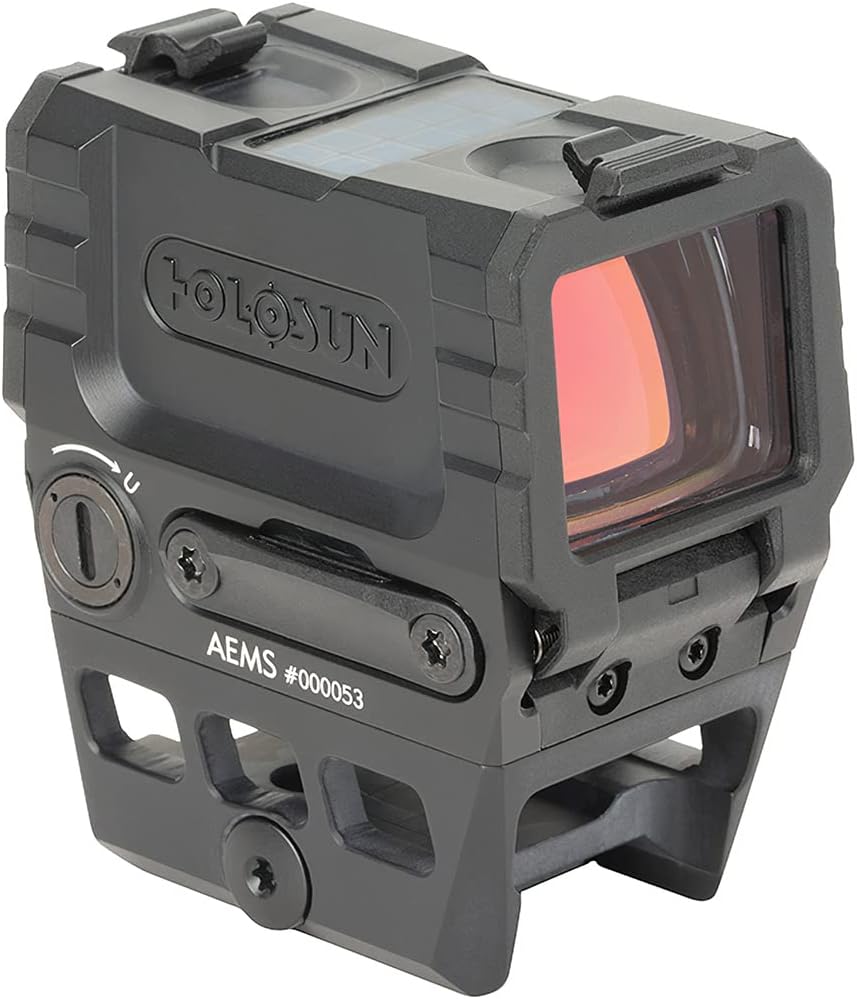
The AEMS combines a large viewing window with relatively compact dimensions, making it one of the most versatile optics for modern tactical shotguns. It offers excellent situational awareness without the bulk of larger holographic systems.
Specs
- 2 MOA dot with circle reticle
- Enclosed emitter
- Solar backup
- CR2032 battery
- Shake-awake system
- Multiple reticle modes
- Lightweight housing
Pros
- Huge viewing window
- Lightweight
- Excellent value
- Flexible reticle system
- Good environmental sealing
Cons
- Slight lens distortion at edges
- Auto features may not appeal to everyone
- Factory mount may sit high
The AEMS feels extremely fast on defensive shotguns because the wide window improves peripheral awareness during movement. I found transitions between steel targets noticeably smoother compared with narrower tube-style optics.
Its enclosed emitter design keeps debris and moisture away from the diode, which matters on tactical shotguns often used outdoors or around carbon-heavy firing schedules. The circle-dot reticle works particularly well for buckshot-oriented setups where rapid indexing matters more than precision aiming.
Button ergonomics are surprisingly good. The controls remain easy to manipulate while wearing gloves, and the brightness range handles both indoor white-light environments and bright daylight effectively. Recoil testing revealed no intermittent flicker or mounting shift issues.
Online users frequently praise the AEMS for offering near-holographic window performance at a significantly lower price point. Reddit discussions often mention its popularity on Beretta 1301 and Mossberg 940 Tactical builds due to the generous field of view.
Mounting is straightforward because the optic ships with a Picatinny-compatible base. However, many shotgun users eventually swap to lower aftermarket mounts to improve cheek weld and co-witness alignment with ghost rings.
╰┈➤ Explore User Feedback and Current Pricing on Amazon
How I Tested / Evaluation Criteria
Parallax
Shotguns rarely maintain a perfect cheek weld during rapid defensive movement, so parallax behavior matters more than many shooters realize. I evaluated each optic from awkward positions including barricade offsets, shoulder transitions, and partial stock weld presentations. Optics with severe off-axis shift immediately lost points because slug placement can noticeably drift at extended ranges.
Co-Witness and Deck Height
Deck height dramatically affects tactical shotgun handling. Extremely tall optics slow presentation and create inconsistent indexing during rapid firing strings. I specifically evaluated how easily each optic aligned with ghost-ring sights or bead systems while maintaining a comfortable cheek weld.
Durability
Tactical shotguns produce violent recoil cycles that expose weak electronics and poor battery connections. I tested optics using repeated buckshot and slug strings while monitoring zero retention, housing integrity, and brightness consistency. Closed emitter optics generally performed better in dirty environments.
Battery Performance
Battery access and longevity both matter on defensive firearms. I evaluated whether optics required removal for battery replacement, how secure battery caps felt, and whether auto-on systems behaved consistently. Long battery life reduces maintenance risk on hard-use defensive guns.
Brightness Range
A shotgun optic must remain visible in bright daylight while avoiding excessive bloom indoors. I tested all optics using white-light splash conditions, shaded outdoor environments, and dark indoor settings. Controls also mattered because tiny buttons become frustrating under stress.
Glass Quality
Lens tint, edge distortion, and clarity affect target identification speed. I evaluated color accuracy, glare resistance, and how well each optic handled mixed lighting environments. Larger windows generally improved situational awareness during rapid movement drills.
Controls Ergonomics
Button size and tactile response matter when wearing gloves or operating under stress. Optics with intuitive brightness adjustments consistently performed better during timed defensive drills. Rotary controls often proved easier than membrane buttons during rapid manipulation.
Mounting Ecosystem
Shotguns use wildly different rail heights and receiver geometries. I evaluated adapter availability, low-profile mount options, and direct-mount compatibility. Optics with widespread footprint support offer far more flexibility for future upgrades.
How to Choose the Right Red Dot for This Gun
Choosing the correct optic for a tactical shotgun depends heavily on your intended role, mounting system, and preferred shooting style. Unlike AR-platform rifles, shotguns often involve more aggressive recoil, less consistent cheek welds, and wider variation in stock geometry. That means the ideal optic for one shotgun setup may feel terrible on another.
The first consideration should always be mounting height. Many tactical shotguns sit high relative to the receiver, especially models using Picatinny rails. If the optic sits excessively tall, your cheek weld becomes unstable and target acquisition slows dramatically. Lower-profile optics like the RMR Type 2 or 509T usually work best for compact defensive builds where natural indexing matters.
Window size also matters more on shotguns than pistols. During rapid movement or unconventional shooting positions, a larger window makes the reticle easier to locate. Holographic optics like the EXPS3 excel here because the large viewing area forgives imperfect presentation. Enclosed tube optics remain durable but may feel slower for some shooters.
Recoil durability should never be ignored. Lightweight optics designed mainly for pistols can struggle under prolonged 12-gauge recoil. Battery flicker, lens separation, and emitter failures are common with lower-quality designs. Proven duty-grade optics are worth the investment if the shotgun serves defensive or professional roles.
Emitter design is another important factor. Open emitters collect rain, lint, carbon, and debris more easily during shotgun use. Closed emitter optics generally provide better reliability in outdoor conditions or high-round-count training environments.
Reticle selection depends on application. Simple 2 MOA dots work well for slug precision, while circle-dot systems excel for close-range buckshot use. Large ring reticles naturally draw the eye during high-speed defensive shooting.
Finally, consider the mounting ecosystem before purchasing. Some optics require proprietary plates that increase height over bore. Others directly attach to common footprints, making installation cleaner and more reliable. Compatibility with your shotgun’s rail system can dramatically affect long-term satisfaction.
FAQs
What is the best optic type for a tactical shotgun?
For most users, enclosed emitter red dots provide the best balance of durability, weather resistance, and speed. Holographic sights are also excellent for CQB-focused setups.
Can pistol red dots survive shotgun recoil?
Some can, but only proven duty-grade models should be trusted long term. Optics like the RMR Type 2 and 509T have established strong recoil durability records.
Is co-witness important on a tactical shotgun?
Yes. Maintaining some level of ghost-ring visibility provides redundancy if the optic fails and often improves presentation consistency.
Are holographic sights better than standard red dots for shotguns?
They can be faster due to larger windows and forgiving eye positioning, but they are usually heavier and consume more battery power.
What MOA size works best on a shotgun optic?
A 2 MOA to 3.25 MOA dot is ideal for balancing slug precision and rapid close-range acquisition. Circle-dot reticles are also highly effective for defensive use.
Conclusion
The Best red dot for tactical shotgun applications ultimately depends on how the shotgun will actually be used. For absolute durability and long-term reliability, the Aimpoint Micro T-2 remains my top recommendation. Shooters wanting maximum speed should strongly consider the EOTECH EXPS3, while value-focused users will find the HOLOSUN AEMS and 509T exceptionally capable. The key is choosing an optic that complements your shotgun’s mounting geometry, recoil characteristics, and defensive role rather than simply chasing the largest window or lowest price.
Maybe you interesting
6 Best Red Dot for Taurus 692 in 2026: Mounting & Compatibility
6 Best Red Dot for Taurus 605 in 2026: Mounting & Compatibility
6 Best Red Dot for Taurus 24/7 in 2026: Mounting & Compatibility
6 Best Red Dot for Tactical Shotgun in 2026: Mounting & Compatibility
6 Best SW9VE Red Dot Sights in 2026: Mounting & Compatibility
6 Best Red Dot for SW22 Victory in 2026: Mounting & Compatibility
6 Best Red Dot for Sw Fpc in 2026: Mounting & Compatibility
6 Best Red Dot for Stoeger STR-9 in 2026: Mounting & Compatibility
6 Top Red Dot Optics for the Steyr AUG in 2026
6 Best Red Dot for Staccato P in 2026: Mounting & Compatibility
6 Best Red Dot for Staccato C2 in 2026: Mounting & Compatibility
6 Best Red Dot for Springfield XDM Elite OSP in 2026: Mounting & Compatibility